
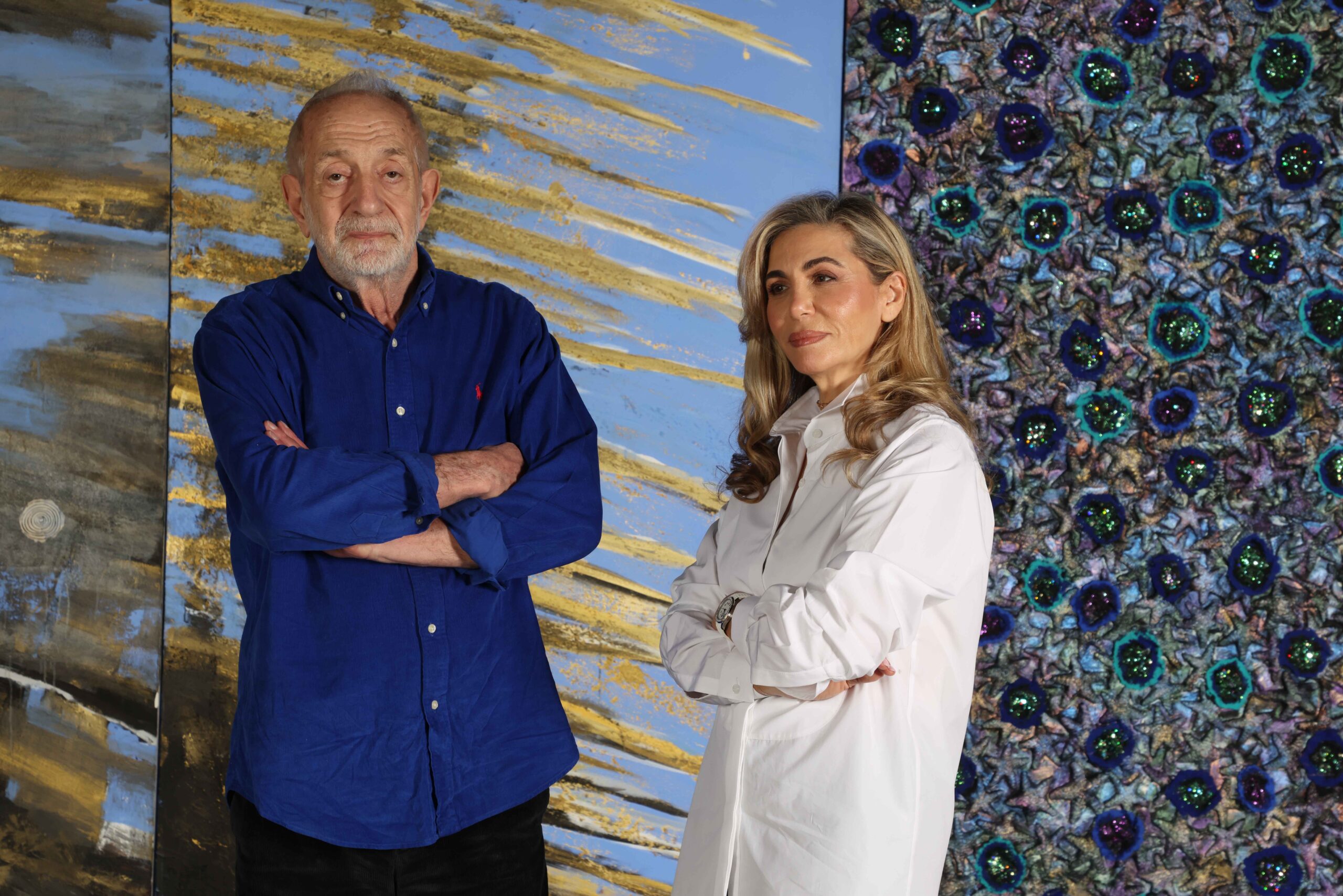
Artist Nabil Nahas and Dr. Nada Ghandour, Commissioner & Curator of the Pavilion of Lebanon at the artist studio – Photo by Milad Ayoub © LVAA
“Don’t Get Me Wrong” proves an apt title for Nabil Nahas’s Venice Biennale installation. In our conversation with Nahas and curator Nada Ghandour, every attempt to locate a definitive beginning, ending, influence, or interpretation seems to open onto another possibility. The forty-five-meter work brings cedars, olive trees, starfish, spirals, geometry, Mediterranean history and spiritual references into the same space, but never a single narrative. Nahas is especially careful when the conversation turns to Lebanon; it is central, deeply present, and inseparable from his visual language, but never the sole lens through which to understand his work.
The title Don’t Get Me Wrong hints at potential misreading. Are there interpretations you hope to steer viewers away from—and why does that matter to you?
Nada Ghandour: The title is an invitation to embrace complexity. We hope to avoid a fixed interpretation. The pavilion certainly emerges from a specific geography and history, but it does not seek to illustrate them.
Don’t Get Me Wrong acknowledges that meaning is never entirely stable; it shifts according to context, memory, and perception. Rather than prescribing a single interpretation, the work asks viewers to accept ambiguity and multiplicity, as well as the possibility of discovering unexpected connections.
Nabil Nahas: This installation is not a narrative and should not be read as such. There is no beginning and no end. The succession of the different themes I have been working on are interconnected, and their fusion is a reflection of the unity of the universe. That is why there are no boundaries to the viewers.
Don’t Get Me Wrong arrives at the Venice Biennale as the result of decades of your artistic research. Looking back, how would you describe the longer arc that leads to this pavilion? What questions have you been pursuing over the years – be it spiritually or conceptually – and how do they culminate here?
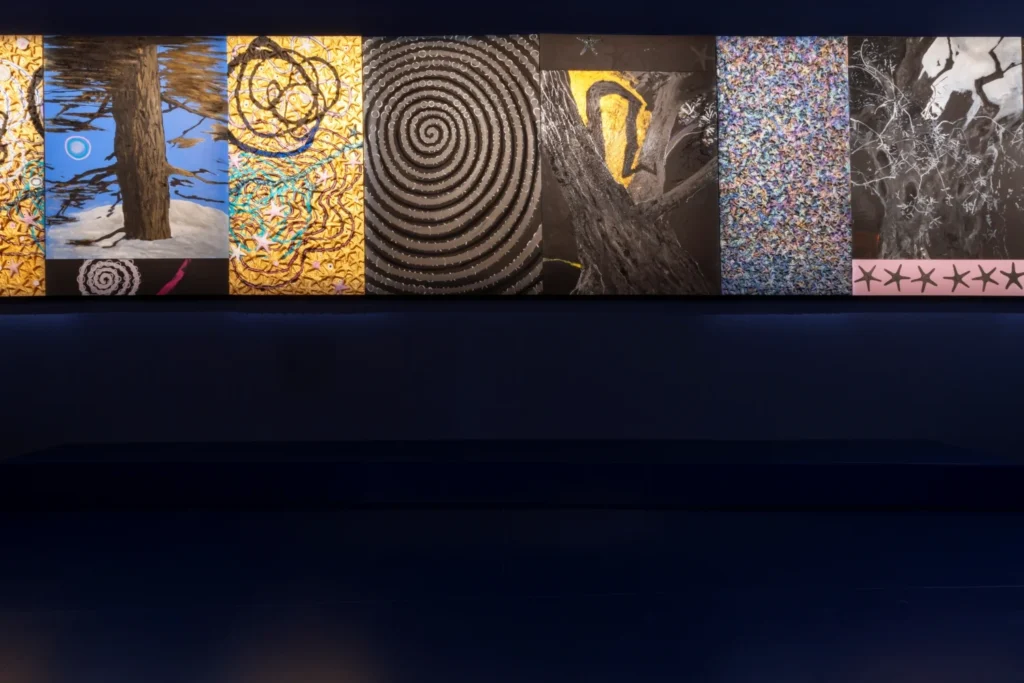
NN: The installation is not a retrospective. Of late, I have been simultaneously working on several topics. The different themes that I explore like the cedar of Lebanon or the Roman olive trees with all their mythological, historical and biblical references coexist along the representation of living and inanimate forms like the starfish with all its connotations of geometric forms that structures the sensible world as well as the spirals recalling the oldest rendering of the universe and still illustrating a quantum rendering of it today.
The pavilion carries the weight of representing Lebanon while resisting linear narrative. How do you move beyond literal depiction toward something complex, while keeping the work open and immersive, so that each viewer can engage with it in their own way?
NG: Lebanon is a place formed through successive layers of civilizations, cultures, religions, and exchanges. The pavilion reflects this complexity through a visual language that embraces multiplicity.
Nabil Nahas has achieved a remarkable synthesis of influences ranging from Greco-Roman and Judeo-Christian traditions to Islamic artistic heritage and contemporary abstraction. These references are not presented separately but are woven together into a unified visual vocabulary.
The installation relies on suggestion rather than description. Through its subjects, rhythms, textures, forms, and spatial relationships, it invites visitors to make their own connections. Each person enters with different memories, experiences, and cultural references, and the work remains open enough to accommodate those differences. In this sense, the pavilion becomes a space that welcomes contradiction and plurality. It reflects Lebanon’s multicultural character, presenting the country as a crossroads of civilizations whose richness emerges precisely from the interaction of its many layers. Ultimately, it celebrates unity in diversity.
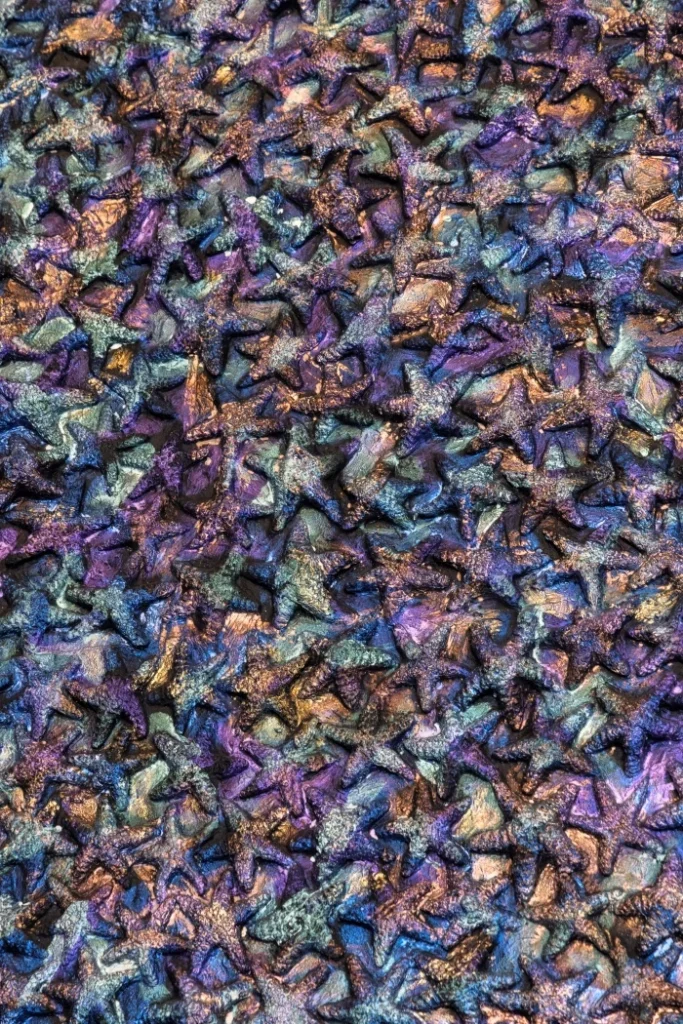
The pavilion has been described as a “sensitive topography,” merging sea, mountains, and sky. How does this multi-layered approach create a memory of Lebanon that goes beyond conventional narratives of conflict?
NN: When undertaking this project, I did not want it to be a pedestrian accumulation of war torn clichés. I chose to be true to myself and my vision, and I trusted that the richness of this country with its biblical nature, multicultural history and its complexities will permeate through my installation.
NG: Too often, Lebanon is understood through the lens of crisis and conflict. While these realities cannot be ignored, they do not encompass the full complexity of the country’s cultural and historical depth.
The pavilion returns to the landscape as a deeper and more enduring repository of memory. The sea, the mountains, and nature are not merely geographical elements; they are carriers of time. They have witnessed countless civilizations, migrations, exchanges, and transformations. They embody a history that extends far beyond political events.
The land itself carries the traces of layered civilizations. A significant source of inspiration for Nahas was Byblos, where he spent time as a child and young man. Walking through its landscape, he would often encounter fragments and artefacts emerging from the soil—material reminders of the many civilizations that have inhabited the region. These discoveries shaped his understanding of Lebanon as a place where history is literally embedded in the land.
The pavilion evokes this accumulated memory. It presents Lebanon not as a succession of conflicts but as a territory of continuous cultural sedimentation, where nature, history, and civilization remain inseparable.
Nada, in framing this project, how did you position yourself in relation to the work—were you interpreting it, extending it, or actively constructing its meaning alongside the artist?
NG: Curating this pavilion was not about translating the work into a fixed discourse, but about creating the conditions through which its complexity could be experienced. My role was to interpret and to extend the conceptual and spatial logic already present within the artist’s practice.
As a curator, I aim to create a framework through which new forms of knowledge and understanding can emerge. Curating involves identifying what is singular, innovative, and significant within a work, while providing visitors with the tools to engage with it in meaningful ways.
My task was to highlight what makes this project unprecedented within Nahas’s five-decade career between Lebanon and the United States. This is his first monumental immersive installation; in which he adapts the principles of Persian miniature to a monumental format. The installation adopts the principles of —several perspectives, juxtaposition of multiple spaces and simultaneous temporalities, and non-linear reading painting—but translates them into a contemporary immersive environment. Spaces and times coexist, while their boundaries are deliberately blurred.
Nabil, your work has long moved between abstraction and figuration, geometry and organic form, the microscopic and the cosmic. How has that visual and philosophical language evolved across the decades and how does it shape the universe you create?
NN: From microcosm to macrocosm, the observation of nature, has always been my source of inspiration. Whether observing a snow flake crystal, a cedar tree or a bright night sky, hence the universe, I realize that we are all one.
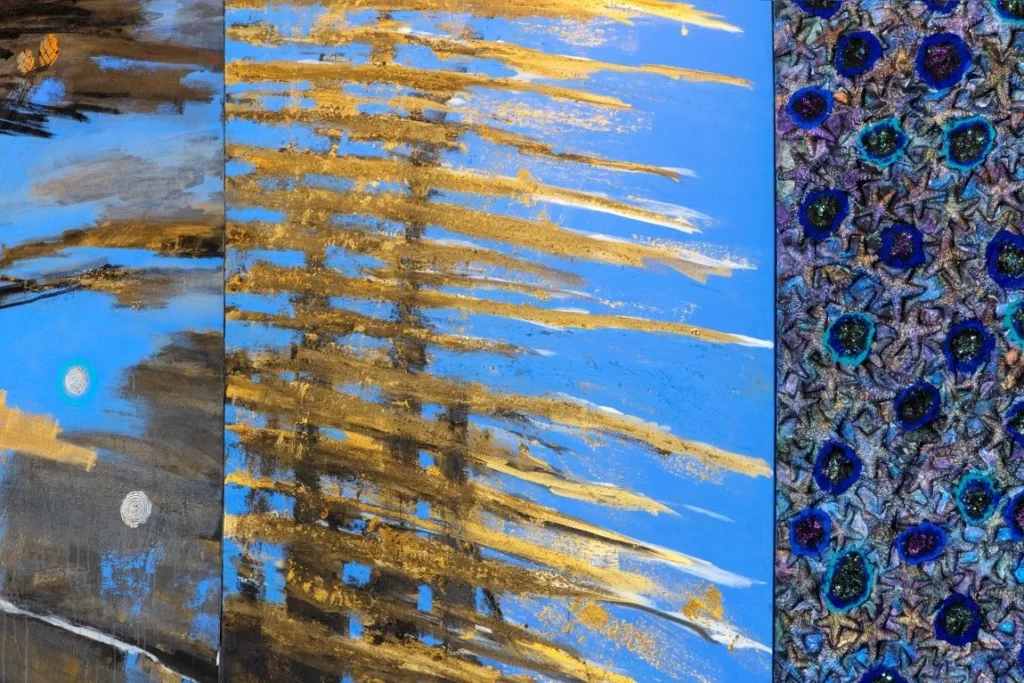
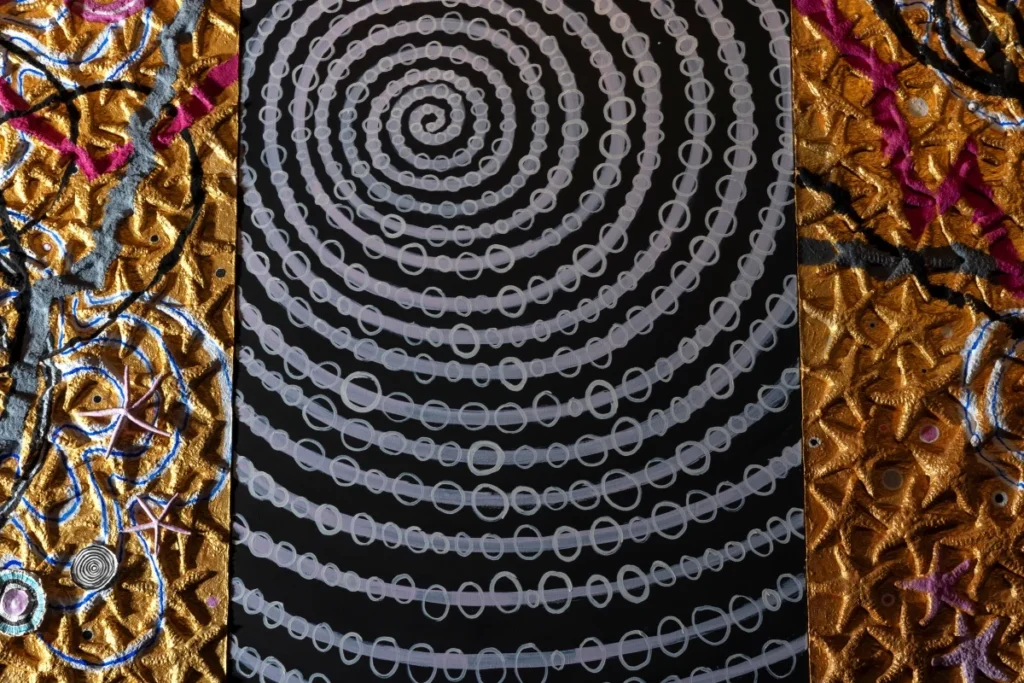
The pavilion resists a single fixed reading and instead proposes an experience to be lived, navigated, and felt, with a work spanning forty-five linear meters and inviting viewers to move within it rather than stand before it. How did you go about that balance in creating a framework without being overly instructive? What does scale make possible here that a more contained format would not?
NG: The challenge was to provide visitors with points of entry while preserving the openness that lies at the heart of the project. The curatorial framework offers orientation rather than explanation, encouraging engagement without prescribing interpretation.
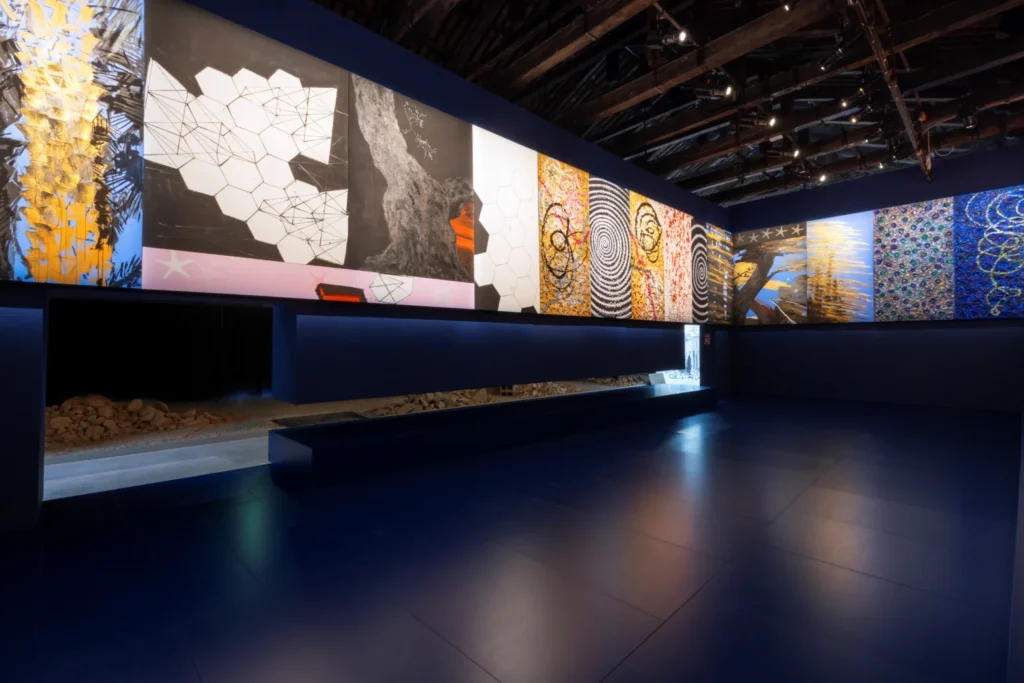
Scale is fundamental to this experience. Extending over forty-five linear meters, the painting cannot be apprehended in a single glance. It unfolds progressively as visitors move through the pavilion, transforming viewing into a form of navigation.
The scenography reinforces this immersion. The deep blue walls and floor dissolve conventional spatial references and create an environment that evokes both sea and sky. The painting is elevated above eye level and appears to crown the pavilion, surrounding and overlooking visitors. This elevation introduces a spiritual dimension that has long been present in Nahas’s work.
The installation explores the relationship between humanity, nature, and the cosmos. Faced with its scale, visitors become acutely aware of their own position within a much larger universe. Human presence appears as a fleeting spark within an immense cosmic order. The experience invites contemplation, introspection, and a reconsideration of our place in the world.
The work draws from Mediterranean civilizations, American Abstract Expressionism, Islamic art, and other traditions. How do you both think about this convergence? Is the work proposing coexistence, contradiction, translation, or something more fluid that exceeds those categories?
NG: The work brings together influences from Mediterranean civilizations and beyond, Islamic art, Judeo-Christian traditions, and Western abstraction, yet it does so without presenting them as separate entities. Nahas succeeds in creating a fusion of all these traditions within a rich visual language.
These references intersect, overlap, and continuously transform one another. The Mediterranean itself has historically been a space of circulation, encounter, and exchange, and the work reflects this dynamic condition rather than attempting to resolve it. Cultures are not isolated structures; they are shaped through contact, exchange, and dialogue.
NN: All the different categories you mentioned have left me with a very rich cultural awareness (To my dismay, being French educated, you omitted the Renaissance and what followed). It is my keen observation of nature that led me to produce the fractals paintings which have no precedents.
The installation frames Lebanon as a “land of confluences”, where layered histories and civilizations have shaped a plural identity. In the current political and regional climate, that idea feels especially charged. What meaning does this pavilion take on at this critical juncture?
NN: I am not a politically engaged artist. My vision although deeply shaped by my Lebanese roots, its cultural richness, and plurality, has led me to a more universal quest. The installation also mirrors through its contradictions, complexity and fluidity, the current situation in Lebanon.
NG: The pavilion presents plurality not as an idealized aspiration but as a historical reality. Lebanon has been shaped by centuries of encounters between cultures, languages, religions, and civilizations. These interactions have generated tensions, but they have also produced extraordinary forms of creativity and renewal.
At a moment marked by polarization and fragmentation, the pavilion offers another perspective. It suggests that art transcends divisions and possesses a capacity to build bridges between communities and civilizations, to celebrate human connections that surpass religious, political, and social boundaries.
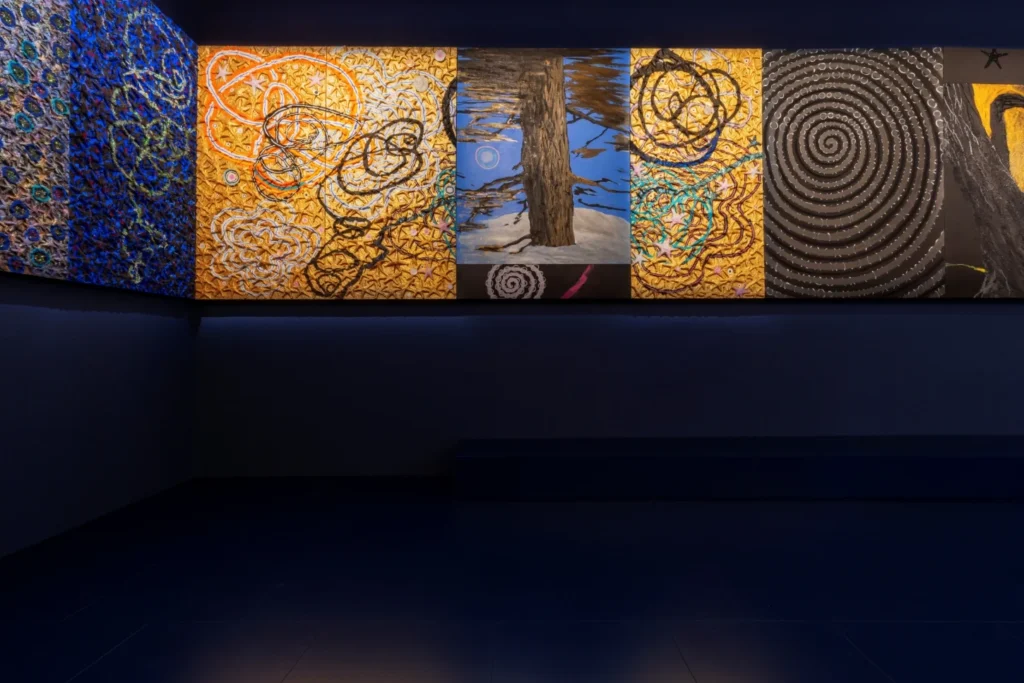
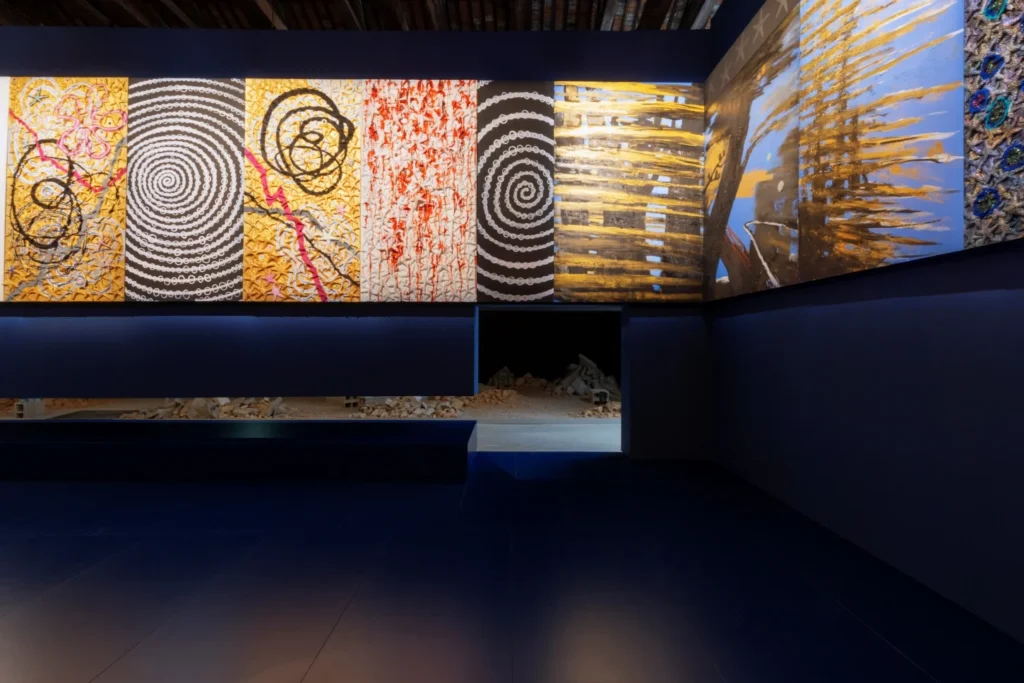
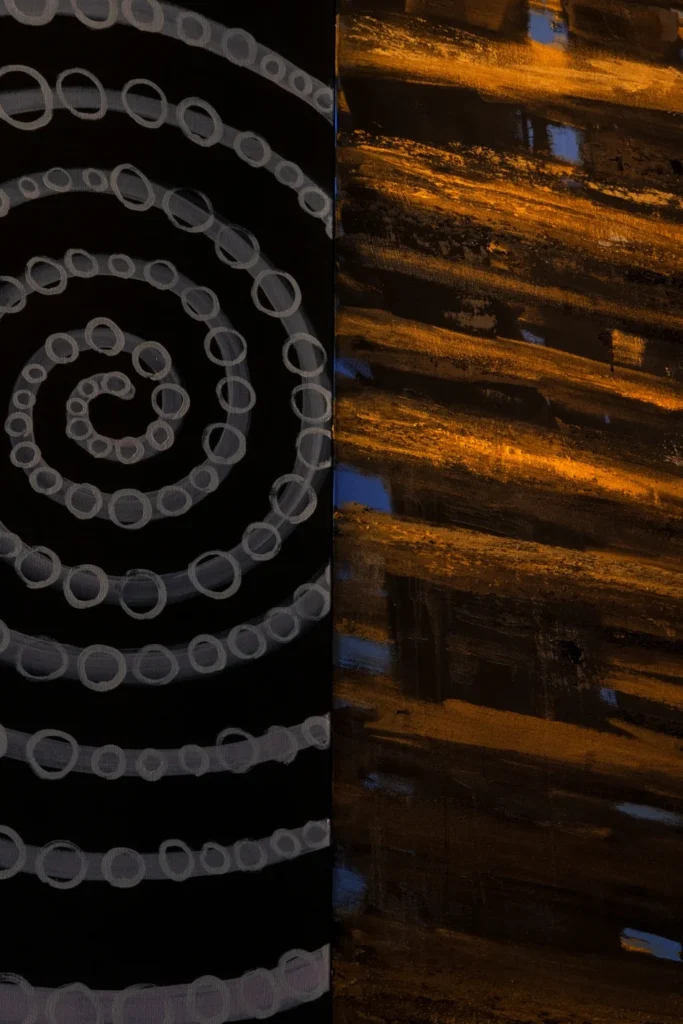
All Images: Don’t Get Me Wrong, Nabil Nahas – Installation view. Pavilion of Lebanon at La Biennale Arte 2026. Courtesy of the Artist & LVAA – Photo by Celestia Studio ©️ LVAA.