
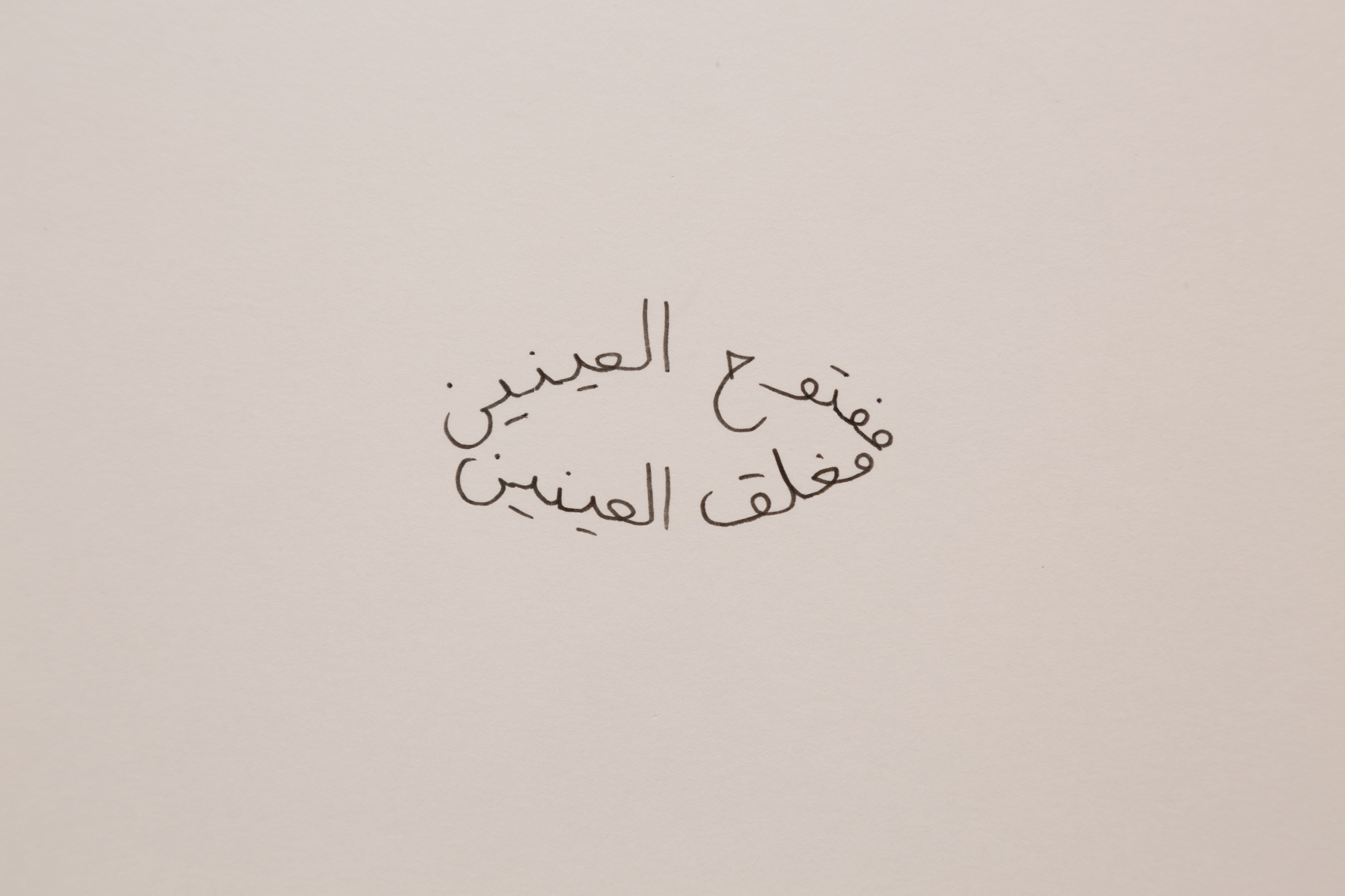
مفتوح العينين، مغلق العينين , [With Eyes Open, With Eyes Closed], 2024, Permanent ink on cardboard, 21x 29.7 cm. Courtesy of the artist and Marfa’ Projects. Photo by Christopher Baaklini.
Stéphanie Saadé’s work begins beneath the obvious. In her musings on minutiae, objects and fragments seem trivial until they aren’t. More often than not, they hold the weight of the world.
Born in Lebanon in 1983, Saadé’s personal and professional trajectory has unfolded between Beirut, Paris, and Amsterdam. She studied at the École Nationale Supérieure des Beaux-Arts in Paris in 2005, before pursuing postgraduate studies at the China Academy of Arts in Hangzhou in 2010. Marked by a continual movement between places, whether voluntary or not, her work reconciles these geographies and timespans, attending to what such movement produces conceptually and materially: shifts in memory, scale, and perceptions of proximity and distance. These questions have quietly shaped and accompanied her practice over the years.
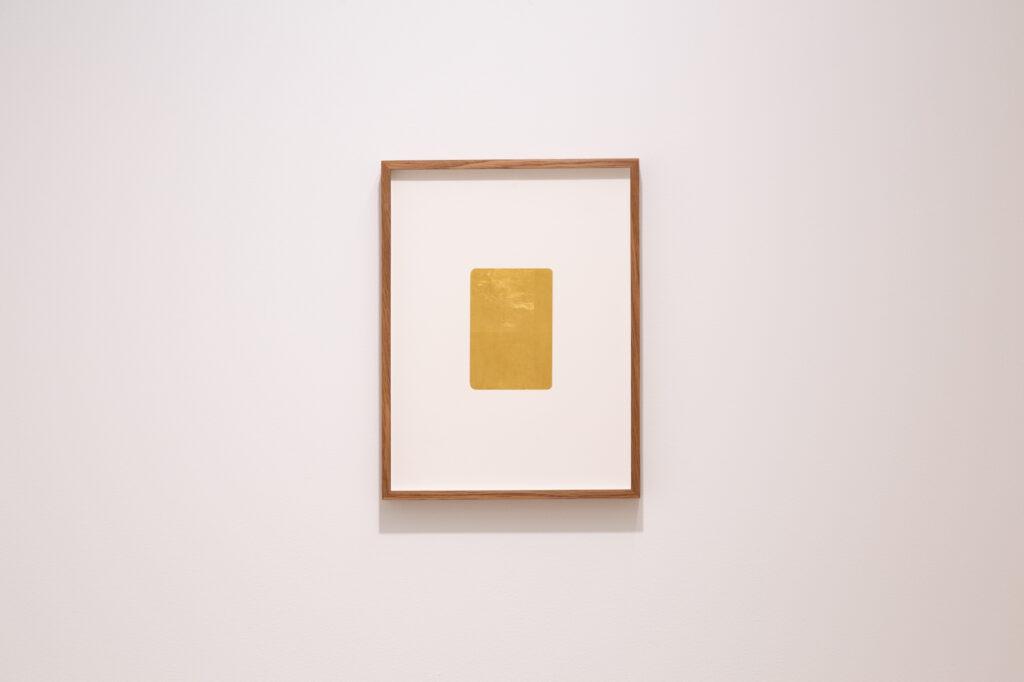
Golden Memories, 2015, Vintage photograph, 24-carat gold leaf, 10 x 15 cm.
Courtesy of the artist and Marfa’ Projects. Photo by Christopher Baaklini.
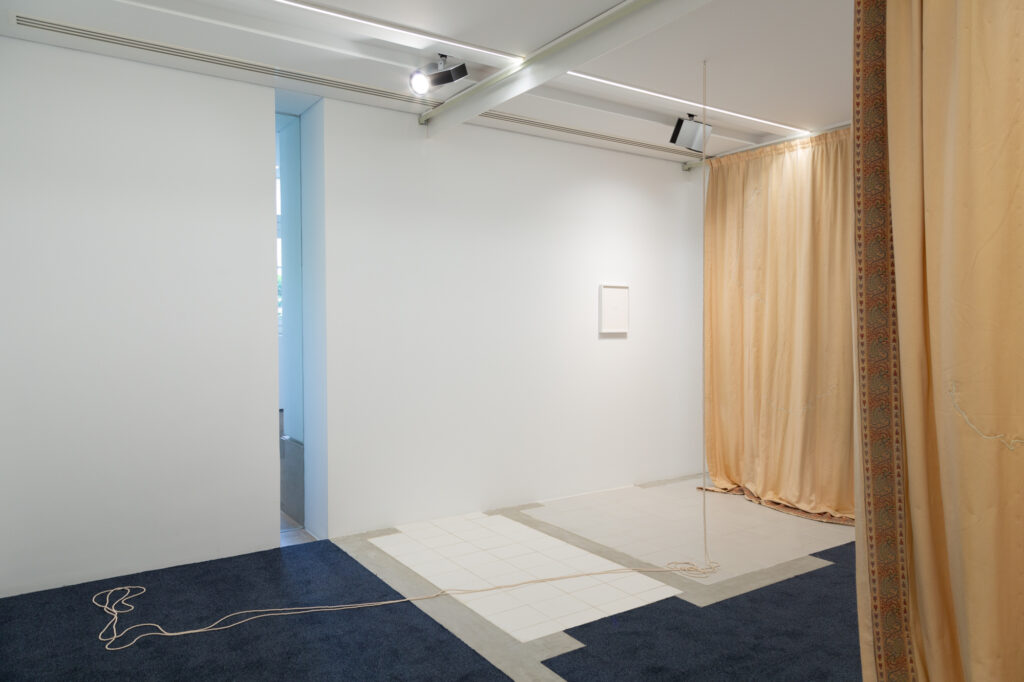
Exhibition View, The Encounter of the First and Last Particules of Dust, Sursock Museum, Beirut, 2025-2026.
Photo by Christopher Baaklini.
When she conceived Building a Home with Time (2019), it was still shaped by a sense that conflict in Lebanon belonged to the past. It also coincided with the uprising of October 2019, the economic collapse, the COVID-19 pandemic, and the 2020 Beirut Port explosion, events that would bring that past back into the present. What had once seemed processed and resolved began to unravel, resurfacing in ways that resisted closure.
Perhaps this is why building, in Saadé’s work, is always ongoing and takes place on uneven ground. Her early works already carry this tension. In Golden Memories (2014), she covers a childhood photograph with 24-carat gold leaf until the image gives way. The gesture is almost paradoxical, shifting what remains of memory into a reflective surface that mirrors the present. In Travel Diaries (2014–2019), the worn folds of used documents are traced in gold, highlighting the weight and preciousness of what had fallen out of use.
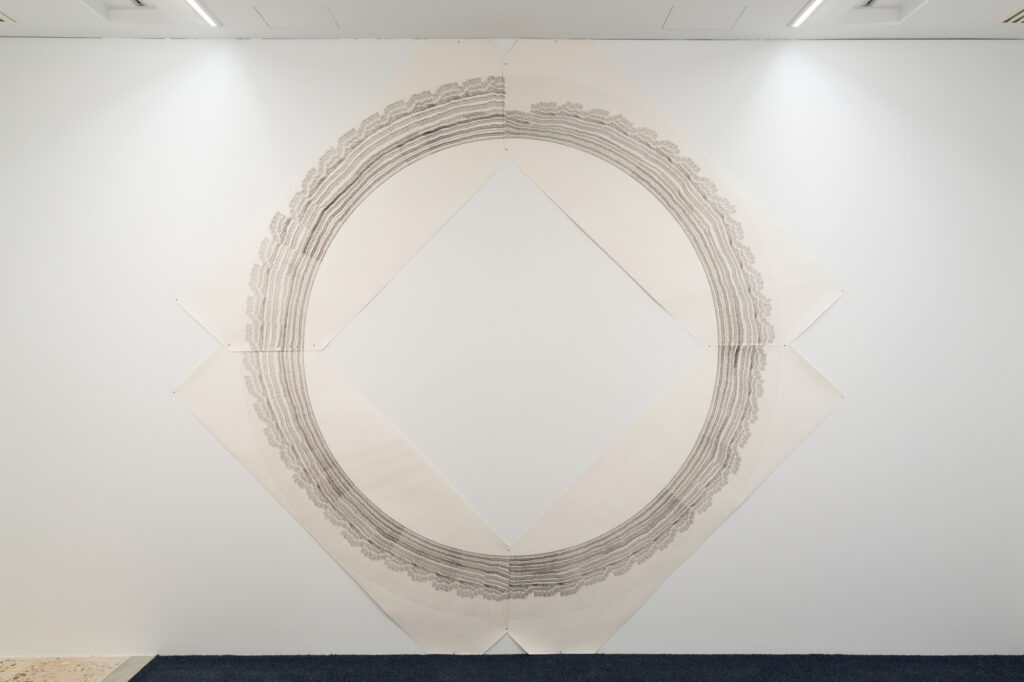
It is…, 2024–2025, Permanent ink on cardboard, 250×250 cm. Courtesy of the artist and Marfa’ Projects. Photo by Christopher Baaklini.
The gesture is consistent. Images fade, but traces remain. Almost as if in response to this very instability, Saadé continuously draws from the familiar: bedsheets, garments, carpets – objects that belong to her and are also shared by others. In Stage of Life (2022), the bed linen from her adolescence is cut and reassembled to fit the dimensions of her current Paris apartment, adapting an object from the past to a present space. In Pyramid (2022), garments of varying sizes are stacked into a compact, sculptural form; differences in scale are absorbed into a single structure in which time gathers.
In Watch (2022), the glass of a wristwatch is replaced with a mirror, reflecting time back onto the viewer. In her temporal calligrams, It is… (2025), time is written out manually, in full. Hours, minutes, and seconds are transcribed letter by letter, turning into something that can be seen and visualised. Here, time is inhabited.
This inevitably extends to Saadé’s notion of space. In Rolling Stones (2022), original building stones from her childhood home in Broummana are inlaid with mother-of-pearl and inscribed with the current geographical coordinates of her family members, scattering multiple geographies across elements from a single location. What is anchored and whole becomes legible through its fragmentation. Yet nothing collapses. This is because fragments, in Saadé’s work, do not signal loss but rather a different way of existing.
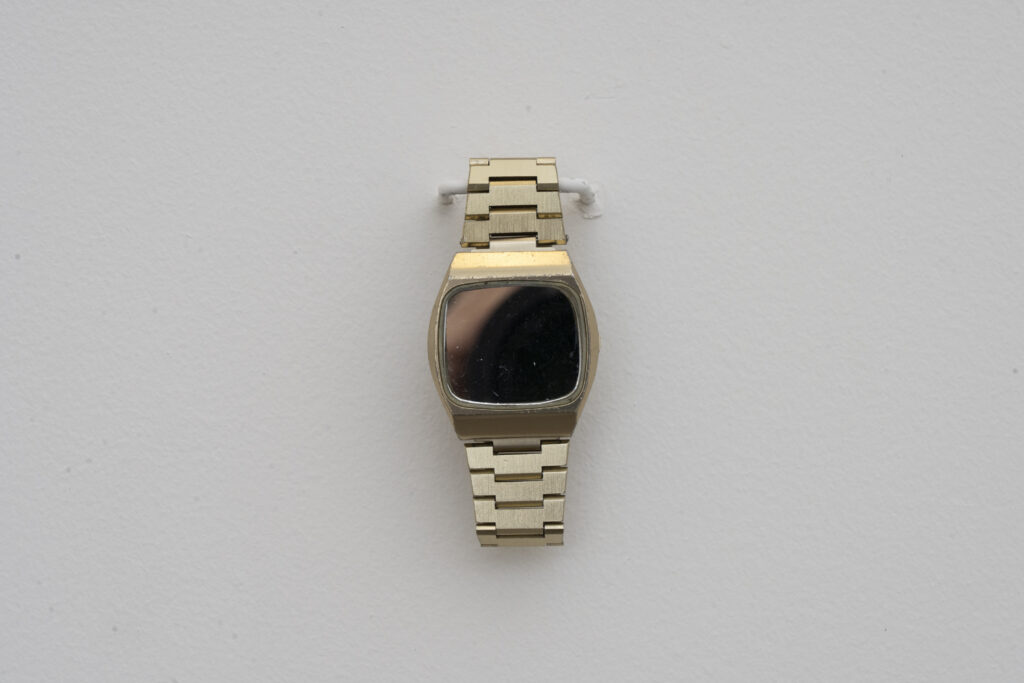
Watch, 2022, Used watch, mirror, 8.5 x 3 cm. Courtesy of the artist and Marfa’ Projects.
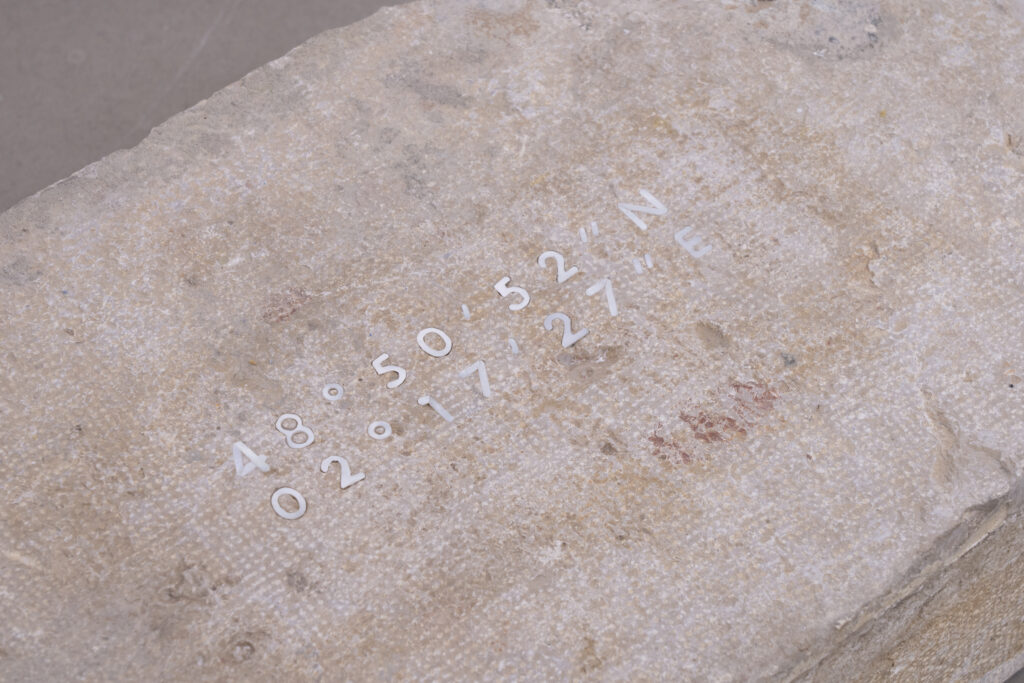
Rolling Stones, 2022, Carved stone, mother of pearl, variable dimension. Courtesy of the artist and Marfa’ Projects.
In We’ve Been Swallowed by Our Houses (2020), conceived during lockdown while she was also carrying life within her body, interior space becomes dense, almost overwhelming, and the idea of home once again loses its stability, an instability further heightened by the Beirut port explosion on August 4, 2020.
This also takes shape in The Encounter of the First and Last Particles of Dust, her solo exhibition at Beirut’s Sursock Museum (2025–2026), where Saadé reconstructs parts of the floors of her childhood home within the exhibition spaces. The installation unfolds horizontally, inviting visitors to walk across it and inhabit the spaces it represents. Embroideries trace routes on curtains originating from her childhood home, while terrazzo carries fragments of memory and lived experience. Dust is no longer an unwanted residue, but a point of both origin and arrival.
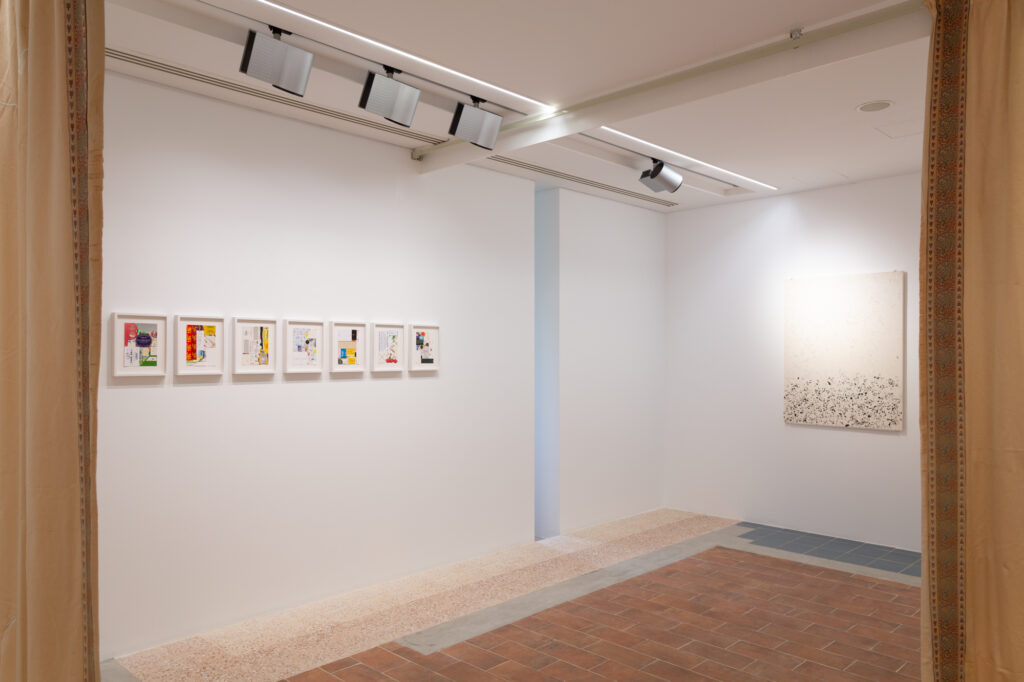
Exhibition View, The Encounter of the First and Last Particules of Dust, Sursock Museum, Beirut, 2025-2026. Photo by Christopher Baaklini.
It is through such shifts in perspective that Saadé’s work is articulated. It is never fixed as loss, but is patiently reconfigured through objects and gestures that feel immediately recognizable.
Saadé’s work has travelled widely across institutions and geographies – exhibited at the Centre Pompidou, MAXXI Rome, the Istanbul Biennial, the Sharjah Biennial, and Punta della Dogana, among others, and held in collections such as the Centre Pompidou, CNAP, the Barjeel Art Foundation, and the Saradar Collection. Yet however far it moves, the work continues to return to something familiar, where what is hers remains close to what feels shared.