
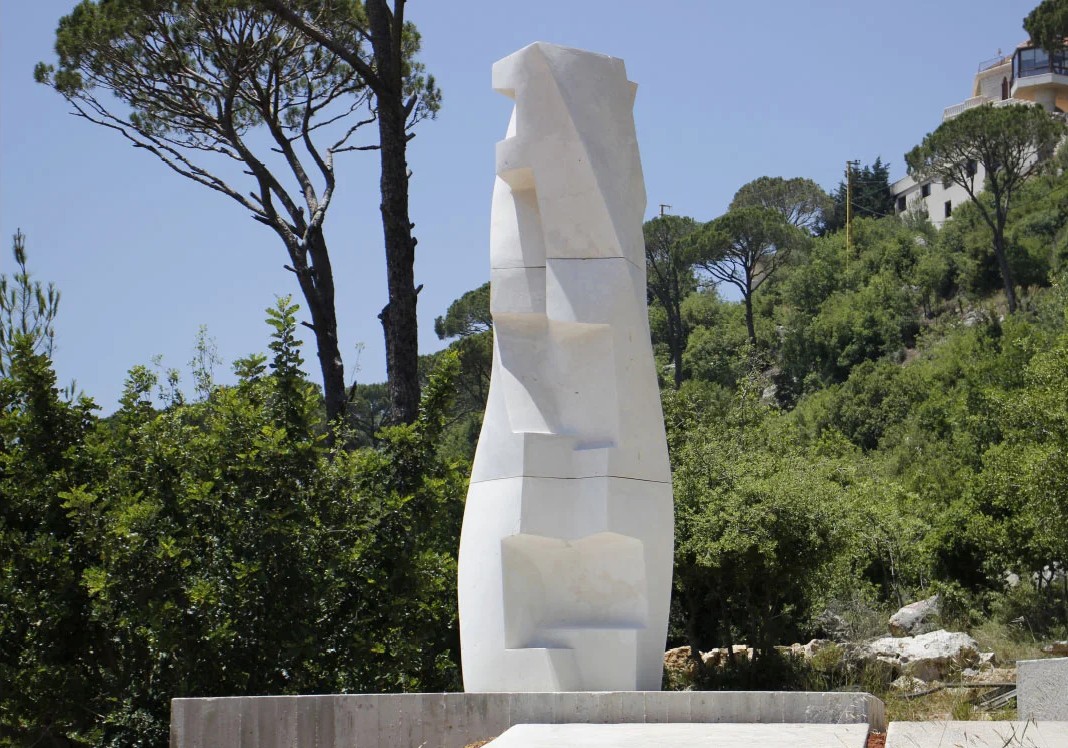
Saloua Raouda Choucair, Infinite Structure I, 1985-1987, Stone, 224 x 60 x 60 cm. © The Saloua Raouda Choucair Foundation/Artists Rights Society (ARS), New York.
Saloua Raouda Choucair did not enter modernism quietly. In 1951, while studying in Paris, she wrote back. The recipient was literary critic Musa Sulaiman; the text was a five-page essay titled How the Arab Understood Visual Art. A young Lebanese Choucair, in the capital of modern art, refused the idea that abstraction needed to be imported, authorized, or explained through Europe alone. For her, the abstract had ancestry rooted in Arab-Islamic visual thought, in geometry, and in the ability of form to speak without imitating the visible world.
Born in Ain El Mreisseh, Beirut, in 1916, Choucair entered a century already marked by rupture. Her father, Salim Raouda, died in Damascus in 1917 as a conscript to the Ottoman Army. Her mother, Zalfa Amin Najjar, raised her in an environment that would eventually lead her through science, drawing, philosophy, and art. She studied at the American Junior College for Women (now the Lebanese American University) where she concentrated on science, and later taught both drawing and science in Kirkuk, Iraq. Far from decorative interests, mathematics and nature trained her eye to value structure, relation, proof, and transformation.
Perhaps this is why her work so rarely feels like abstraction in the cold sense. A shape in Choucair’s hands is not a frame, but a proposition. It can hold, split, stack, open, or wait.
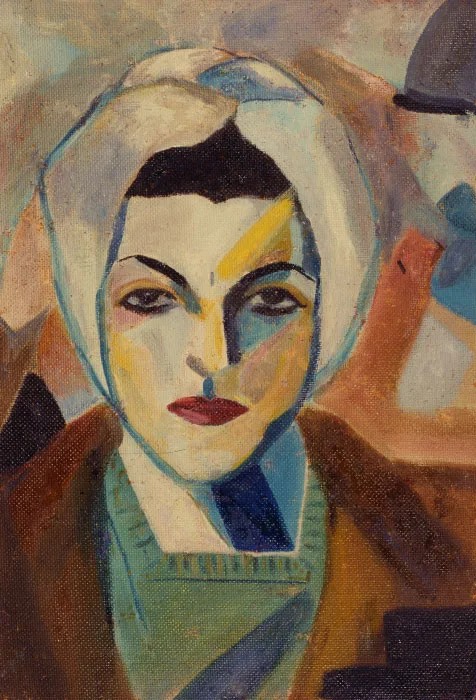
Saloua Raouda Choucair, Self Portrait, 1943, Oil on Board, 54 x 42 cm.
© The Saloua Raouda Choucair Foundation/Artists Rights Society (ARS), New York.
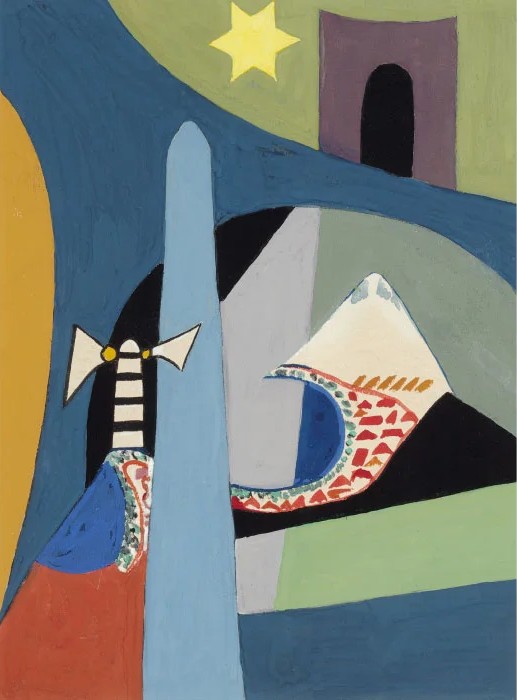
Saloua Raouda Choucair, Paris Beirut, 1948, Gouache on Paper, 32 x 23.5 cm.
© The Saloua Raouda Choucair Foundation/Artists Rights Society (ARS), New York.
Her paintings, which have long received less attention than they deserve, make this clear even earlier than her sculpture does.
In her 1943 Self Portrait, Choucair does not present herself as a smooth, legible subject. Her face is cut by angled planes of color; the eyes are direct, but the image around them is already under construction. Shadow, blue, yellow, and line divide the face without diminishing its force.
Before the modular sculptures, carved towers and interlocking forms, Choucair’s self was arranged through shifting shapes.
The gouaches and oils of the late 1940s still hold figures, yet the human body is already losing its authority. In works like Les Trois Graces and Seated Nude, bodies flatten into silhouettes and planes. In Paris Beirut, biography appears as a collision of forms rather than a sentimental bridge between two cities. Something other than the figure begins to organize the image.
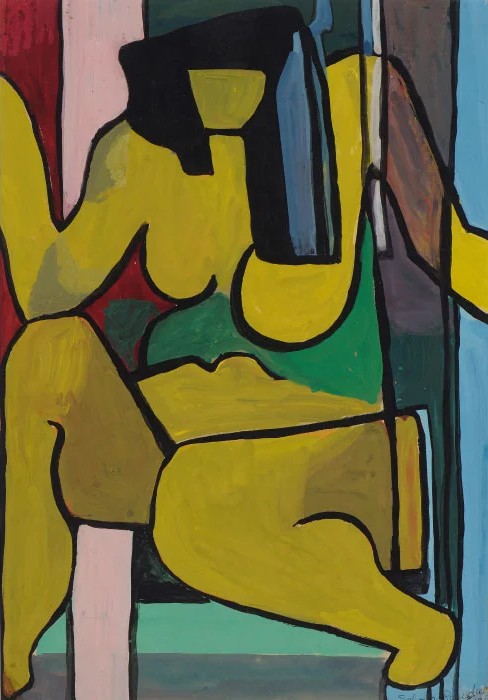
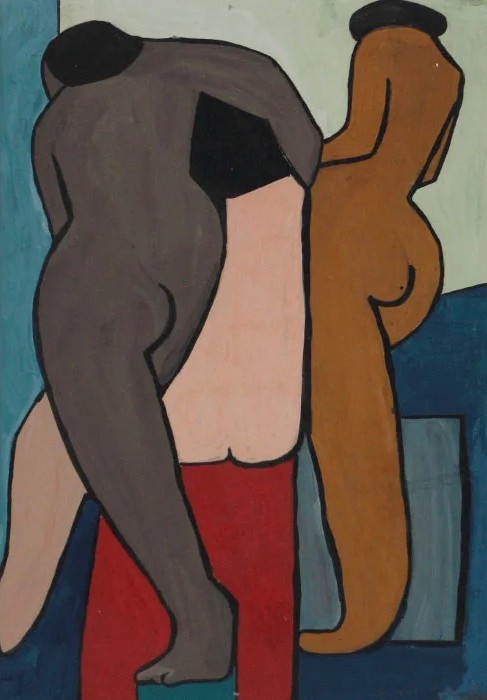
Saloua Raouda Choucair, Seated Nude, 1948, Gouache on Paper, 37 x 26 cm.
© The Saloua Raouda Choucair Foundation/Artists Rights Society (ARS), New York.
Saloua Raouda Choucair, Les Trois Graces, 1948, Gouache on Paper, 35.5 x 25 cm.
© The Saloua Raouda Choucair Foundation/Artists Rights Society (ARS), New York.
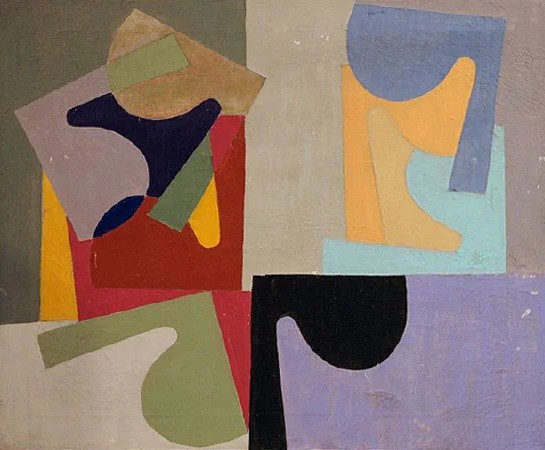
By the time of the Fractional Module and Rhythmical Composition paintings, produced between the late 1940s and 1950s, fragments sit, press, overlap, and test one another. As though rehearsing assembly, the paintings think like sculpture before sculpture has been given weight.
This turn toward abstraction was a consequence of conviction. During her studies at the American University of Beirut (AUB) in the 1940s, Choucair was reportedly told by a professor that Greek art was superior to Islamic art because the latter lacked human images. That comment became her catalyst; rather than accept the absence of the figure as a limitation, Choucair treated it as a door. In her 1951 essay, she argued that Arab artists had reached into the essence of the subject rather than the imitation of visible reality.
Paris gave her exposure, not definition. She moved there in 1948, studied at the École Nationale des Beaux-Arts, spent a short period in Fernand Léger’s studio, and joined L’Atelier de l’Art Abstrait. Yet she left Léger’s studio after finding his approach to abstraction unsatisfying. Rather than return to Beirut as a disciple of European modernism, she came back with a vocabulary sharpened by encounter and disobedience.
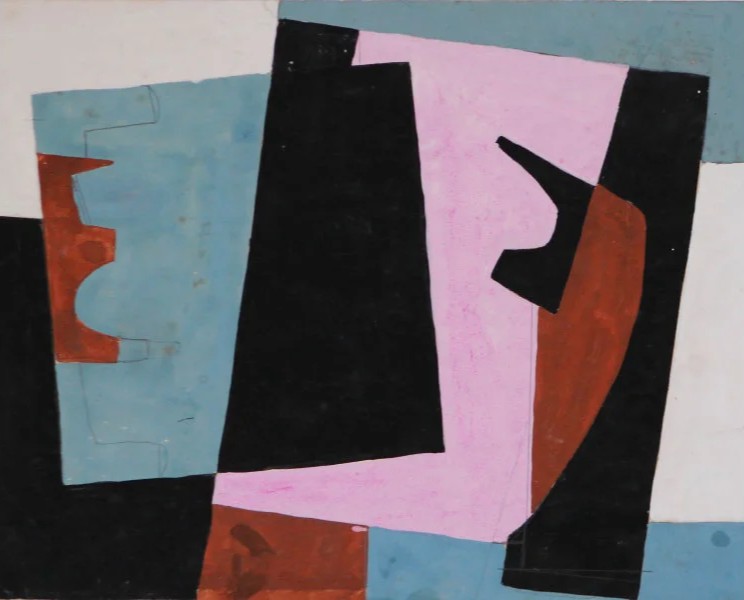
Saloua Raouda Choucair, Plus et Moins I, 1951, Gouache on Paper, 23 x 31 cm.
© The Saloua Raouda Choucair Foundation/Artists Rights Society (ARS), New York.
Saloua Raouda Choucair, Fractional Module II, 1947-1951, Oil on Canvas, 49 x 69 cm.
© The Saloua Raouda Choucair Foundation/Artists Rights Society (ARS), New York.
One of the clearest keys to that vocabulary is Trajectory of a Line. Begun in the late 1950s and revisited across materials and scale, the series carries the intelligence of a lifelong question. The early brass and terracotta versions feel intimate, with curved openings that turn absence into part of the object’s anatomy. In later stone iterations, including the 2013 version, the idea stands taller, cleaner, and more architectural.
The trajectory is not only the line inside the form, but rather Choucair’s own method of return. An idea could come back decades later with new weight and new weather.
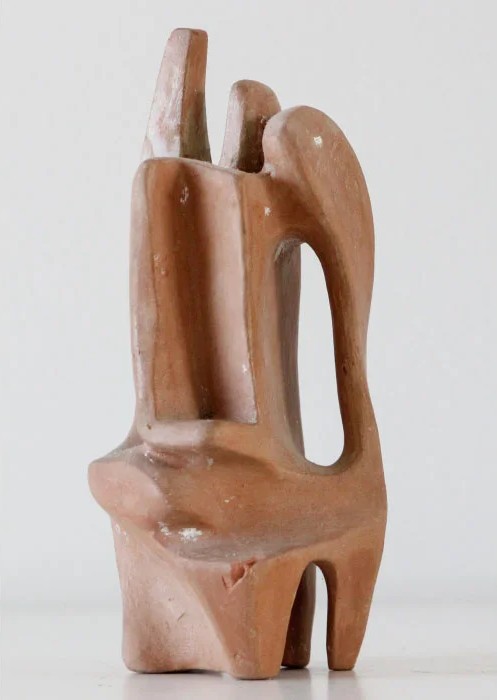
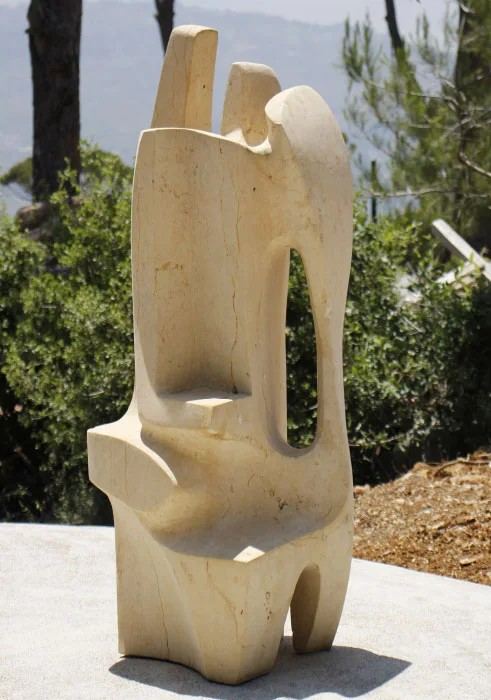
Saloua Raouda Choucair, Trajectory I, 1957-1959, Terracota, 18 x 8 x 8 cm.
© The Saloua Raouda Choucair Foundation/Artists Rights Society (ARS), New York.
Saloua Raouda Choucair, Trajectory I, 1959-2013, Stone, 127 x 49 x 51 cm.
© The Saloua Raouda Choucair Foundation/Artists Rights Society (ARS), New York.
The Interform works of the 1960s open another register. Towers and ovals appear pierced by apertures, recesses, and passages. The void leads the eye to enter, pause, exit, and circle back. These pieces carry the logic of buildings without becoming buildings, and the intimacy of objects without shrinking into design.
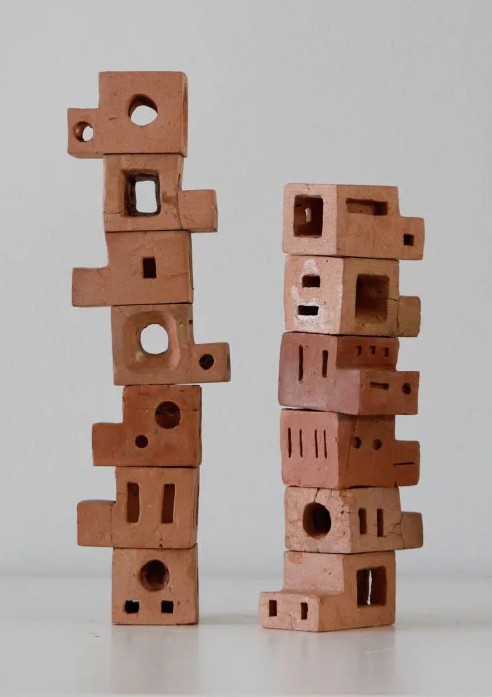
Then come the Infinite Structure works, dense and vertical, block upon block. Apertures repeat and grooves interrupt the surface. Some versions look archaeological, others urban, and others almost scripted. Structure suggests order and infinity suggests continuation. Somehow, Choucair keeps both in play.
Poetry enters here not as metaphor, but as engineering. Her celebrated modular sculptures, especially the Poem series, are composed of interlocking pieces that can be taken apart and reordered. AUB describes them as works that can be rearranged “as in a Sufi poem,” while Christie’s notes their relationship to Arabic poetic structure, where a verse or stanza can stand alone while belonging to a larger whole.
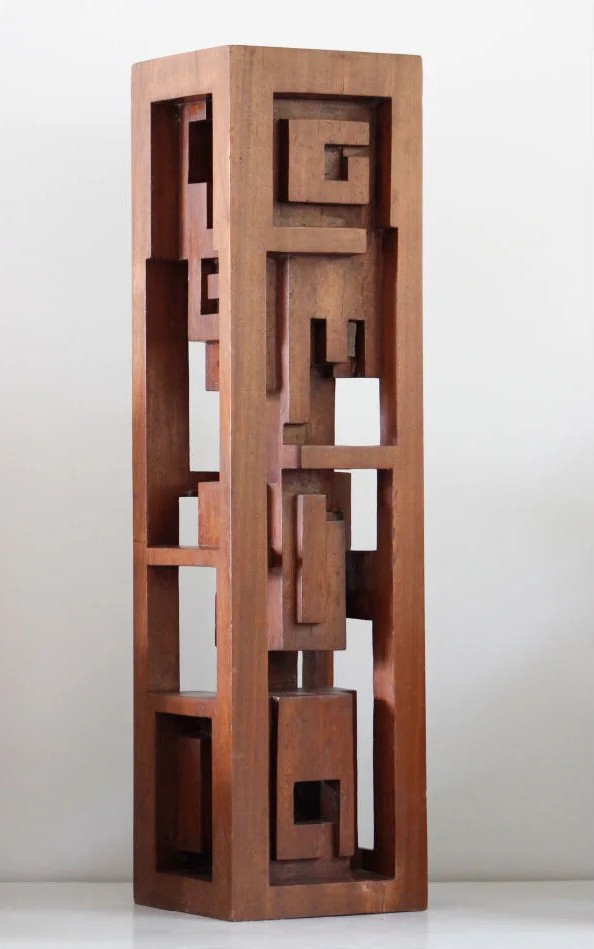
Saloua Raouda Choucair, Interform, 1960-1962, Wood, 108.5 x 27.5 x 28 cm.
© The Saloua Raouda Choucair Foundation/Artists Rights Society (ARS), New York.
Saloua Raouda Choucair, Infinite Structure III, 1983-1985, Terracota, 4 x 5.5 x 4 cm.
© The Saloua Raouda Choucair Foundation/Artists Rights Society (ARS), New York.
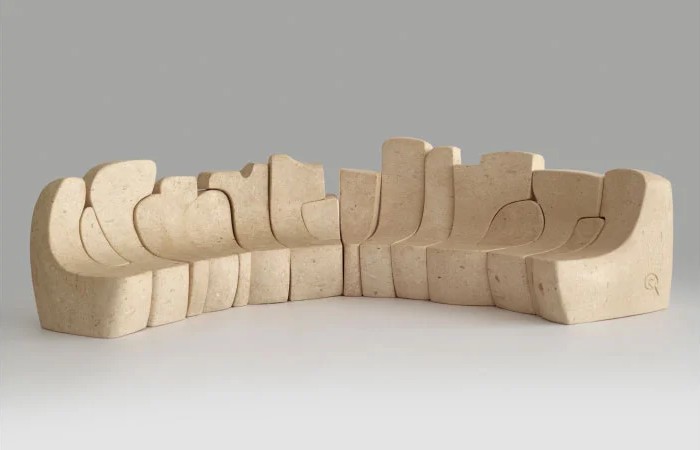
Saloua Raouda Choucair, Poem Bench, 1969-1998, Stone, 17 x 71 x 17 cm.
© The Saloua Raouda Choucair Foundation/Artists Rights Society (ARS), New York.
This is where her work becomes most human. Choucair’s sculptures understand relation: how one part leans on another, how separation can still carry memory, how unity can be temporary, and how a system can hold difference without smoothing it away.
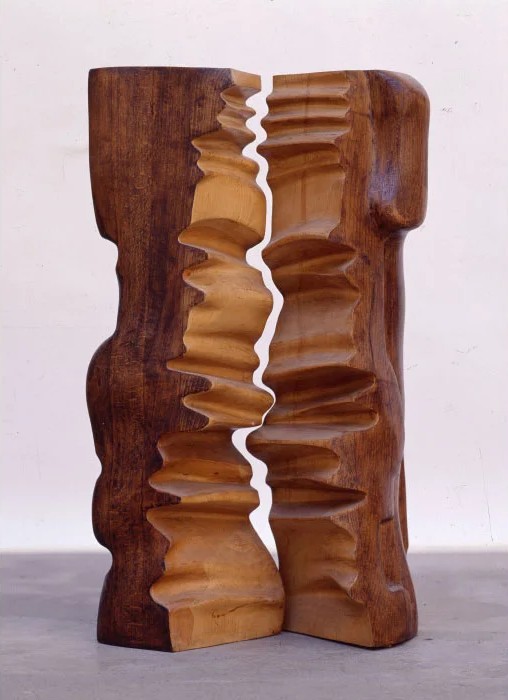
The Dual series, incepted during the years of the Lebanese Civil War, gives this language its most charged form. The works were made during a traumatic period between 1976 and 1980, when the war was raging and Choucair and her husband were trapped in their apartment. It only makes sense that they have often been read through the conflict.
But Dual is not a simple binary. The forms are divided, yet intimate, almost shaping each other by proximity. Their seams behave like scars, hinges, fractures and faults. The line of separation is discreet in some, and jagged and bodily in others. Conflict, here, is the difficulty of being too close to separate cleanly. It is an apt reading of Lebanon’s Civil War that Choucair’s works have given structure. Streets, families, histories, neighbors, affiliations, all pressed into unbearable contact, and entangled as strongly as they were opposed.
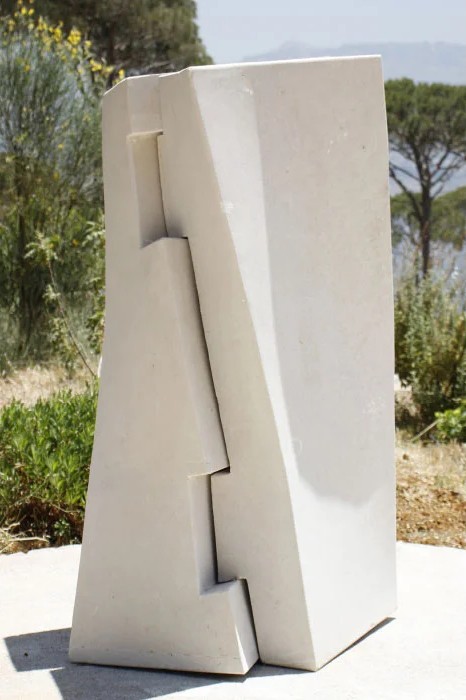
Saloua Raouda Choucair, Dual III, 1975-1977, Stone, 139 x 53 x 53 cm.
© The Saloua Raouda Choucair Foundation/Artists Rights Society (ARS), New York.
Saloua Raouda Choucair, Revelation, 1985-1987, Wood, 63 x 30 x 15 cm.
© The Saloua Raouda Choucair Foundation/Artists Rights Society (ARS), New York.
Recognition came late, Choucair had been respected within a circle of art lovers, but remained little known internationally until the 2013 Tate Modern retrospective – which presented more than 160 works and marked a turning point in her global reception. Her daughter, Hala Shoucair, once said that her mother was admired and respected, “but it wasn’t in the way that she wanted.” Choucair had hoped for large public sculptures and work that lived among people rather than remaining confined to select spaces.
That hope came to life in 2024, with the opening of the Saloua Raouda Choucair Museum in Ras El Metn, Mount Lebanon, on land that had long enchanted the artist. The museum holds around 600 pieces, with about 500 on display, across wood, stone, terracotta, fiberglass, plexiglass, brass, bronze, aluminum, stainless steel, furniture, carpets, plates, and jewelry. Beyond a showcase, the museum is a fitting afterlife. A body of work that began with lines, figures, modules, towers, poems, dualities, and structures now gathered in a place where art, architecture, archive, and landscape meet.
Choucair passed away in Beirut in 2017, at the age of 100. Yet her work still feels ahead of us. It understood that a line could think, that a part could carry a whole, that abstraction could hold memory, and that form could keep growing long after the hand that shaped it was gone.