
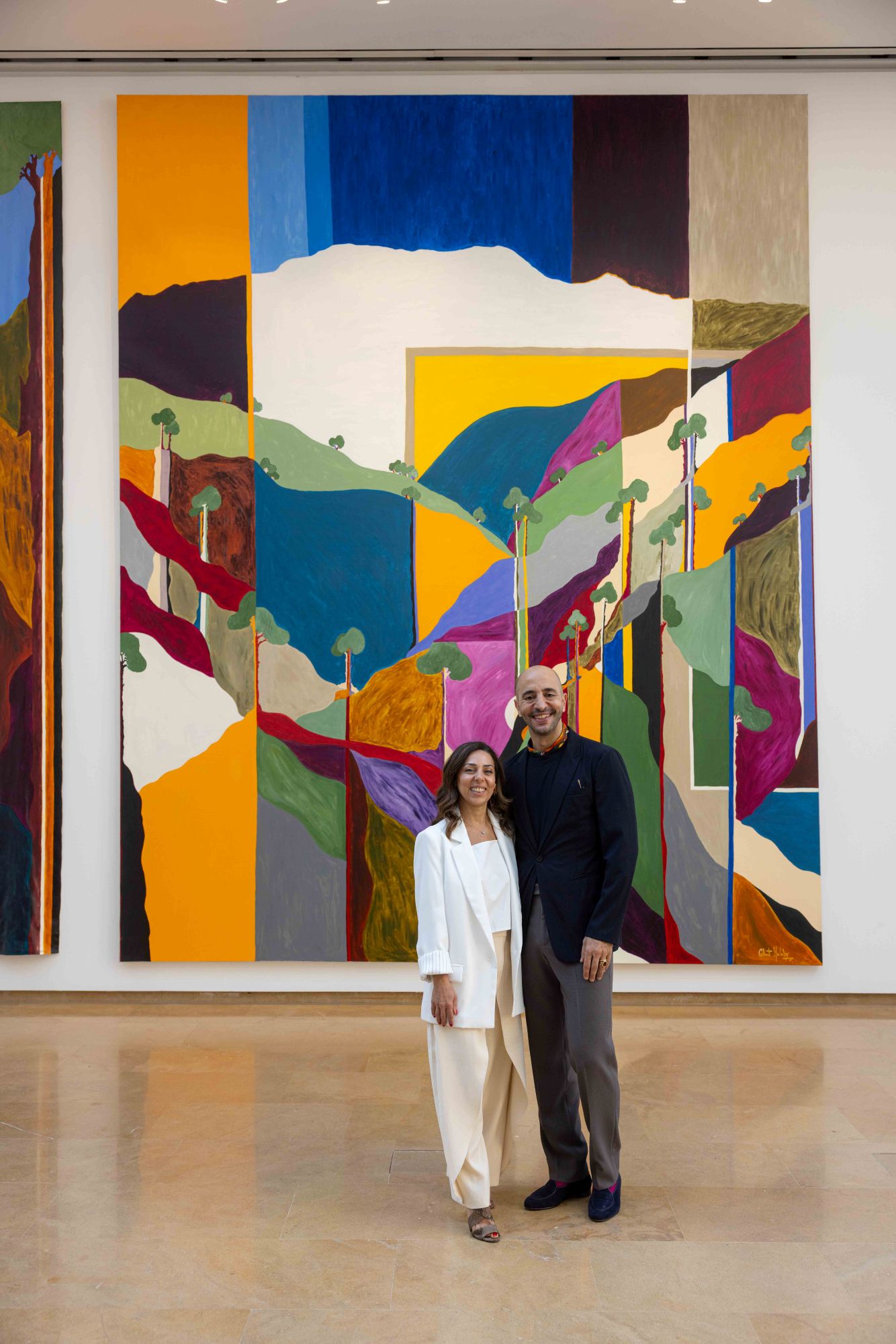
Muriel Asmar & Gilbert Halaby, Echoes of Existence Exhibition at the Nuhad Es-Said Pavilion for Culture, 2026 – Photo by Christopher Akiki.
For Gilbert Halaby, the pine begins in Dhour Choueir, in the landscapes of childhood he has carried with him through years of living in Rome. For curator Muriel Asmar, that same tree offered a way to connect Halaby with Enzo Cucchi, Lebanon with Italy, and contemporary painting with a much longer history of looking at the land. Echoes of Existence follows that connection across three levels, moving from the two artists to Lebanese modern masters, and finally to the forests themselves through an environmental installation. What emerges is a tree carrying several lives at once: personal memory, shared cultural inheritance, and a living ecosystem under pressure.
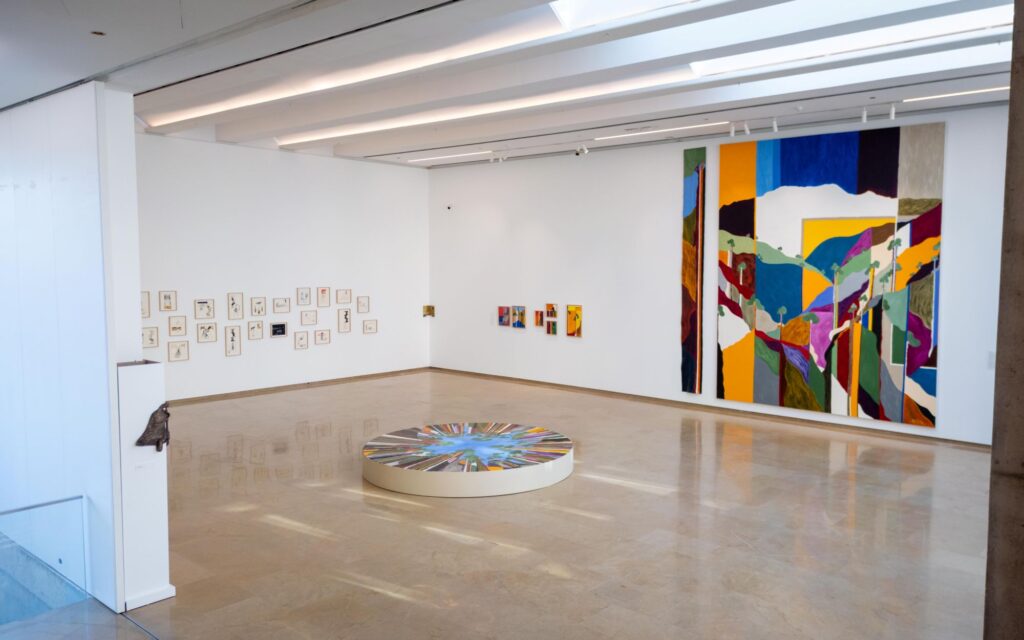
Echoes of Existence Exhibition at the Nuhad Es-Said Pavilion for Culture, 2026.
Photo by Christopher Akiki.
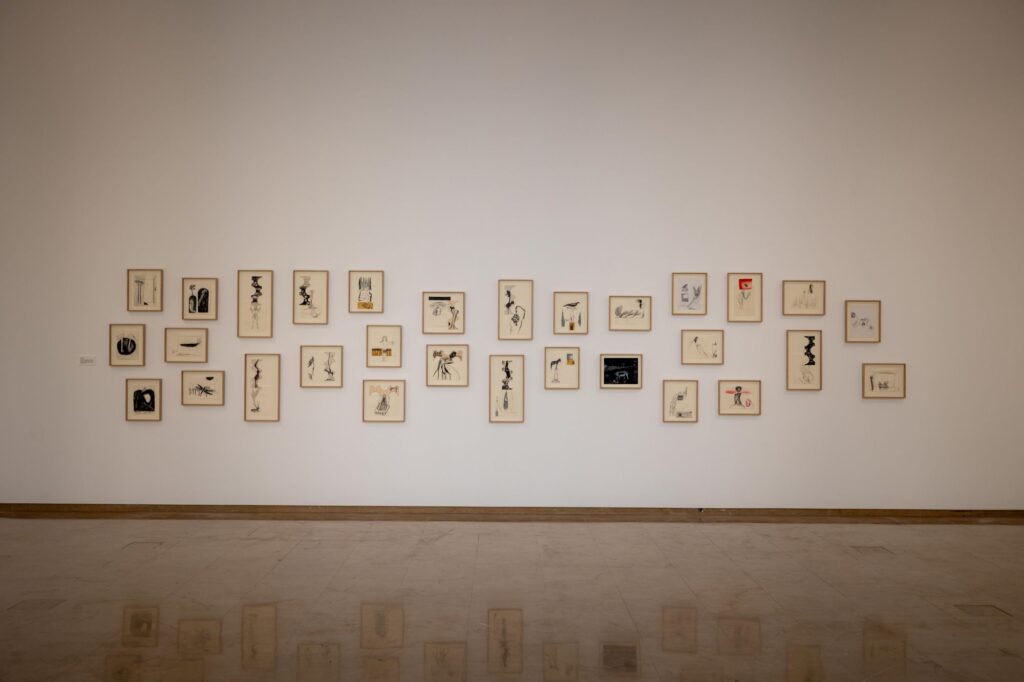
Echoes of Existence Exhibition at the Nuhad Es-Said Pavilion for Culture, 2026.
Photo by Christopher Akiki.
Muriel, the pine emerged as a shared motif in the work of Gilbert Halaby and Enzo Cucchi. What did you see in this unexpected connection that made it such a compelling starting point for the exhibition?
What immediately struck me was that the pine could become much more than a visual motif. Gilbert Halaby and Enzo Cucchi come from very different cultural and artistic backgrounds, yet both use the pine as a deeply personal and symbolic presence. I saw in this connection an opportunity to create a dialogue between Lebanon and Italy, between memory and landscape, and between the personal and the universal.
The pine also felt particularly meaningful because it exists across the Mediterranean. It carries associations of belonging, memory, continuity and place, while at the same time being a living element of a fragile ecosystem. This allowed the exhibition to move naturally from art and poetry into questions of identity, heritage and environmental responsibility. For me, the pine became almost a thread connecting all the different layers of Echoes of Existence.
Gilbert, you repeatedly turn to the pine in your work. What is it about this particular tree that continues to draw you back to it?
The pine has always felt deeply connected to my memory and to the landscape I come from, which is Dhour Choueir and the Lebanese mountains. It is a tree I have known since childhood, but I think what keeps bringing me back to it is that it carries many layers at once. It is rooted in a very specific place, yet it is also universal.
For me, the pine is not simply a tree or an element of the landscape. It becomes a way of speaking about memory, time, belonging and existence. Its verticality, its strength, its ability to remain present through changing seasons, all of these qualities make it an endlessly rich subject. The more I paint it, the more I realize that I am not really painting the tree itself, but everything that the tree has come to represent.
The exhibition places your work alongside Enzo Cucchi’s. What do you think emerges from seeing these two approaches to the pine side by side, and did this encounter reveal anything new to you about your own relationship with the subject?
Seeing my work alongside Enzo Cucchi’s creates a dialogue that goes beyond the pine itself. We approach the subject from very different personal and visual languages, yet there is something shared in the way the tree becomes more than a representation of nature.
Cucchi’s work carries a very particular Italian and poetic dimension, while my relationship with the pine is strongly connected to Lebanon, memory, and the landscapes that have shaped me. Placing the works together made me more conscious of how a familiar image can travel between cultures and still retain its emotional power.
It also reminded me that a symbol does not belong to one person or one place. The pine can become a bridge between Lebanon and Italy, between the personal and the universal. In that sense, the encounter made me see the pine’s wider possibilities.
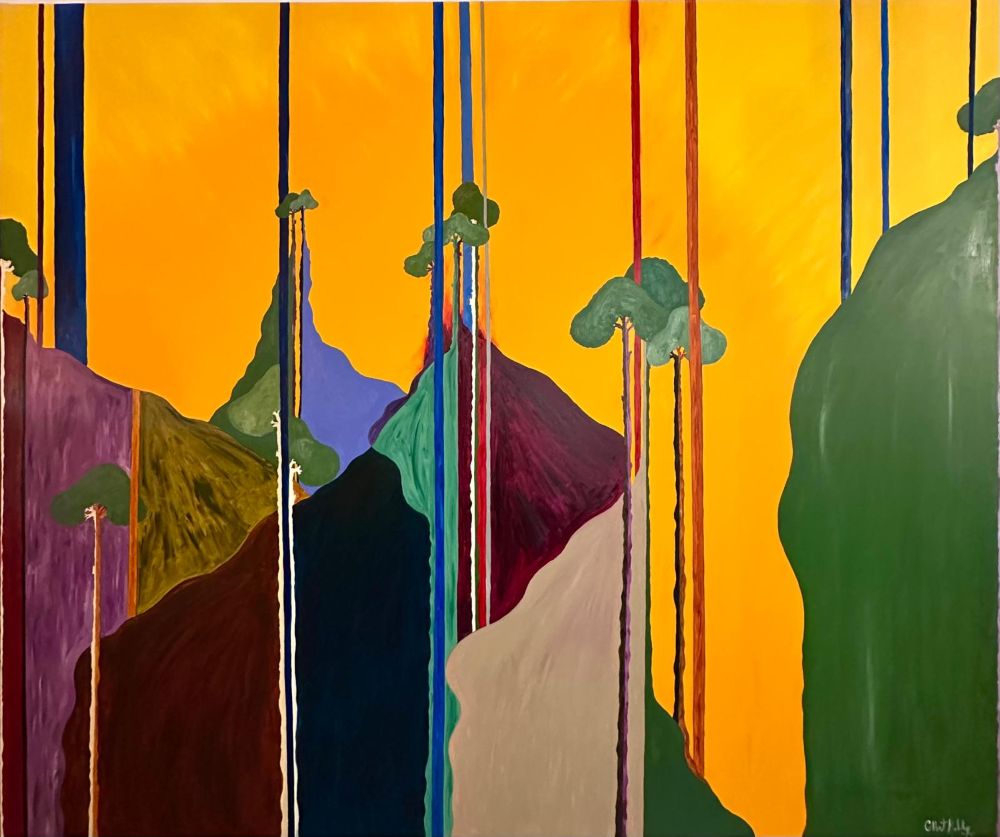
Gilbert Halaby, The Sky to Recite, 2025. Oil on canvas, 200 x 240 cm.
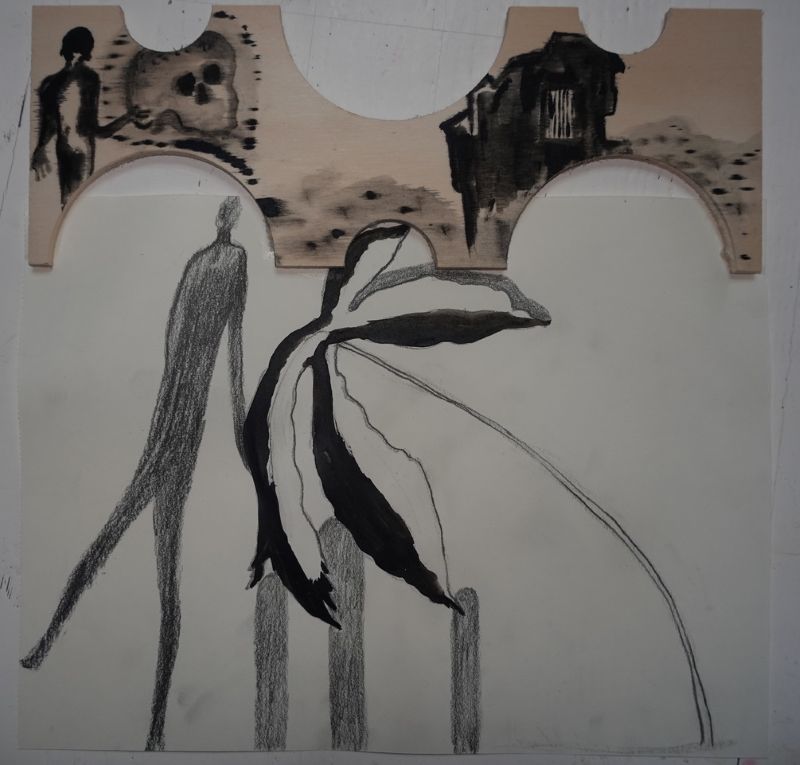
Enzo Cucchi, Untitled, 2024. Pencil, ink and wood on paper, 28 x 28 cm.
Gilbert, in works such as Sannine, the landscape is recognisable, but it doesn’t feel like a traditional landscape painting. What happens to the landscape once you begin to distort, repeat or transform it through your own visual language?
The landscapes I paint are rooted in places I know intimately, particularly Dhour Choueir and the surrounding Lebanese mountains. In works such as Sannine, the landscape is recognisable because it comes from a real place, but painting allows me to move beyond what the eye actually sees.
I can distort proportions, repeat forms, shift perspectives and simplify the landscape until it becomes almost a memory or an internal image. The mountain, the pines and the horizon remain present, but they begin to exist somewhere between reality and imagination.
For me, this transformation is a way of making the landscape personal. I am not trying to document Dhour Choueir or Sannine; I am trying to express what these places mean to me. The landscape becomes a language through which memory, emotion and time can coexist.
Muriel, the exhibition brings together works by Omar Onsi, Moustafa Farroukh, César Gemayel and Aref El Rayess, all of whom have depicted the Lebanese landscape in their own ways. What made these particular works and artists important to include, and what do they bring to the exhibition’s exploration of the pine?
I wanted the Lebanese modern masters to provide a historical and cultural context for the contemporary dialogue between Halaby and Cucchi. This section was selected by Saleh Barakat, whose expertise in Lebanese modern art helped bring together works that reflect different approaches to the Lebanese landscape.
Artists such as Omar Onsi, Moustafa Farroukh, César Gemayel and Aref El Rayess each developed a very distinctive way of looking at the Lebanese landscape. Their works remind us that our relationship with nature and with the land has been part of Lebanese artistic expression for generations.
I was particularly interested in showing that the landscape is never simply a backdrop. It carries memory, identity and emotion. By bringing these works into the exhibition, the pine becomes part of a longer visual history, one that connects generations of Lebanese artists with the contemporary interpretations of Halaby and Cucchi.
Gilbert, you have lived in Rome for many years while continuing to return to the Lebanese landscape in your work. How, if at all, has the experience of living away from Lebanon and returning to it shaped the way you see and paint the landscape?
Living in Rome has inevitably changed the way I see Lebanon. Distance creates another kind of intimacy. When you live away from a place, you begin to see things that may have been invisible when you were inside them. Returning to Lebanon, and particularly to Dhour Choueir and the landscapes of my childhood, I no longer see them only as something familiar; I see them through memory, absence, and the experience of having lived elsewhere.
Rome has also given me another cultural and artistic language through which to look at my own landscape. There is a constant dialogue between the two places in my work, not necessarily as a contrast, but as two parts of my experience.
Perhaps this is why the Lebanese landscape keeps returning in my paintings. Distance has not weakened my connection to Dhour Choueir or to Lebanon; it has made that connection more conscious. I return to these landscapes not simply to remember Lebanon, but to rediscover them each time through a different perspective.
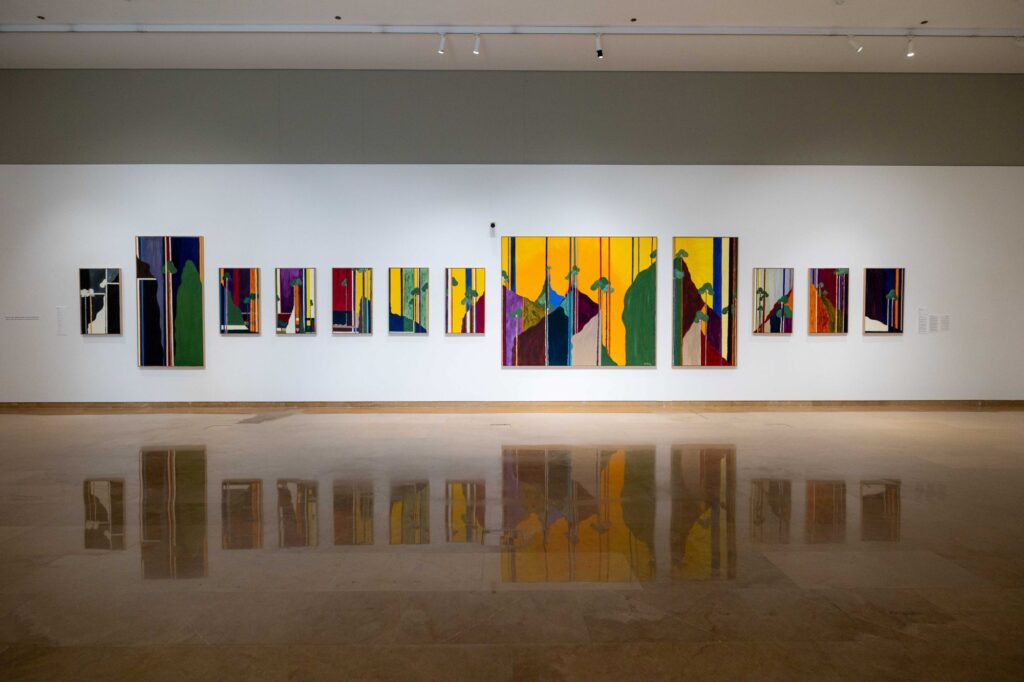
Echoes of Existence Exhibition at the Nuhad Es-Said Pavilion for Culture, 2026.
Photo by Christopher Akiki.
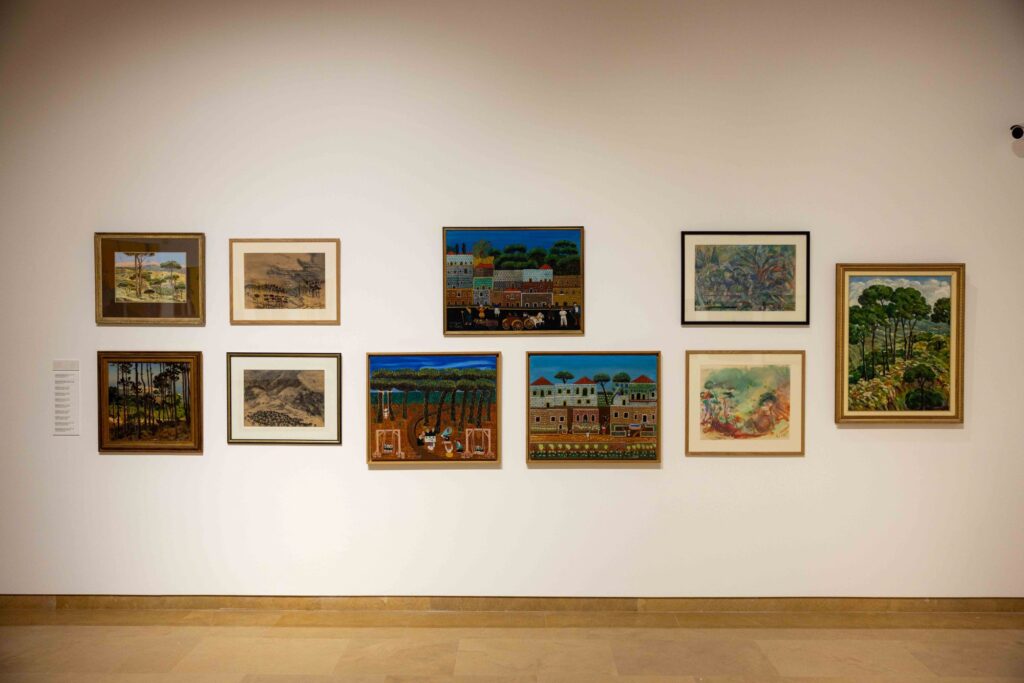
Echoes of Existence Exhibition at the Nuhad Es-Said Pavilion for Culture, 2026.
Photo by Christopher Akiki.
Muriel, the exhibition unfolds across three levels, moving from Halaby and Cucchi, to the Lebanese modern masters, and finally to the environmental installation. How did the physical structure of the exhibition shape the way you wanted the viewer to encounter these different layers?
The three levels were very important to the way I conceived the exhibition. I wanted the visitor to experience it almost as a journey rather than as three separate sections.
The first level introduces the contemporary dialogue between Gilbert Halaby and Enzo Cucchi, allowing the viewer to encounter the pine through two very different artistic languages. The second level takes us backwards into Lebanese modernism, creating a sense of memory and continuity and showing how deeply the landscape is rooted in our artistic heritage.
Then, as the visitor moves to the final level, the perspective changes completely. The environmental installation by the Carabinieri Biodiversity and Forestry Units brings us from representation to reality, from the pine as an artistic and cultural symbol to the actual challenges facing forests today.
So the movement through the building mirrors the conceptual movement of the exhibition: from art, to memory, to responsibility.
The environmental dimension enters the exhibition through the Carabinieri Biodiversity and Forestry Units and their work around the protection of Italian forests. Why was it important to bring the pine’s cultural history into conversation with its very real ecological vulnerability today?
Because I felt that it would not be enough to celebrate the pine only as an artistic or cultural symbol without acknowledging the reality of what is happening to it in nature.
The pine has been present in our landscapes, our memories and our artistic traditions for generations. But today, these forests face very real environmental pressures. The involvement of the Carabinieri Biodiversity and Forestry Units allows us to make that connection tangible and to remind the viewer that what we admire in a painting also exists as a living, vulnerable ecosystem.
This was an essential part of Echoes of Existence: to create a dialogue between culture and nature. Art can make us look at something differently, and I wanted the exhibition to encourage that second look, to see the pine not only as an image or symbol, but as something alive that needs to be understood and protected.
In that sense, the exhibition becomes a reflection on our responsibility towards the landscapes we inherit.
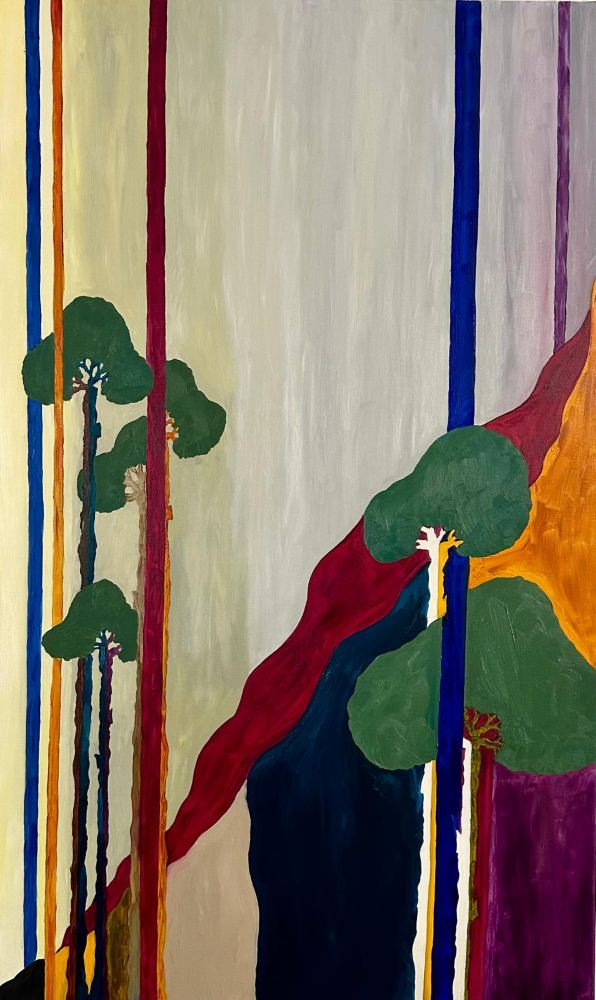
Gilbert Halaby, To a Vast, 2025. Oil on canvas, 100 x 60 cm.
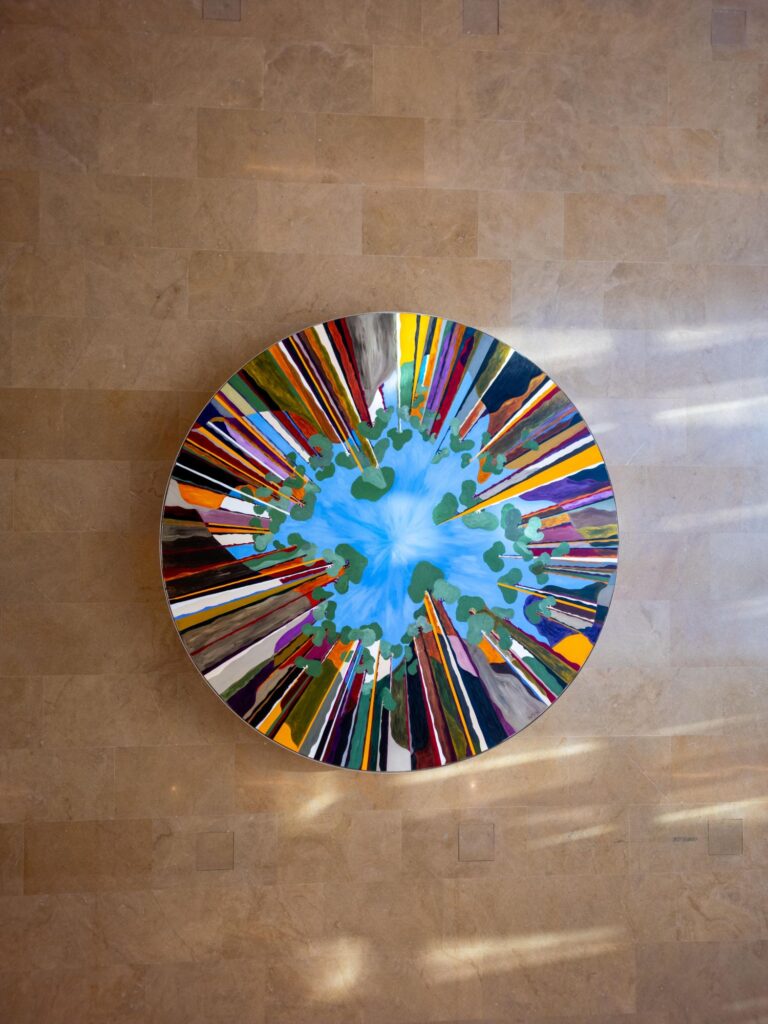
Echoes of Existence Exhibition at the Nuhad Es-Said Pavilion for Culture, 2026.
Photo by Christopher Akiki.