
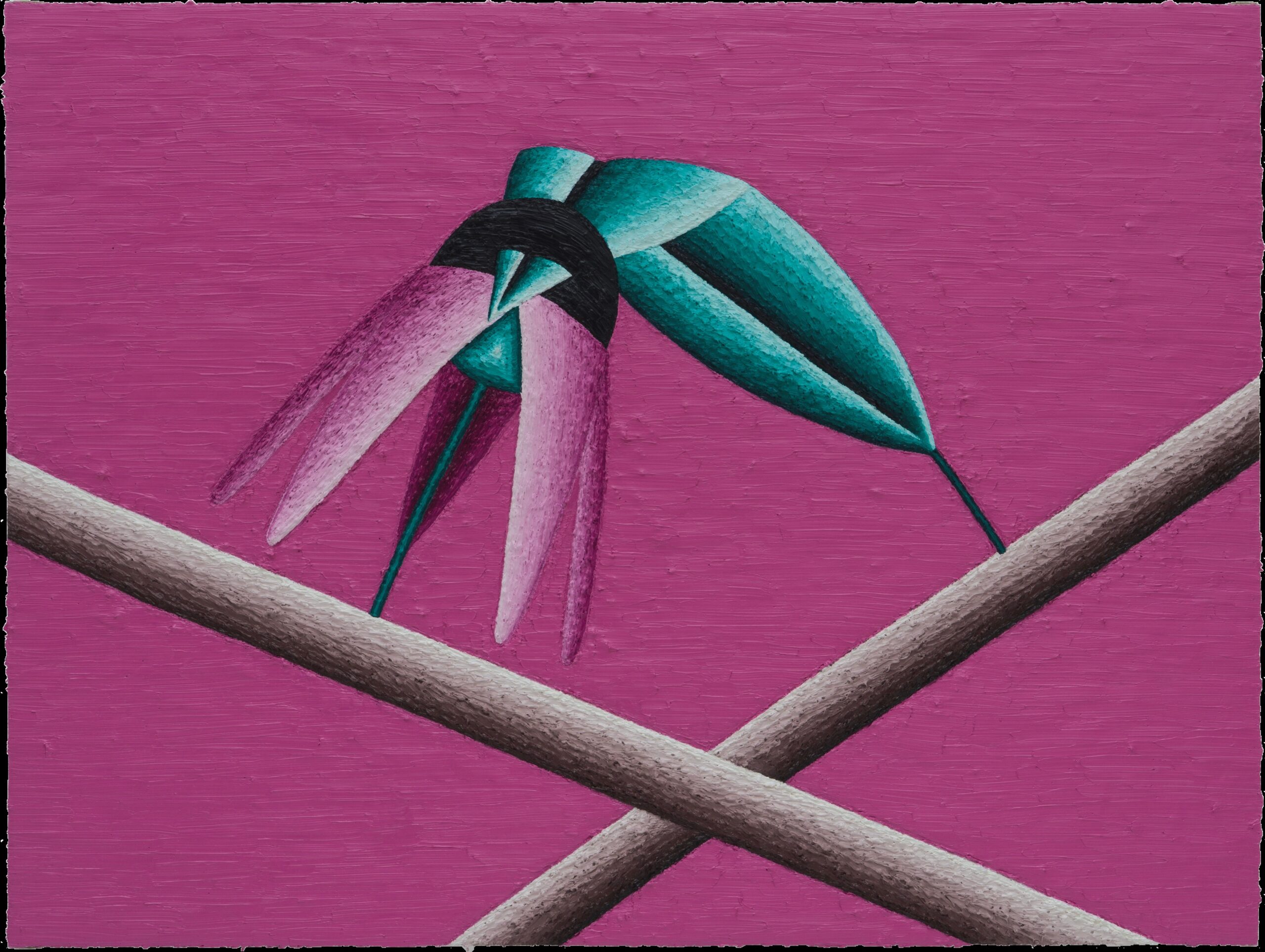
Nadia Ayari, Oblivion II, 2025, Oil on Linen, 71.1 x 94.6 cm. Courtesy of the artist and Selma Feriani Gallery.
In Nadia Ayari’s paintings, a flower does not appear because the world is gentle enough to let it bloom. It appears because the world has made survival difficult. Stripped of its naivete and formed under pressure, Ayari’s nature has learned how to answer back in soft power.
Born and raised in Tunis and now based in Brooklyn, the Tunisian American painter has long drawn from the botanical landscape of North Africa, inventing flowers, branches, leaves, figs, trees, and other recurring forms that operate more as characters than mere motifs.
But to read her practice only through origin would be too easy. Ayari herself has resisted the art world’s appetite for identity as shorthand. In a 2014 interview, she described herself as “post-identity”; Tunisian culture had once helped her contextualize the work, but her process had become too mysterious and multi-layered to be reduced to national belonging.
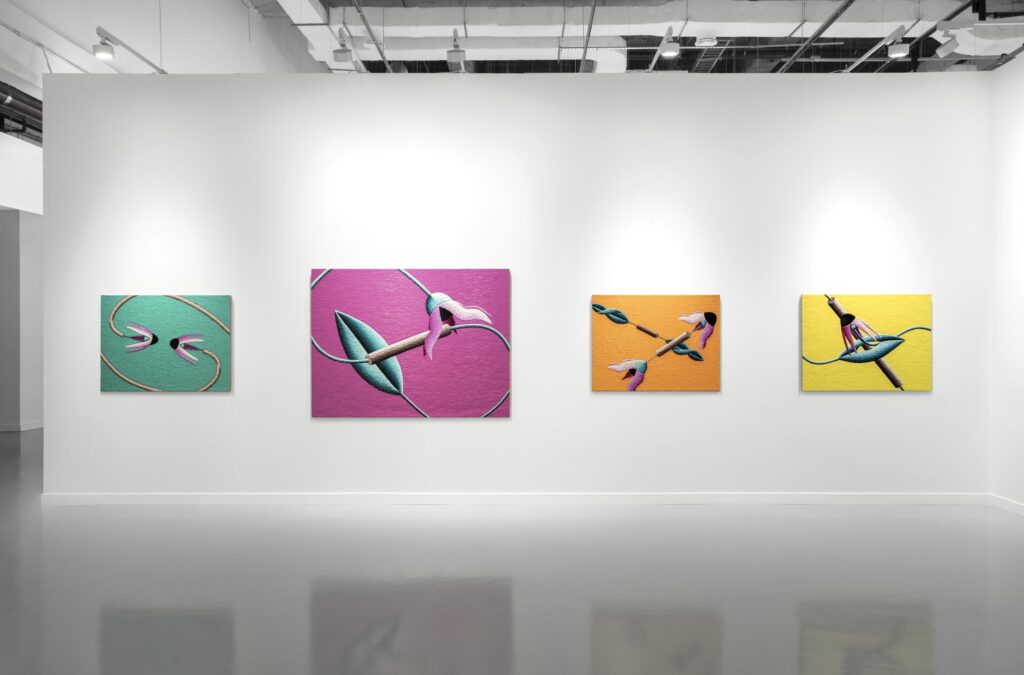
Nadia Ayari, Oblivion Rains: Notations of Gravity, Light, and Resistance, 2026,
Solo exhibition at Selma Feriani Gallery, Tunis. Courtesy of the artist and Selma Feriani Gallery.
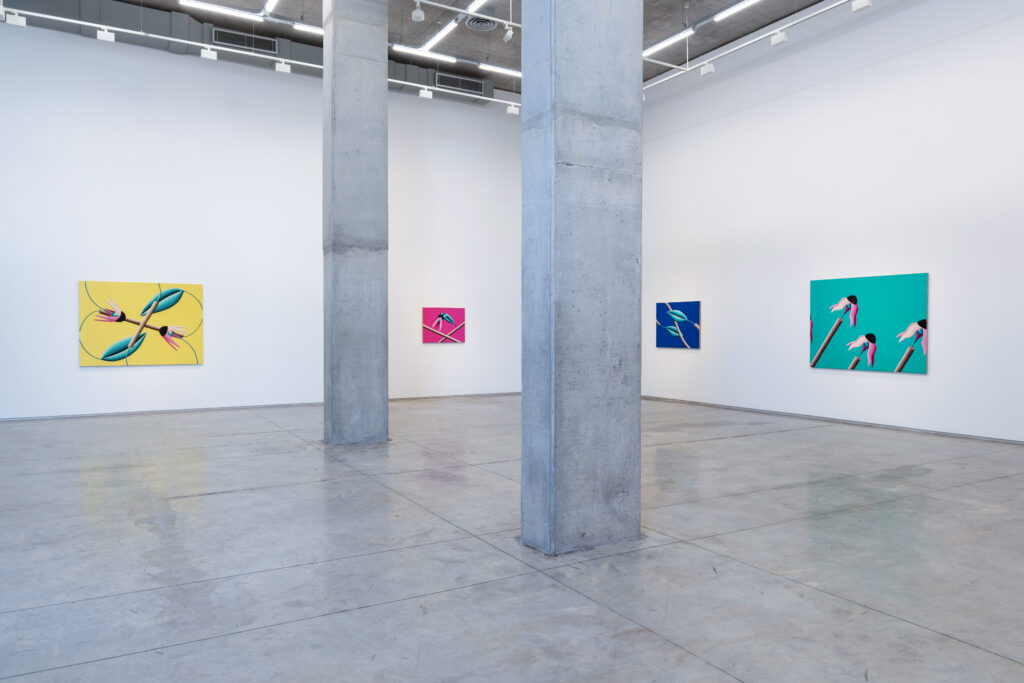
Nadia Ayari, Oblivion Rains: Notations of Gravity, Light, and Resistance, 2026,
Solo exhibition at Selma Feriani Gallery, Tunis. Courtesy of the artist and Selma Feriani Gallery.
Just as vehemently as it insists on being present, place refuses to behave like a label in her works. If Ayari’s native landscape gives her a vocabulary, painting gives that vocabulary a system. Her flowers are neither botanical studies nor decorative references. They are actors, pressure points, bodies by other means. They have become characters in their own right, at once natural, disembodied, and strangely human.
That migration from body to form has been central to Ayari’s evolution. In earlier works such as The Fence (2007) or Right of Return (2008), the image feels more blurred, turbulent, and explicitly populated. Bodies, eyes, veils, symbols, and politically charged titles occupy the picture with a different kind of immediacy.
But the crucial point is not that the politics disappeared when the figures became less legible. Ayari has said that she initially struggled to reconcile her political commitments with abstraction, and that early protagonists such as the eyeball, finger, and tongue helped open a new mode of making. Later, with figures such as the fig, tree, and blood, she said the symbolism became less precise, partly because she had transferred political weight “onto its supporting structures,” as she once told Jadaliyya.
That sentence may be the key to her practice. Rather than leave the painting, the political simply changes location.
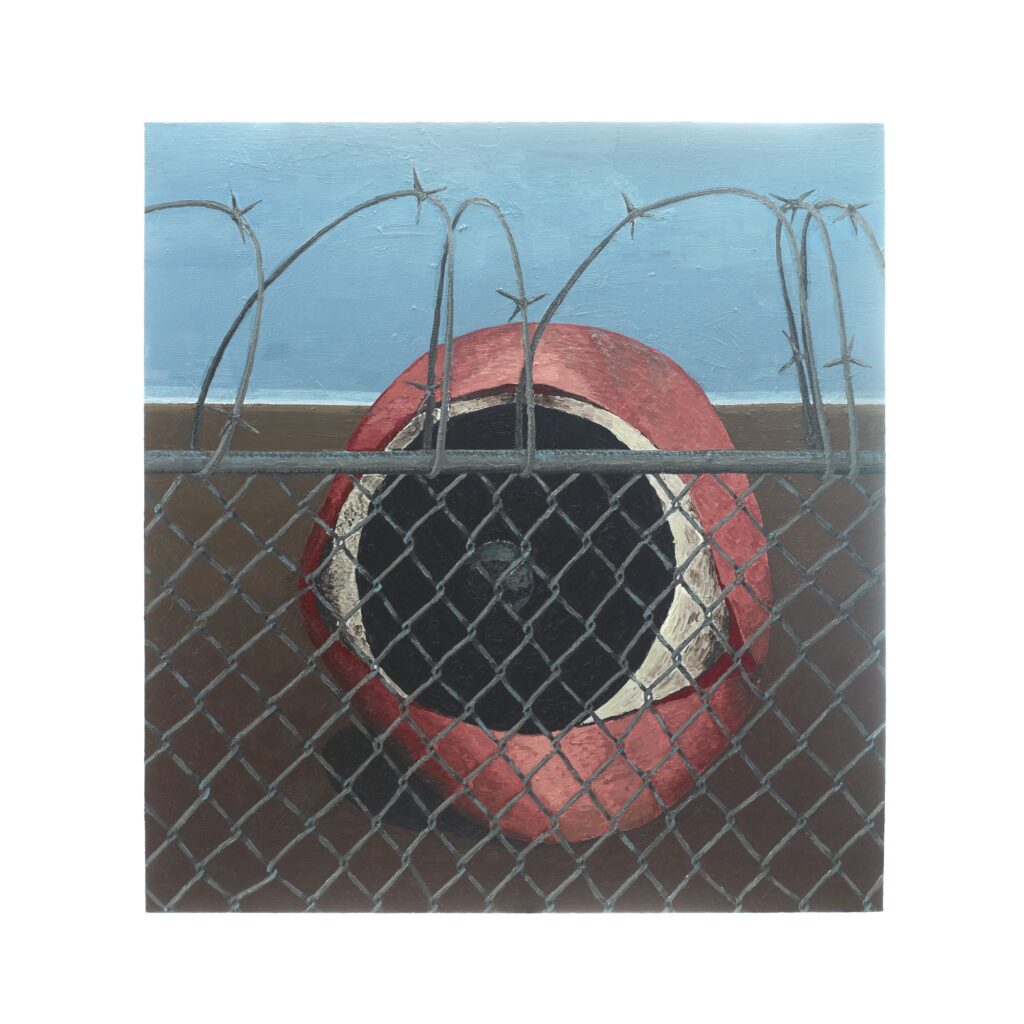
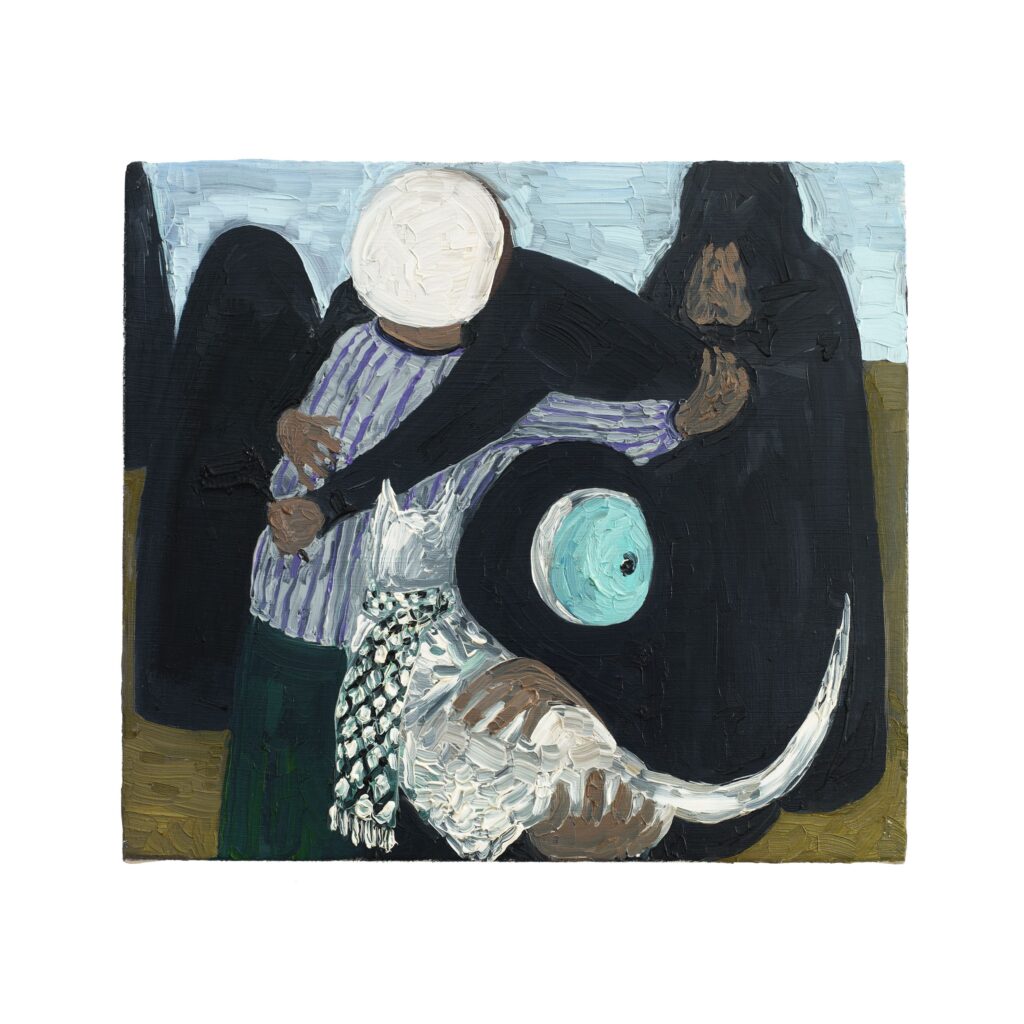
Nadia Ayari, The Fence, 2007, Oil on Canvas, 152.5 x 142.3 cm.
Courtesy of the artist and Barjeel Art Foundation.
Nadia Ayari, Right of Return, 2008, Oil on Canvas, 35.5 x 40.5 cm.
Courtesy of the artist and Barjeel Art Foundation.
In other words, Ayari’s work does not move from politics to flowers, but from scene to symbol to syntax. A crowd becomes repetition. A fence becomes loop, wire, stem, structure. A body becomes surface. A wound becomes pressure. The figure disappears, but the pressure remains.
In Balcony (2011), the plant world is still lush, crowded, and almost excessive. The fig tree bends under the weight of its own ripeness; fruit swells against branch, impasto thickens into sculptural flesh, and nature feels fertile but overburdened. Already more than fruit, the fig still belongs to a dense organic world.
Later, that world begins to harden. Metallic lines start circling through the paintings like hostile armatures, closer to wire than vine. Flowers grow where spikes might have been, asserting themselves against the very structures that threaten to contain them – wars, political turmoil, and climate change. Nature is under pressure. And the flower does not soften the wires, but survives them.
Ayari’s process reinforces this tension. Her paintings are made through slow, layered, methodical applications of oil paint, giving the protagonists and the spaces they occupy what many have called “substantial skin”. In a 2026 text, the artist’s process is described through her own phrase: “building the skin with brushes.” The significance of this phrase is in the paintings’ bodily quality. The skin of the flower, the skin of the field, and the skin of the painting begin to merge.
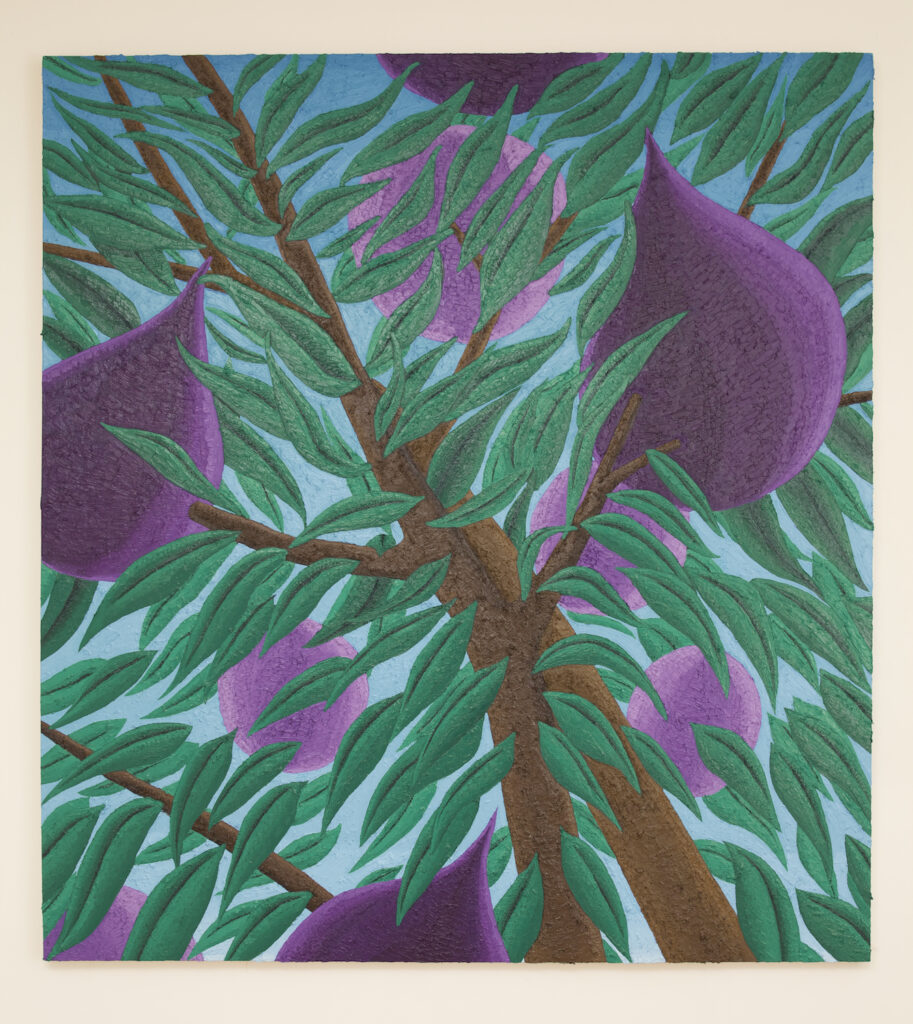
Nadia Ayari, Balcony, 2011, Oil on Canvas, 208.3 x 190.5 cm.
Courtesy of the artist and Barjeel Art Foundation.
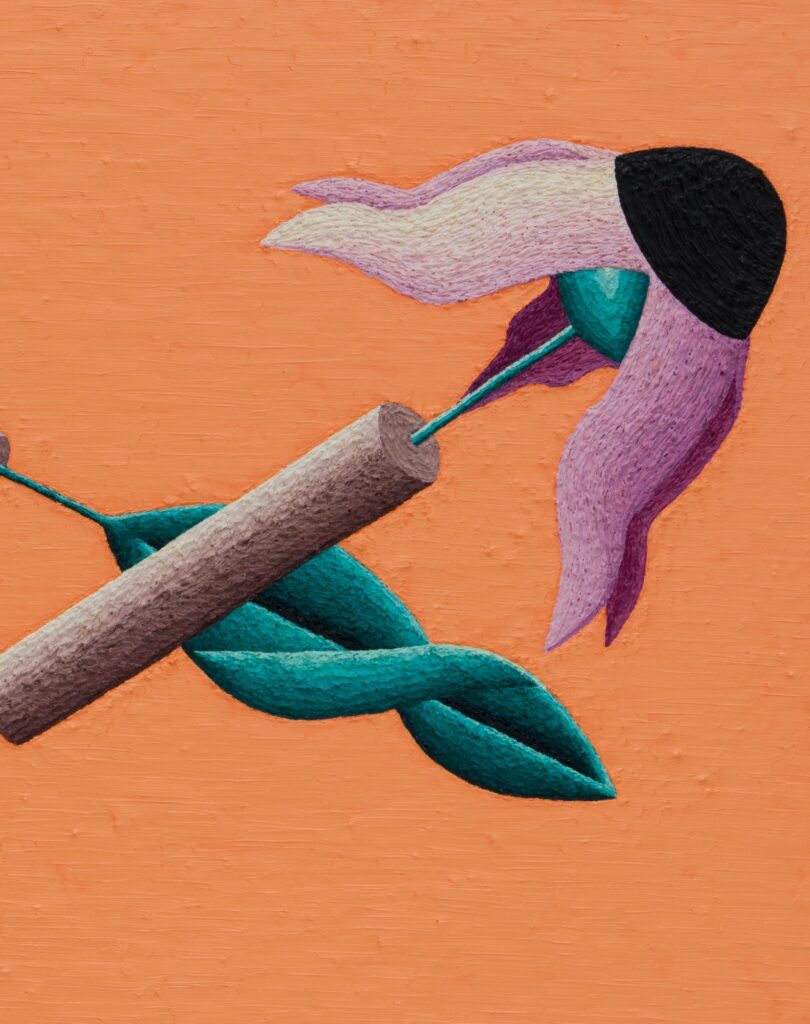
Nadia Ayari, Drift I (detail), 2025, Oil on Linen, 88.9 x 118.1 cm.
Courtesy of the artist and Selam Feriani Gallery.
By About Surrender, Ayari’s 2024 exhibition, the question becomes what this skin can withstand. Here is where resistance learns to bend. The title signals not defeat but a shift in her ways: Ayari’s paintings resisted her usual process, forcing each work to be approached on its own terms. Repetition loosened. Gravity entered. Petals turned downward, and surrender became less an ending than another way of continuing.
Gravity returns, more forcefully, in Oblivion Rains: Notations of Gravity, Light, and Resistance, Ayari’s 2026 solo exhibition at Selma Feriani Gallery – and her first in her hometown of Tunis. While About Surrender introduced the necessity of yielding, Oblivion Rains asks what happens after surrender has been absorbed into the work. The answer is resistance with a different posture.
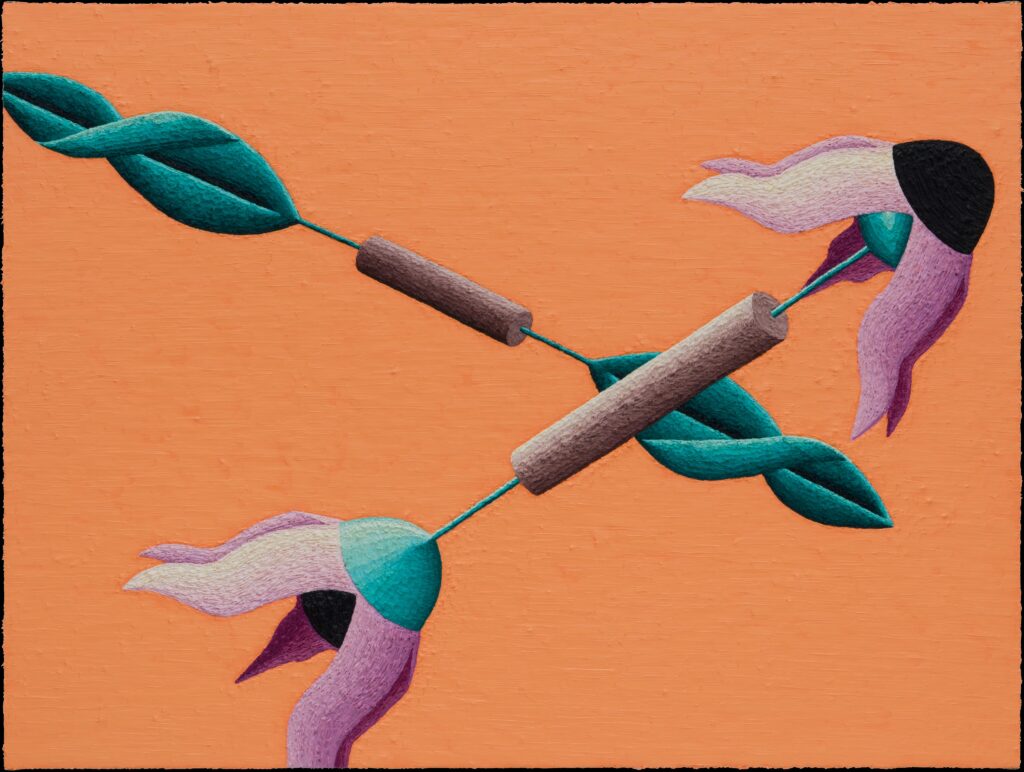
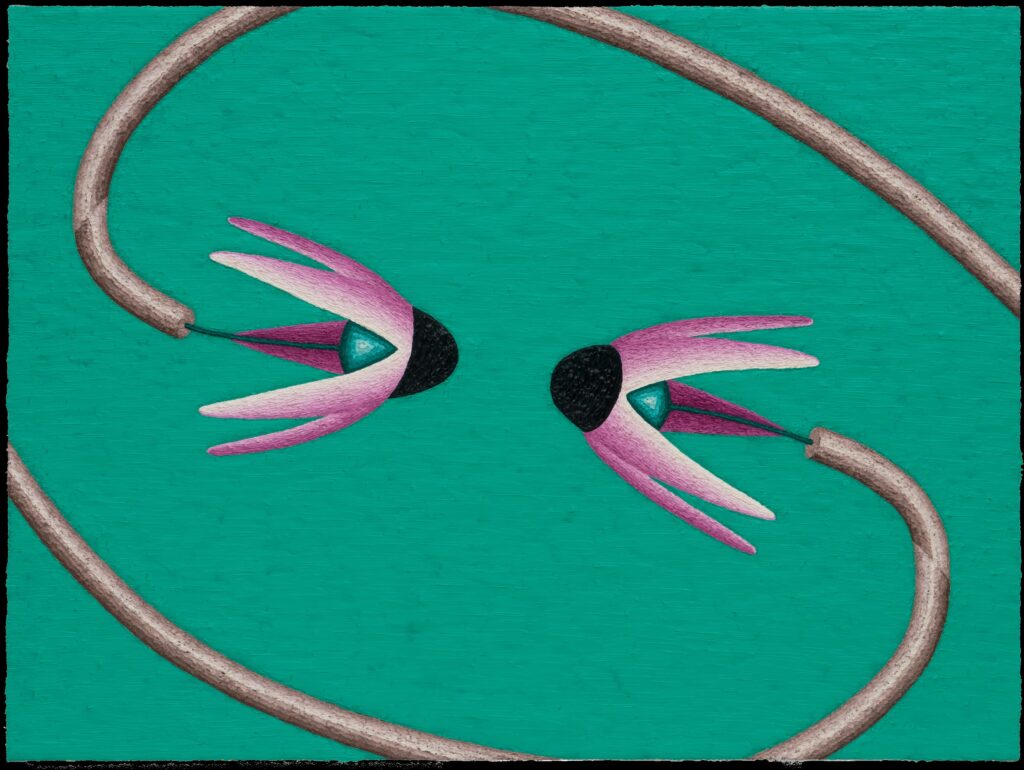
Nadia Ayari, Drift I, 2025, Oil on Linen, 88.9 x 118.1 cm.
Courtesy of the artist and Selam Feriani Gallery.
Nadia Ayari, Facing I, 2024, Oil on Linen, 88.9 x 119.4 cm.
Courtesy of the artist and Selam Feriani Gallery.
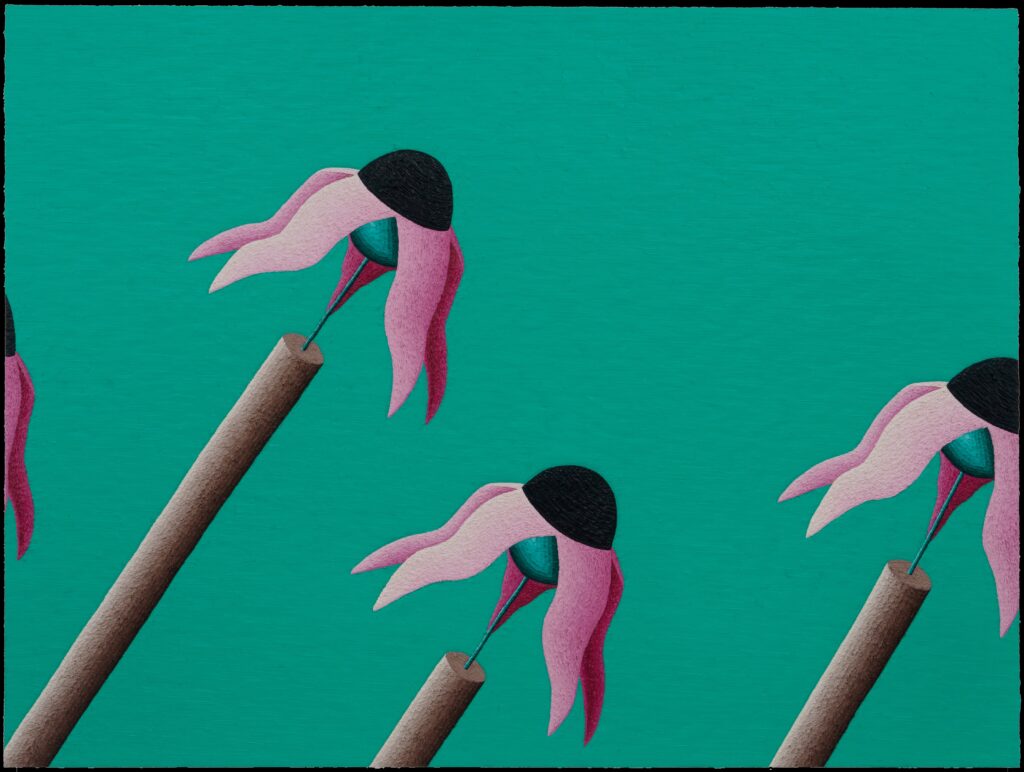
In her latest works, Ayari’s botanical protagonists are cleaner, sharper, more isolated, and more choreographed than in earlier botanical paintings. They do not grow in a landscape so much as act within a field of force. In Facing (2024), two forms confront one another in a scene that feels less like a floral encounter than a negotiation. In Teeth II (2025), the flower acquires bite; petal and weapon become difficult to separate. In Oblivion I (2025), a heated yellow atmosphere turns suspension into pressure, as if the forms are held between falling and refusing to fall. In Together (2025), connection is not simple tenderness, but dependence, tension, and circulation – effectively, survival as relation.
This is where Ayari’s work becomes most compelling. Resilience is enacted rather than illustrated. It happens through motion, contact, repetition, pressure, and skin. The human figure has migrated into the stem, the branch, the leaf, the painted surface, the act of holding together under pressure. In Ayari’s paintings, nature is nurtured by force. What survives is not innocence, but form.
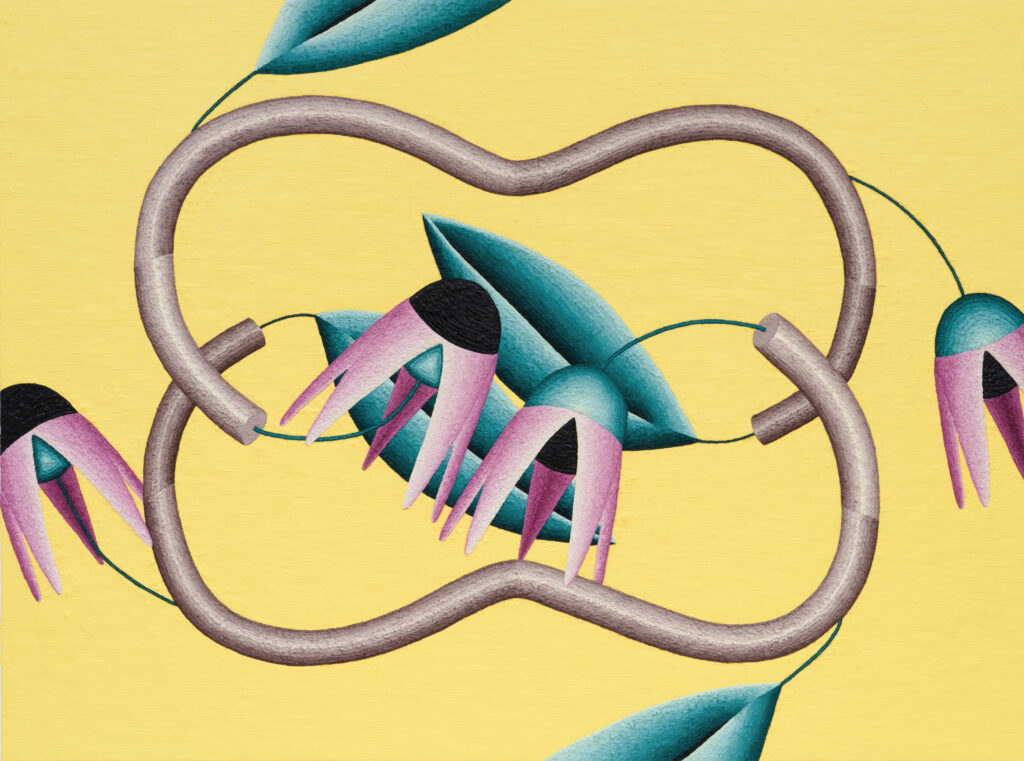
Nadia Ayari, Together, 2025, Oil on Linen, 139.7 x 187.96 cm.
Courtesy of the artist and Selam Feriani Gallery.
Nadia Ayari, Teeth II, 2025, Oil on Linen, 137.2 x 182.9 cm.
Courtesy of the artist and Selam Feriani Gallery.