
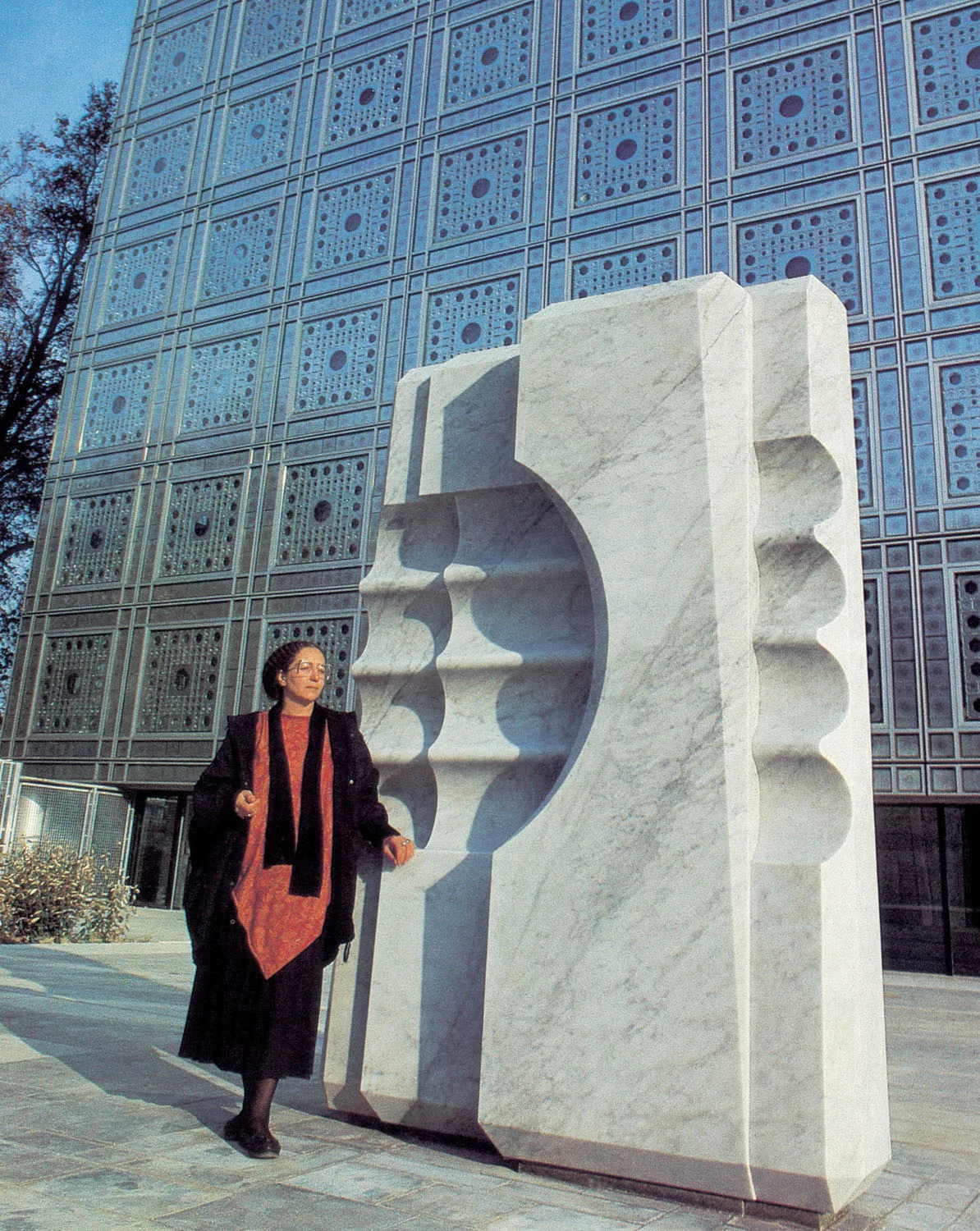
Portrait of artist and her work Geometry of the Spirit (1987) in front of the IMA. Courtesy of Mona Saudi Foundation.
Some artists inherit their medium. Mona Saudi chose hers with defiance. Born in Amman in 1945, she grew up in a traditional Jordanian household, her ambitions constrained by conservatism, rather carved in stone. Yet she would spend her childhood wandering the ruins of the ancient Nymphaeum, grazing the worn surfaces of Roman columns, and imagining how stone could hold meaning across millennia. “My first feelings were toward being earthy,” she said in an Aramco World interview in 2010. And the earth, quite literally, shaped her destiny.
At the young age of 17, forbidden by her father from studying at university, Mona resorted to the more radical route. She fled. Her departure from Amman to Beirut would coincide with the golden age of Arab culture and creativity in the 1960s. Between Hamra’s cafés and living rooms, poets like Adonis and Youssef Al Khal, painters like Paul Guiragossian, and sculptors like Michel Basbous, she found a home for her voice. In turn, this community found in Saudi an artist burning to emerge. With the proceeds from her first small exhibition, she funded her next big bet: a ticket to Paris.
Paris gave her technique, training, and discipline, but never identity. At the École Nationale Supérieure des Beaux-Arts, she carved her first stone sculpture, Mother/Earth (1965), a work that would become her artistic north star. She trained under Atelier Colamarini, studied marble in Carrara, absorbed Brancusi’s forms at the Louvre, and learned the sculptural languages of geometry and purity. Yet she also felt the constraints of European cultural hierarchy. So she left in 1968, not in rejection, but in pursuit of the deeper ground from which her work would grow.
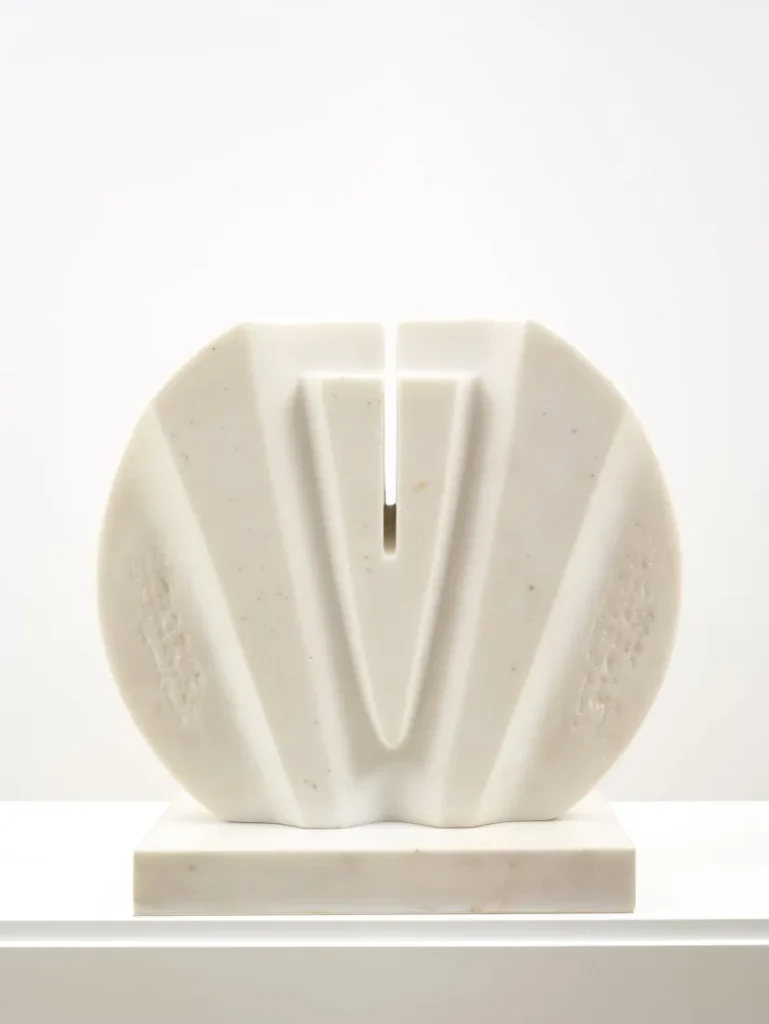
Birth of Beirut, Marble, 48.5 x 50.5 x 25 cm.
Courtesy of Dalloul Art Foundation

The Dawn of Creation, Marble, 48.5 x 46 x 16 cm.
Courtesy of Lawrie Shabibi Gallery.
Back in the Arab world, her artistic, political, and human commitments collided in powerful ways. After the 1967 war, she worked with Palestinian refugee children in the Baqa’a camp, documenting their drawings in In Time of War: Children Testify. The experience marked her profoundly, grounding her in solidarity and in a belief that art must hold witness. Beirut became her anchor once more in 1969, even as the region lurched toward instability.
Her sculptures, meanwhile, took shape slowly, deliberately, through a devotion to stone unrivaled in the region. She worked almost exclusively with her hands, carving stones from all over her world map: Jordanian jade, Syrian diorite, Lebanese marble, Yemeni alabaster, Carrara white. As expansive as her stones were Saudi’s references, from Nabataean curves to Ammonite spirals, Etruscan silhouettes to Greek balance and Aztec strength. She belonged simultaneously to all and none of these traditions, sculpting a language of origin that predated borders and belonged to earth, and earth only.
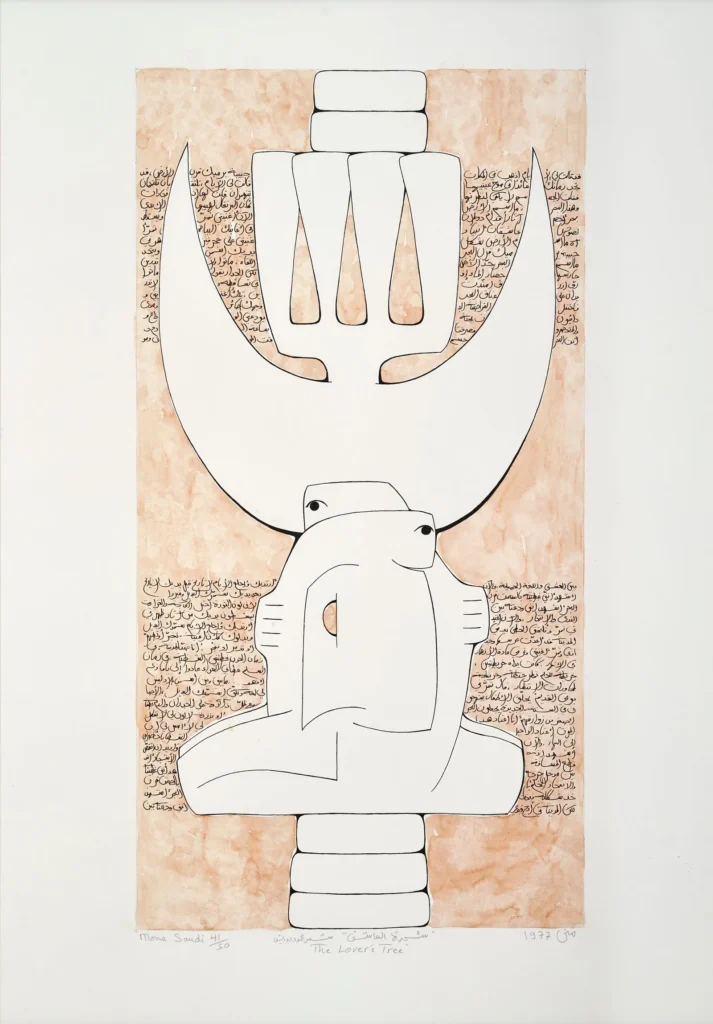
Homage to Mahmoud Darwish: The Lover’s Tree, 1977, Silkscreen and Watercolor on Paper, 82.5 x 43 cm.
Courtesy of Dalloul Art Foundation.
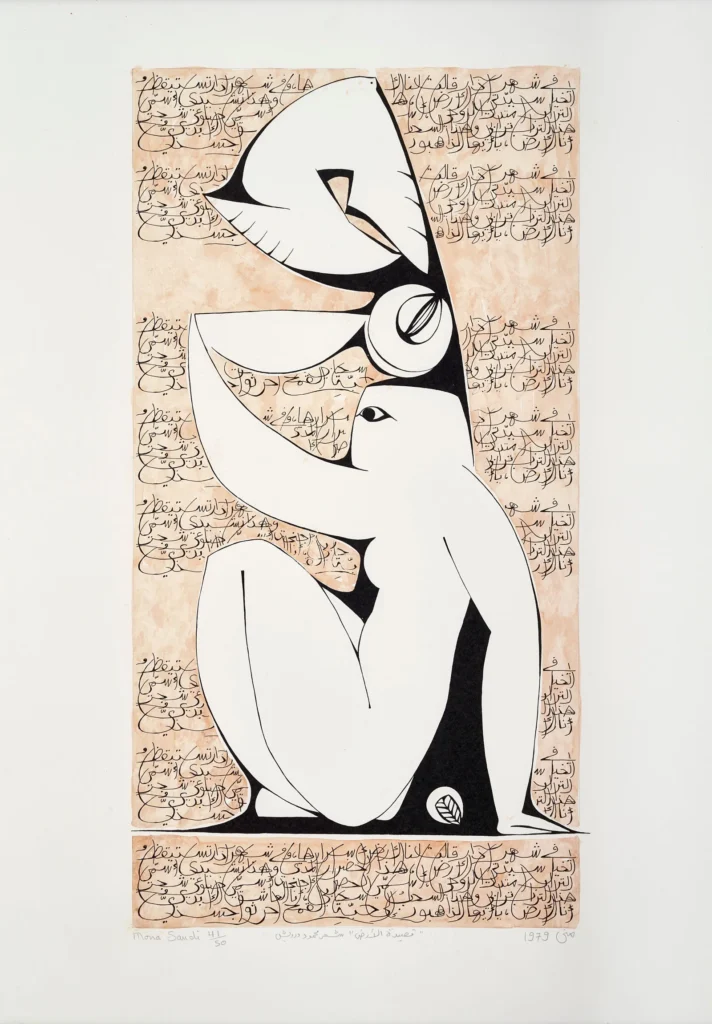
Homage to Mahmoud Darwish: Poem of the Sand, 1979, Silkscreen and Watercolor on Paper, 82.5 x 43 cm.
Courtesy of Dalloul Art Foundation.
Her global recognition followed quietly but steadily. A monumental granite sculpture, Geometry of the Spirit, was installed outside the Institut du Monde Arabe in Paris in 1987. It is the only artwork permitted in the public space of architect Jean Nouvel’s building. Major institutions that have collected Saudi’s work include the British Museum, Barjeel Art Foundation, Sharjah Art Foundation, National Gallery of Fine Arts in Amman, National Museum of Women in the Arts, and Guggenheim Abu Dhabi.
Despite this stature, Saudi remained committed to the simple life, devoted to solitude and creation. “My relationships with people are also reductive,” she once told Vogue, as “my work requires me to be alone.” Saudi would sculpt until her final years. She passed away in Beirut in 2022, leaving behind poems, prints, drawings, and sculptures that, like their maker, refuse to let time have the last word.