
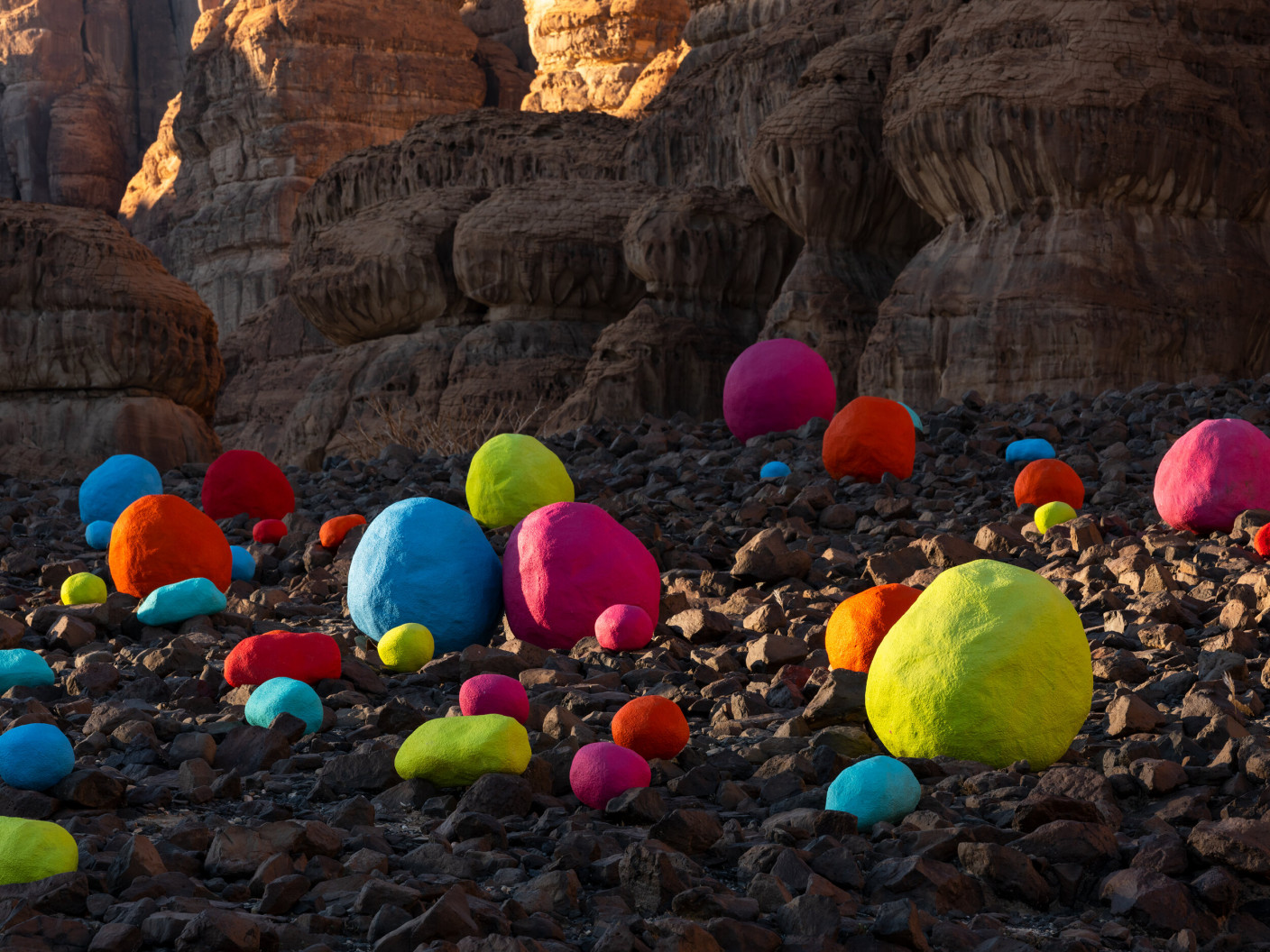
Mohamed Ahmed Ibrahim, Falling Stones Garden, 2020, Desert X AlUla. Courtesy of the artist and Desert X. Photo by Lance Gerber.
Mohamed Ahmed Ibrahim once told Art Basel that “you don’t stop seeing when you close your eyes”. For the Emirati artist, the space between the pupil and the eyelid gives birth to shapes before they are even named. It is a fitting way into his practice, which has always found its place somewhere before language and after landscape. His forms may look like trees, tools, fossils, plants, or ancient signs. The point is that they are never only one thing. They hover and, in that hovering, become his.
Born in Khor Fakkan in 1962, Ibrahim belongs to the UAE’s first generation of contemporary artists, emerging in the late 1980s alongside Hassan Sharif, Abdullah Al Saadi, Hussain Sharif, and Mohammed Kazem – a group that would become central to the country’s experimental and conceptual art scene. But Ibrahim’s trajectory is far from that of an artist leaving a small town to enter the art world.
Rather than the place he outgrew, Khor Fakkan has become Ibrahim’s system through which he views and sees the world. Khor Fakkan is pressure, memory, rhythm, and method. Far from a scenic backdrop. With the Gulf of Oman on one side and the Hajar Mountains on the other, the city’s landscape becomes language in his practice.
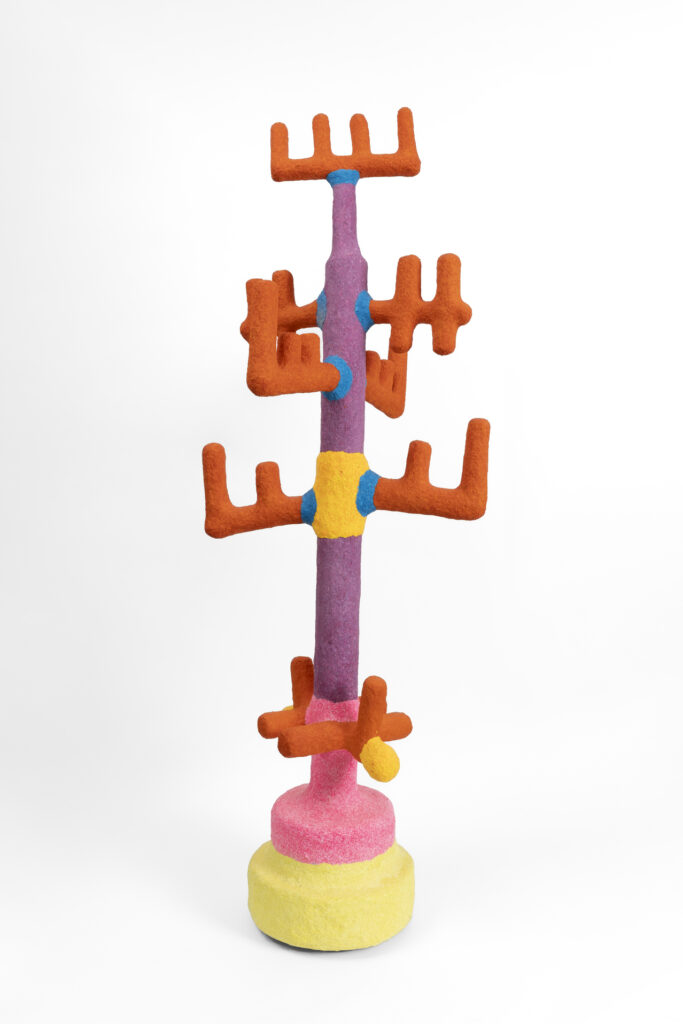
Mohamed Ahmed Ibrahim, Tree, 2024, Paper mâché, glue and cardboard, 188.5 x 66 x 66 cm.
Courtesy of the artist and Lawrie Shabibi.
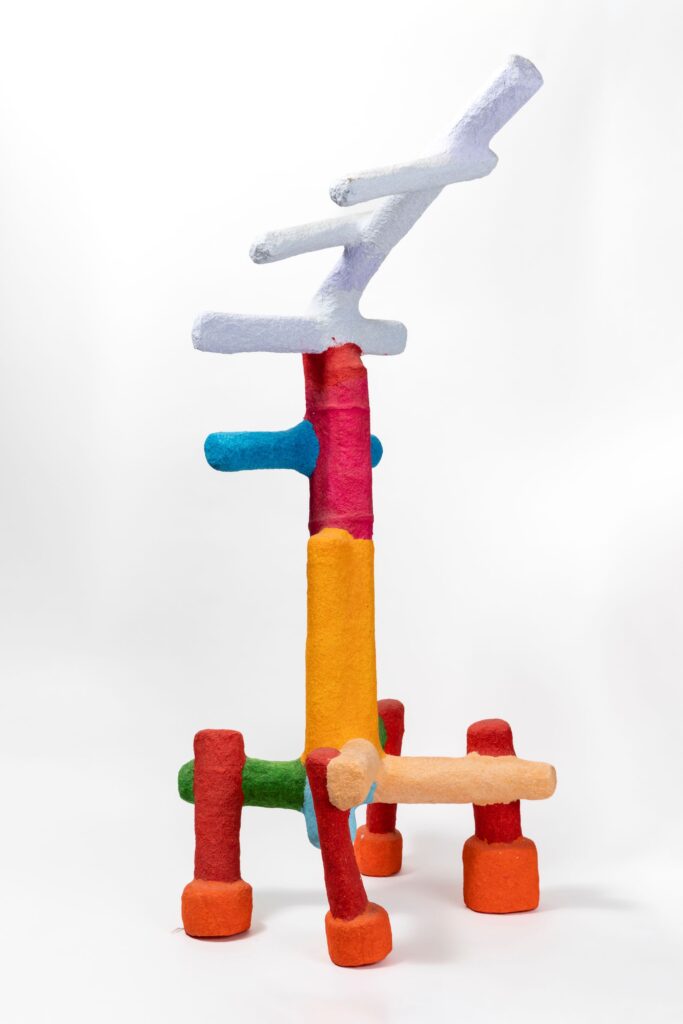
Mohamed Ahmed Ibrahim, Untitled, 2021, Paper mâché, glue and cardboard, 168 x 71.2 x 68 cm.
Courtesy of the artist and Lawrie Shabibi.
That language was built slowly, stubbornly, and often without much structure of infrastructure around it. As a teenager, Ibrahim encountered an image of Picasso’s Guernica in an Arabic newspaper, an experience that shifted his understanding of art away from likeness and beauty toward emotional and conceptual force. He later studied psychology at Al Ain University, a field that would quietly feed his interest in perception, memory, and the inner life of forms. Without formal art education, Ibrahim would spend months translating English and German textbooks sent from abroad. Word by word, he built his vocabulary before developing a visual language that often seems to precede word entirely.
His meeting with Hassan Sharif in the mid-1980s was decisive. Sharif introduced Ibrahim to a wider community of artist, writers, and intellectuals, pulling him into a conversation that effectively defined UAE avant-gardism. But Ibrahim’s path never became derivative of that circle. If his encounter with Sharif opened the door to conceptual experimentation, Ibrahim walked through it carrying stones, leaves, cardboard, soil, symbols, and the private weather of Khor Fakkan.
Scarcity also shaped him. In the 1980s, Ibrahim made his limited access to art materials into a method for improvisation. He would stretch his own canvasses, sometimes used tent fabric, and developed an entire practice around what was readily available. His land art experiments grew out of this same intimacy with place. Days spent camping alone inspired him to create with surrounding natural elements. This ritual persisted in different forms even in his later works, such as Falling Stones Garden for Desert X AlUla in 2020. The work features hundreds of brightly-colored stone-like forms, placed into the landscape without overpowering it.
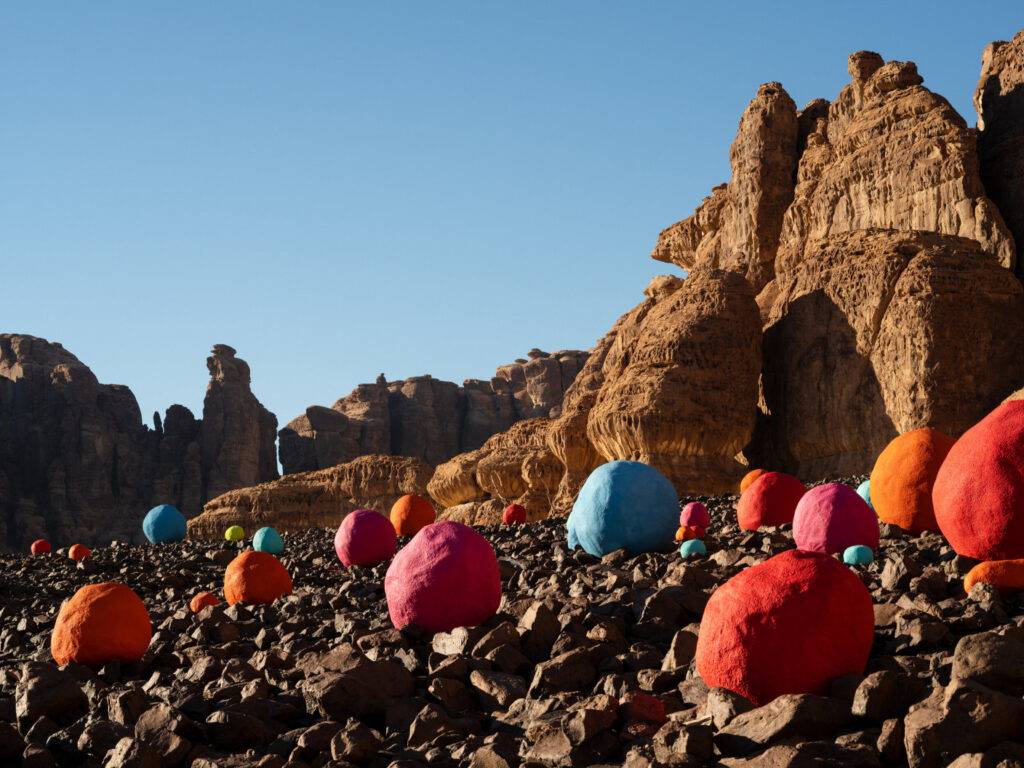
Mohamed Ahmed Ibrahim, Falling Stones Garden, 2020, Desert X AlUla. Courtesy of the artist and Desert X. Photo by Lance Gerber.
One of the most turning points in his artistic journey came in 1999 when, professionally disappointed and emotionally strained, Ibrahim burned a large body of his own earlier work. Hardly a romantic gesture of an artist staging destruction for myth, his was a very human act of exhaustion, frustration, and rupture. And then, almost immediately, of return. Ibrahim resumed creating soon after, finding solace in gardening before drawing again. In his world, even rupture becomes part of the process. Things burn, grow back, repeat, mutate.
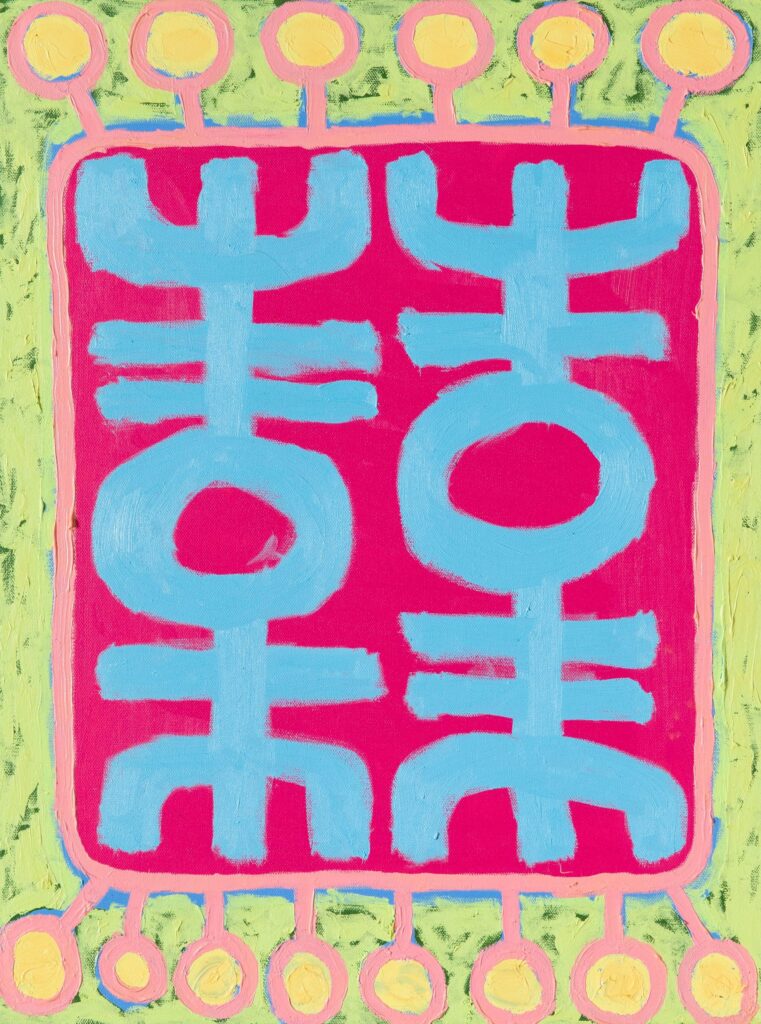
His works on paper often carry this sense of repetition as both discipline and memory. In Flying Carpet, repeated forms gather into a vivid, almost architectural composition. The symbols resemble coded signs suspended in motion, somewhere between ornament, circuitry, and imagined script.
Mountain Peaks + Four Blue Clouds pushes this language even further. Here, Ibrahim transforms landscape into a dense field of glyph-like marks and cluster forms that feel part map, part memory system.
This visual language reached monumental scale in Between Sunrise and Sunset, Ibrahim’s presentation for the UAE National Pavillion at the 2022 Venice Biennale. Composed of 128 biomorphic structural elements, the installation transformed the pavilion into an immersive field of shifting color and movement, inspired by the changing light of Khor Fakkan. Whether these forms are plants, coral, bodies, or even cities is a question Ibrahim leaves deliberately unresolved. And the answer seems to change depending on where one stands.
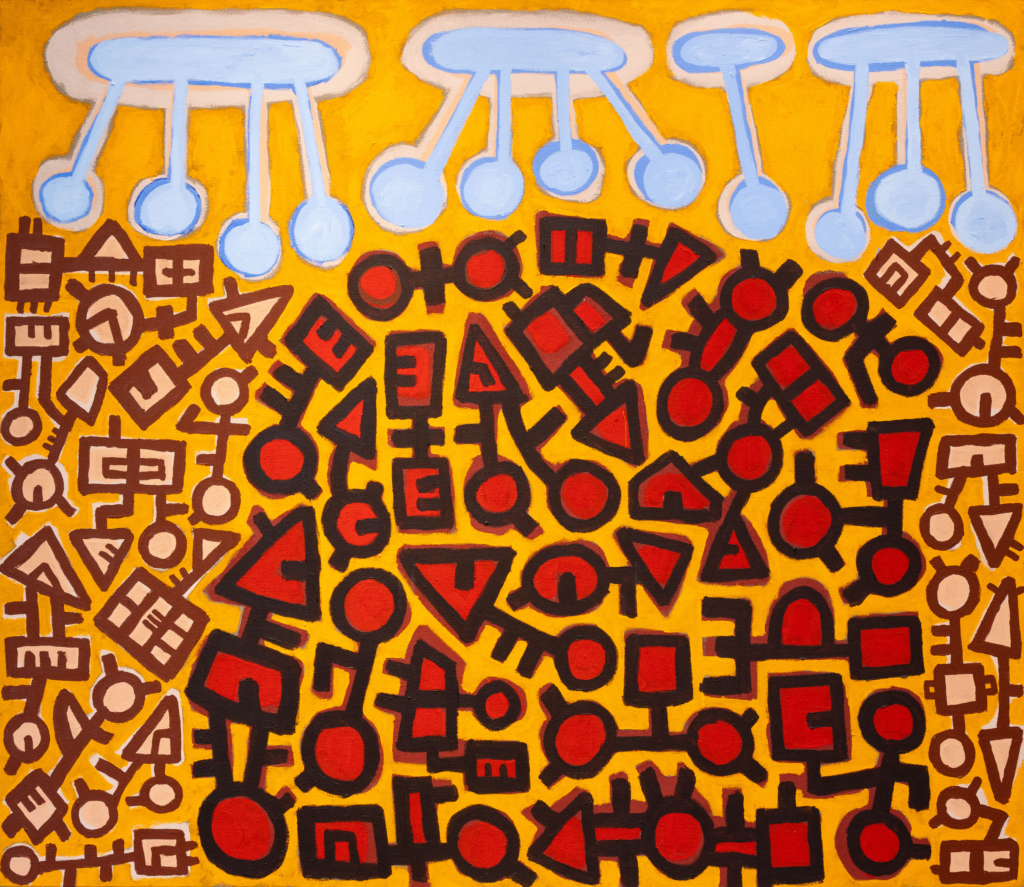
Mohamed Ahmed Ibrahim, Mountain’s Peak + Four Blue Clouds, 2024, Acrylic on canvas, 160 x 185 cm.
Courtesy of the artist and Lawrie Shabibi.
Mohamed Ahmed Ibrahim, Flying Carpet 10, 2023 Oil on canvas, 61 x 46 x 1.8 cm.
Courtesy of the artist and Lawrie Shabibi.
This openness is not to be mistaken for vagueness. Ibrahim has repeatedly spoken of wanting viewers to interpret his work freely, with children often offering the readings he found most interesting. It is perhaps why his work, serious as it is, never becomes severe. Rooted in conceptual practice, psychology, and material experiment, it also protects something rare: wonder.
Over the decades, Ibrahim’s work was featured across major exhibitions and institutions – from the Venice Biennale, Sharjah Biennial, Havana Biennial, and Cairo International Biennial, to Elements at Sharjah Art Foundation (2018), Between Sunrise and Sunset at the Maraya Art Center (2025), and Two Clouds in the Night Sky at the Cultural Foundation in Abu Dhabi (2025). His work is held in collections such as the Solomon R. Guggenheim Museum, Centre Pompidou, Sharjah Art Foundation, Art Jameel, and Barjeel Art Foundation.
And yet despite all this movement, the center remains Khor Fakkan. Ibrahim may belong to the UAE’s conceptual vanguard, but his work does not behave like theory first. It behaves like something grown, collected, burned, planted, and remembered. In a world increasingly obsessed with clarity, he continues to leave space for ambiguity, wonder, and the possibility that some things are better felt before they are understood.
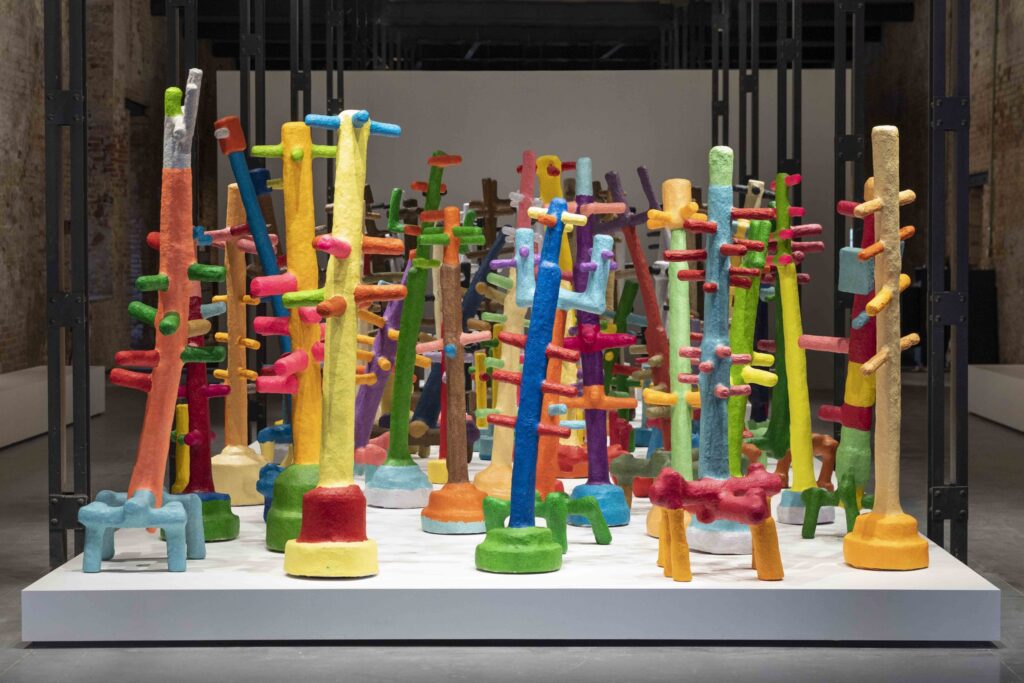
Mohamed Ahmed Ibrahim, Between Sunrise and Sunset, 2022. Courtesy of UAE National Pavilion at the Venice Biennale.