
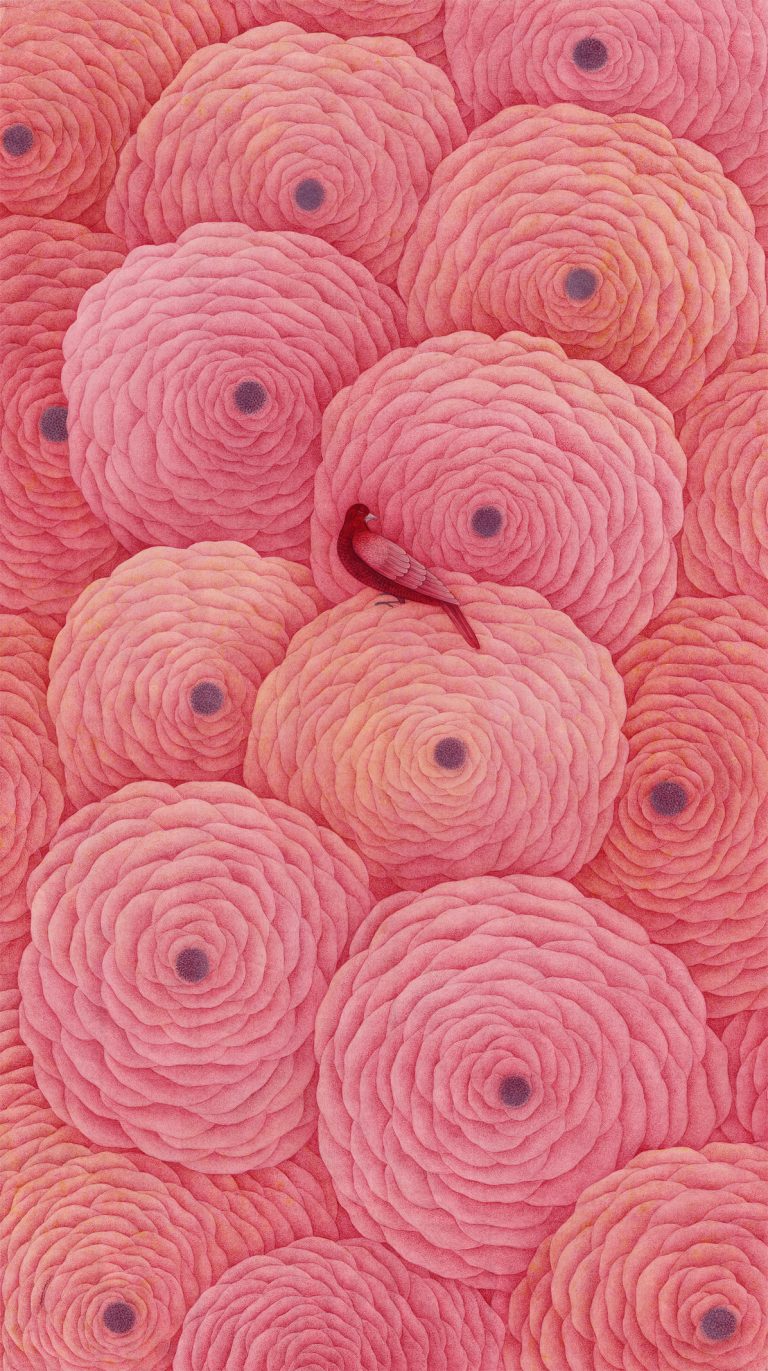
Maryam Lamei Harvani remembers being born on “a cold winter day” in northwestern Iran, near the border with Azerbaijan. But her childhood would soon be filled with color and motion. After her family moved to the city, Lamei left behind the red flowers, the Aras River, the ‘Moqan jungle’, and the branches shifting in the wind. An apple tree in her family’s new yard would become the only reminder of that vivid past. She would climb the tree to study, absorb the sunlight with her eyes closed, and sway with the branches. Her father, a plant specialist, taught her well enough she could identify plants by smell alone. Seeing a tree today, she told Sandytimes, feels like meeting “very old friends” again.
It makes sense, then, that at thirteen, Lamei’s mother took her to study Gol-o-Morgh, the Persian flower-and-bird tradition, with art teacher Seyed Reza Najafi. Hardly the model student by her own admission, Lamei eventually decided to prove herself to her persistent mentor; she had learned something, and she had a roughly one-and-half-meter-long colored pencil drawing to show for it. This act of defiance marked an unlikely beginning.
In the Gol-o-Morgh tradition Lamei inherited, the bird is the lover and the flower, the beloved. The pairing is deeply rooted in Persian literature and visual culture, where rose and nightingale have long carried earthly and mystical significance, and often, the soul’s quest to unite with the divine. Lamei describes the technique she learned as built from thousands of dots and fine marks, with spiritual discipline in the very heart of making. She later trained in miniature painting (Negargari) under one of the art’s most prominent masters, Mohammad Baqer Aqamiri. Her mature work is interesting precisely because she learned that language thoroughly enough to change it to taste.
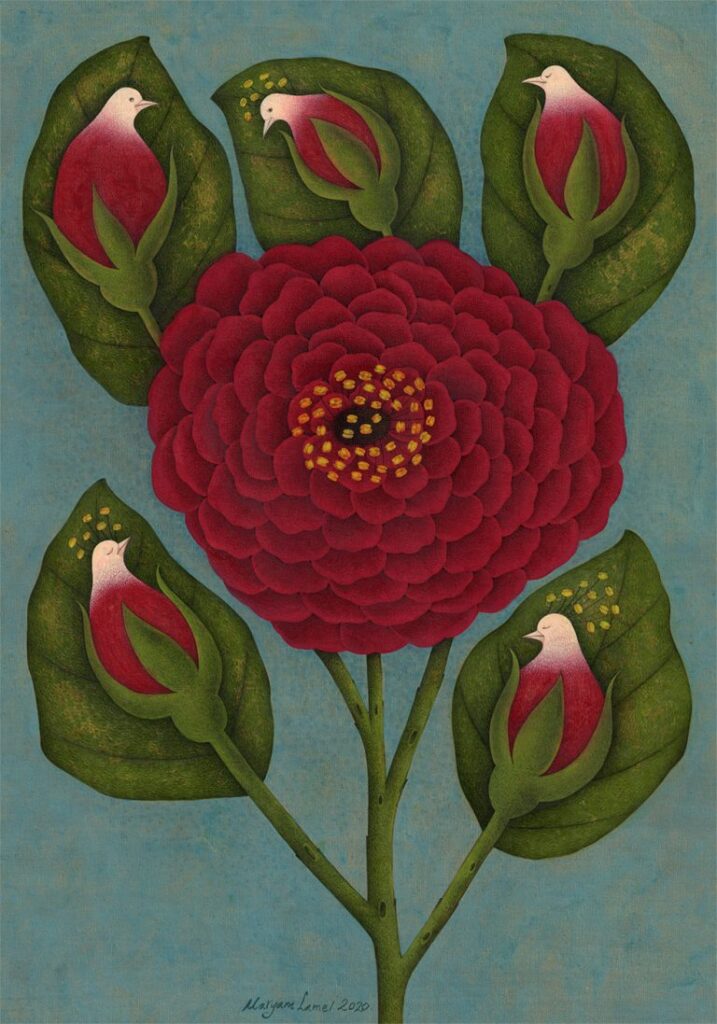
Maryam Lamei, The Lover Makes Love, 2020, 120 x 85 cm, Acrylic on Canvas.
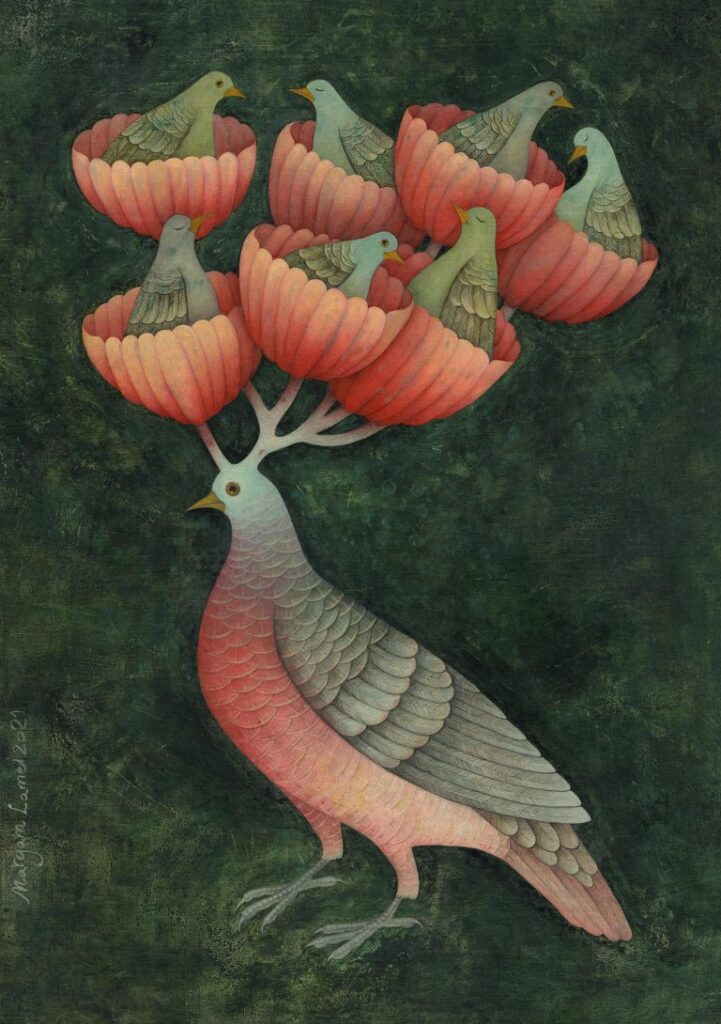
Maryam Lamei, I’m Talking to Thousands of my Nightingales, 2021, 120 x 85 cm, Acrylic on Canvas.
“I open it up, wound it, breathe life into it,” Lamei has said of the miniature tradition. Years of technical discipline eventually gave way for both control and permission to disobey. About a decade ago, the artist identifies a turning point when she stopped following tried and tested approaches and recognized a language as her own, one that would redefine the traditional roles and features of her birds and flowers. Lovers cannot always touch. Eyes close. Bodies double, fuse, mirror and multiply. Narratives unravel as fragments and pauses. Lamei had created her own expansive syntax out of a narrow vocabulary.
This is visible in The Lover Makes Love (2020), where lover and beloved fuse into a single botanical body, with birds and buds seemingly sharing the same organism. In I’m Talking to Thousands of My Nightingales (2021), a private conversation with a multitude, plurality itself becomes intimate. Elsewhere, You and Me Seem to Have to Be One (2024) turns union into a proposition rather than a happy ending, while Me and Another Me turns the visual logic inward. Love moves from you to me to us, to another me.
This linguistic distinction speaks to Lamei’s unusual attentiveness to character. Her affection for Russian novelist and philosopher Dostoevsky initially seems far removed from flower-and-bird painting, until she explains what she loves in his final masterpiece, The Brothers Karamazov: the way psychological detail makes a character feel alive. So absorbed was she that Lamei stopped halfway through and began the book again. She gives her birds a similar insistence on particularity. Some sleep. Others stare. A few have no eyes at all. Lamei considers these choices a form of “body language” and describes the eye as a window to the soul. A centuries-old symbolic “bird” becomes, in her hands, a cast of individuals.
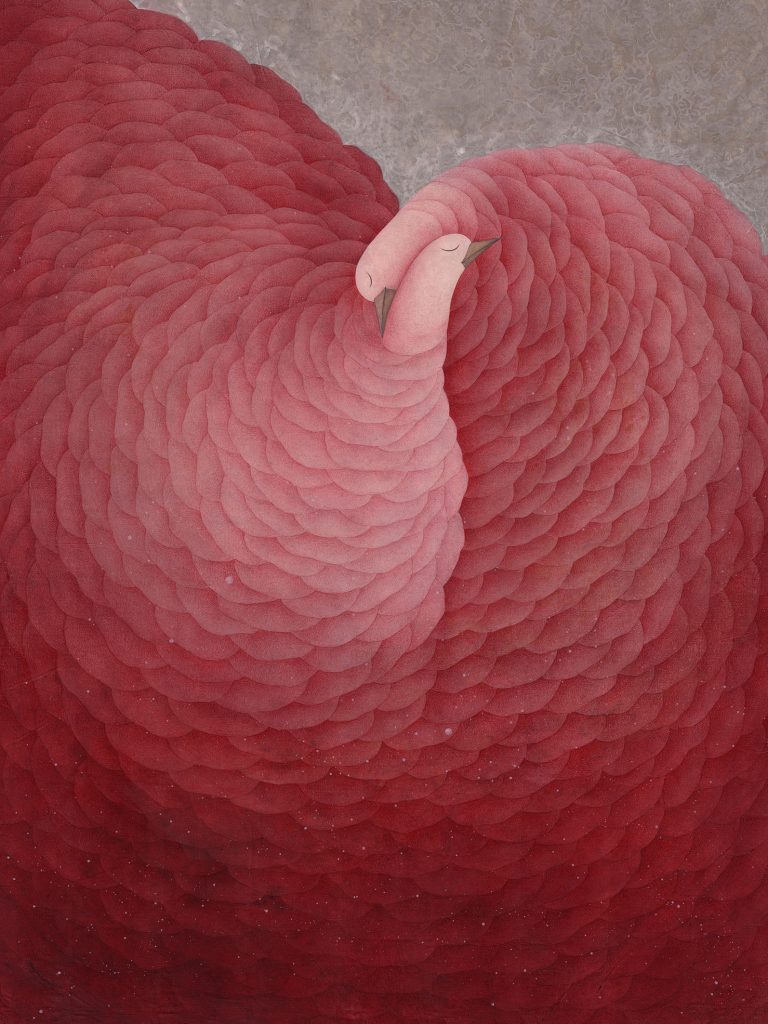
Maryam Lamei, You and Me Seem to Have to Be One, 2024, 200 x 150 cm, Acrylic on Canvas.
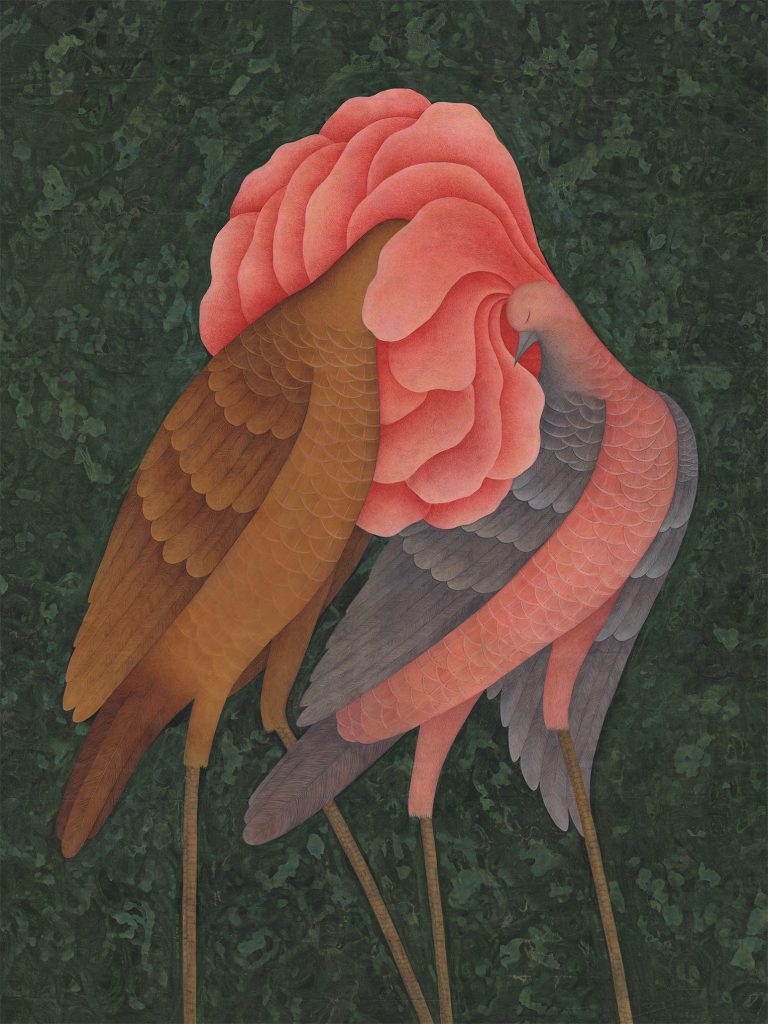
Maryam Lamei, The Smell of Your Hug, 2023, 200 x 150 cm, Acrylic on Canvas.
By 2023, closeness and separation are pulling against each other with particular force. In The Smell of Your Hug (2023), two birds fold their long bodies toward one another beneath a fleshy crown of petals. Inevitably Parallel (2023), from the same year, is much cooler. Two elongated forms rise side by side against a blue field. They are visually paired, held apart by a narrow interval, yet moving in the same direction. Lamei creates intimacy out of contact and distance with the same poignancy.
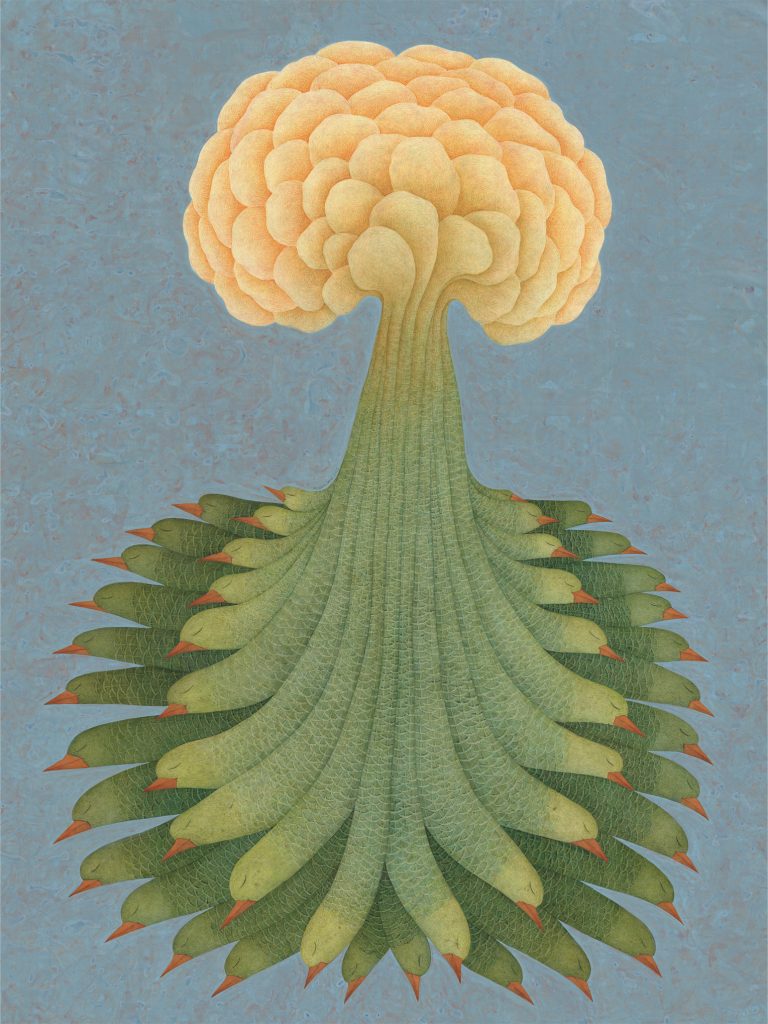
Flight introduces another dimension. In A Bud Full of Flight (2024), a flower-like pod opens to reveal small pale birds nested inside, reversing expectation; blooming and departure occupy the same body, and flight is already packed within the bud. A year later, I Am not the Only One in Love with You (2025) distributes desire across a whole structure, with bird forms arranged around a towering bloom. The title refuses the fantasy of singular possession. The beloved has a flock.
From the sentiment Lamei’s birds and flowers evoke, it would be easy to assume that hers is a serene process. But Lamei’s account of making is rougher than the finished work suggest. She says she creates most easily under emotional pressure, when life is difficult or painful.
She is equally more concerned with images that refuse to arrive. Sometimes an image stays in her mind for years because, as she puts it, it is “not yet ready to be born.” She will not force it.
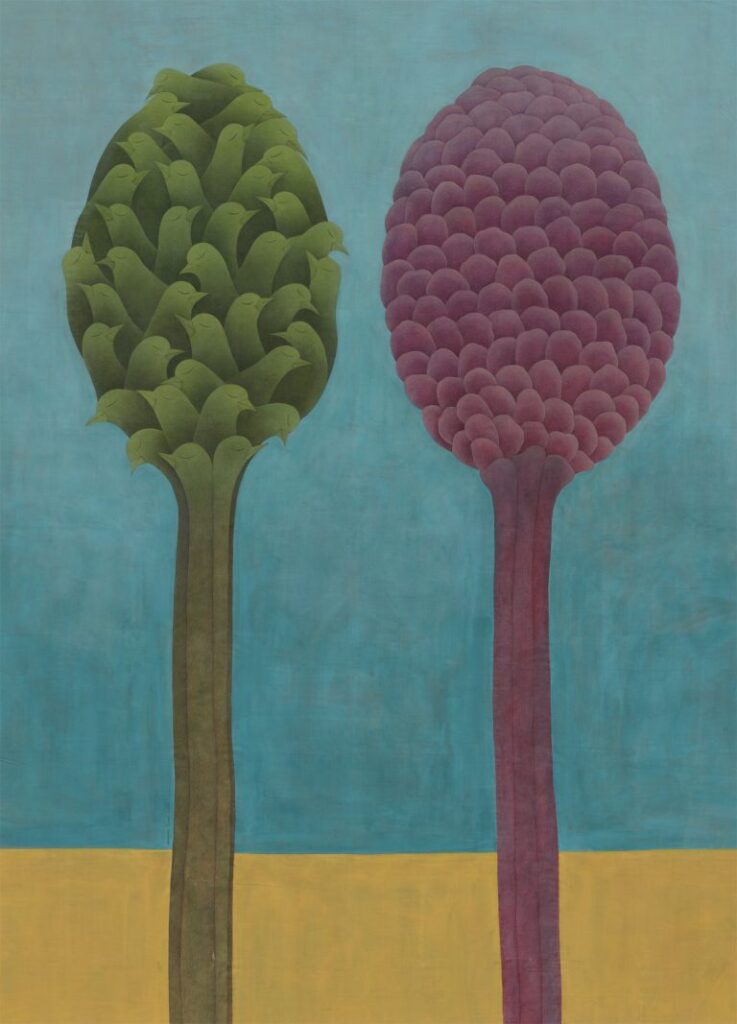
Maryam Lamei, Inevitably Parallel, 2023, 250 x 180 cm, Acrylic on Canvas.
Maryam Lamei, I Am Not The Only One In Love With You, 2025, 200 x 150 cm, Acrylic on Canvas.
“Sometimes what I leave unpainted carries more weight than what I render,” she says. That makes The Emptiness of You (2026) feel less like a romantic lament than part of a larger philosophy of absence. In the painting, a solitary pale bird sits within a dense blue field. Emptiness has accumulated around a body.
Here, the discipline of miniature painting and the surrender of her current process meet. Lamei works with limited palettes, often three or four colors, yet says she does not decide them in advance. One color leads to the next. She has spoken about allowing the painting to interrupt her and abandoning the pursuit of perfection. Her freedom is built on years of precision. Even silence, for her, is compositional. She protects solitude, listens to wind and footsteps, sometimes sings simply to hear emotion without an image. The artist who once had to prove she could execute a monumental drawing now seems most interested in knowing when not to insist.
Perhaps that is because love, a subject Lamei claims she could spend a lifetime exploring, both contains and anchors all of her paintings. Beyond her work, she continues to study love across Rumi, Freud, and Erich Fromm. Critic Yahia Lababidi has described her as “braiding her explorations of love on the physical plane with devotion on a higher plane.”
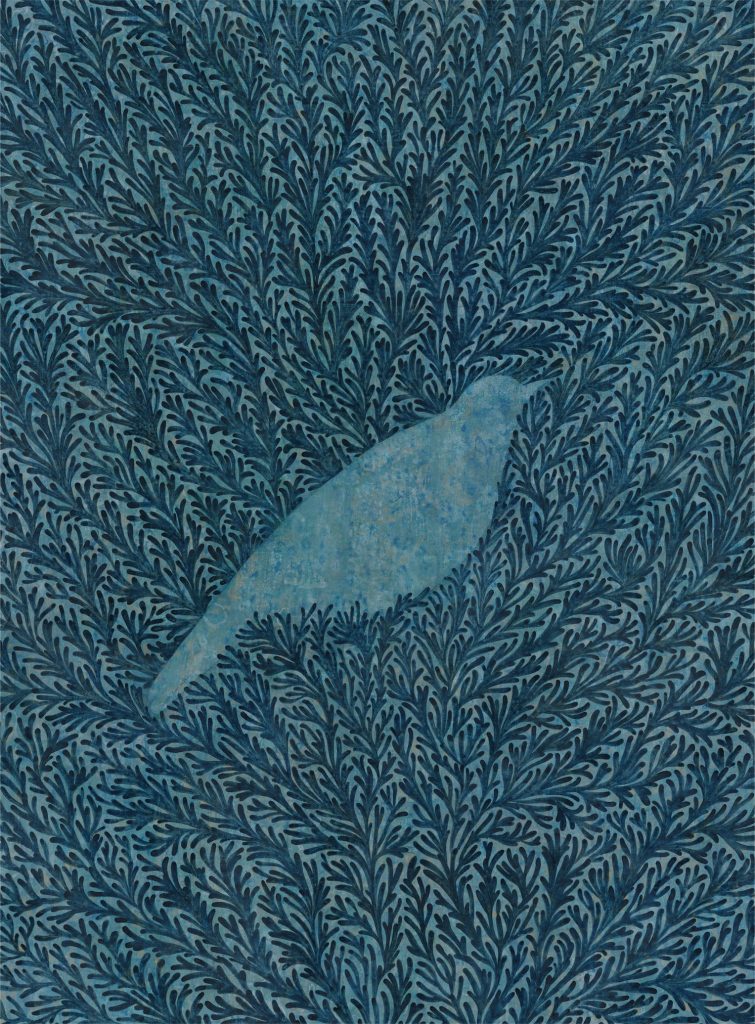
Maryam Lamei, The Emptiness of You, 2026, 190 x 140 cm, Acrylic on Canvas.
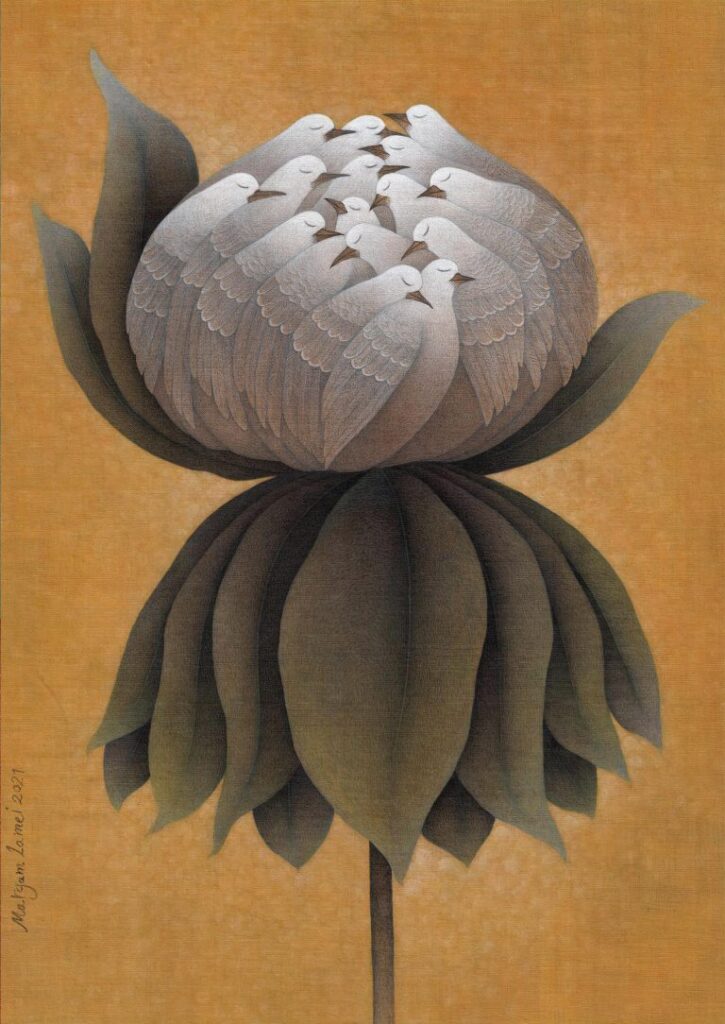
Maryam Lamei, Birds Are Gathered in God, 2021, 85 x 60 cm, Acrylic on Canvas.
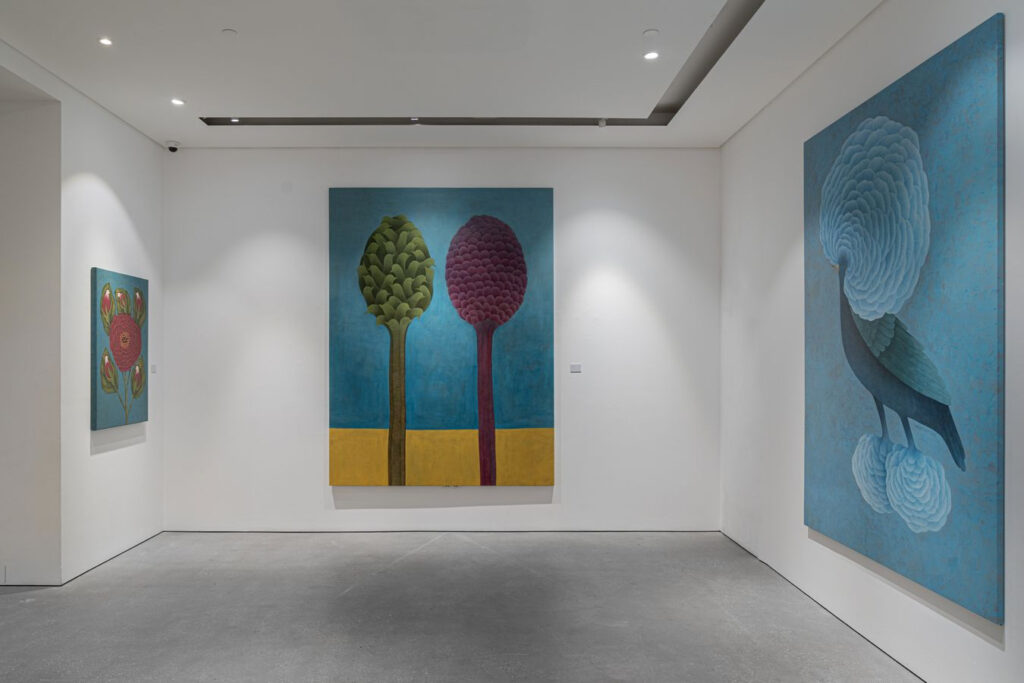
Lamei herself keeps the spiritual and worldly in circulation. In her 2024 Dubai solo exhibition Symphony of Birds, bird-and-flower symbolism expanded toward justice, peace, freedom, and ethical salvation as well as divine longing. Love becomes a way of asking how one being relates to another.
It is perhaps why Birds Are Gathered in God (2021) feels so central. Individual birds fold into a larger floral body until the distinction between one creature and many – and between lover and beloved – becomes difficult to hold.
Lababidi has similarly observed how avian and botanical forms exchange properties in Lamei work. The effect brings us back to the child in the apple tree, before flower and bird had fixed symbolic assignments, when the natural world was first encountered through smell, touch, light, and movement.
For Lamei, the essence of life comes down to loving. Her paintings make that sentence more complicated than it sounds. Love can look like convergence, parallelism, self-division, a bud crowded with possible departures, or an absence dense enough to paint. Ancient tradition gave her the bird and the flower. Everything that passes between them now is hers, in her tense.
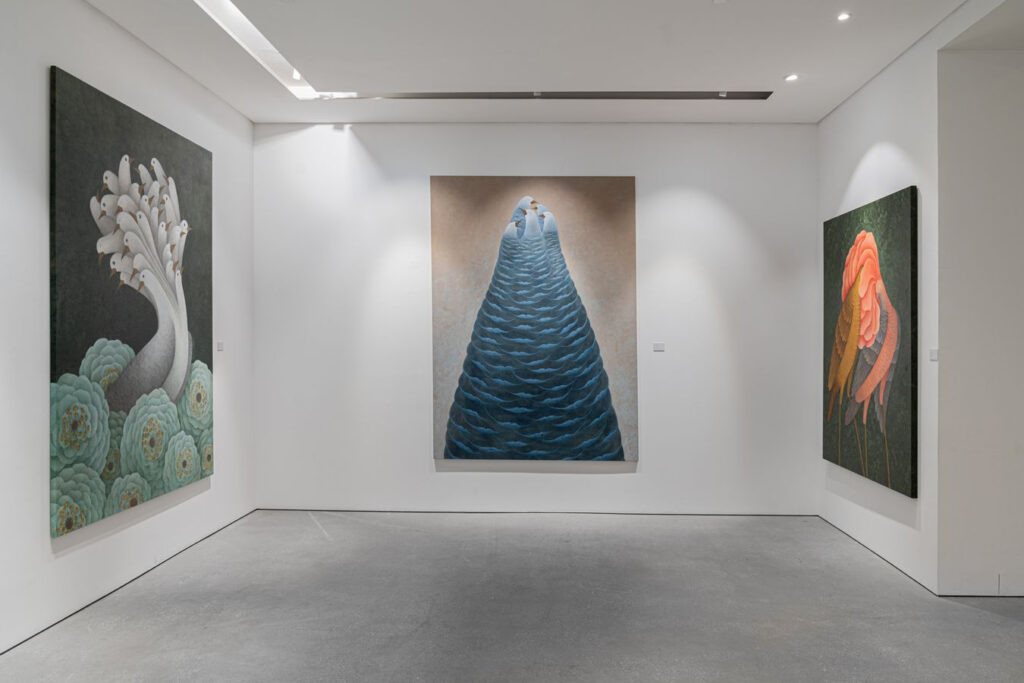
Maryam Lamei, Symphony of Birds, Exhibition View, Leila Heller Gallery Dubai, 2024.
Maryam Lamei, Symphony of Birds, Exhibition View, Leila Heller Gallery Dubai, 2024.
All images courtesy of the artist and Leila Heller Gallery.