
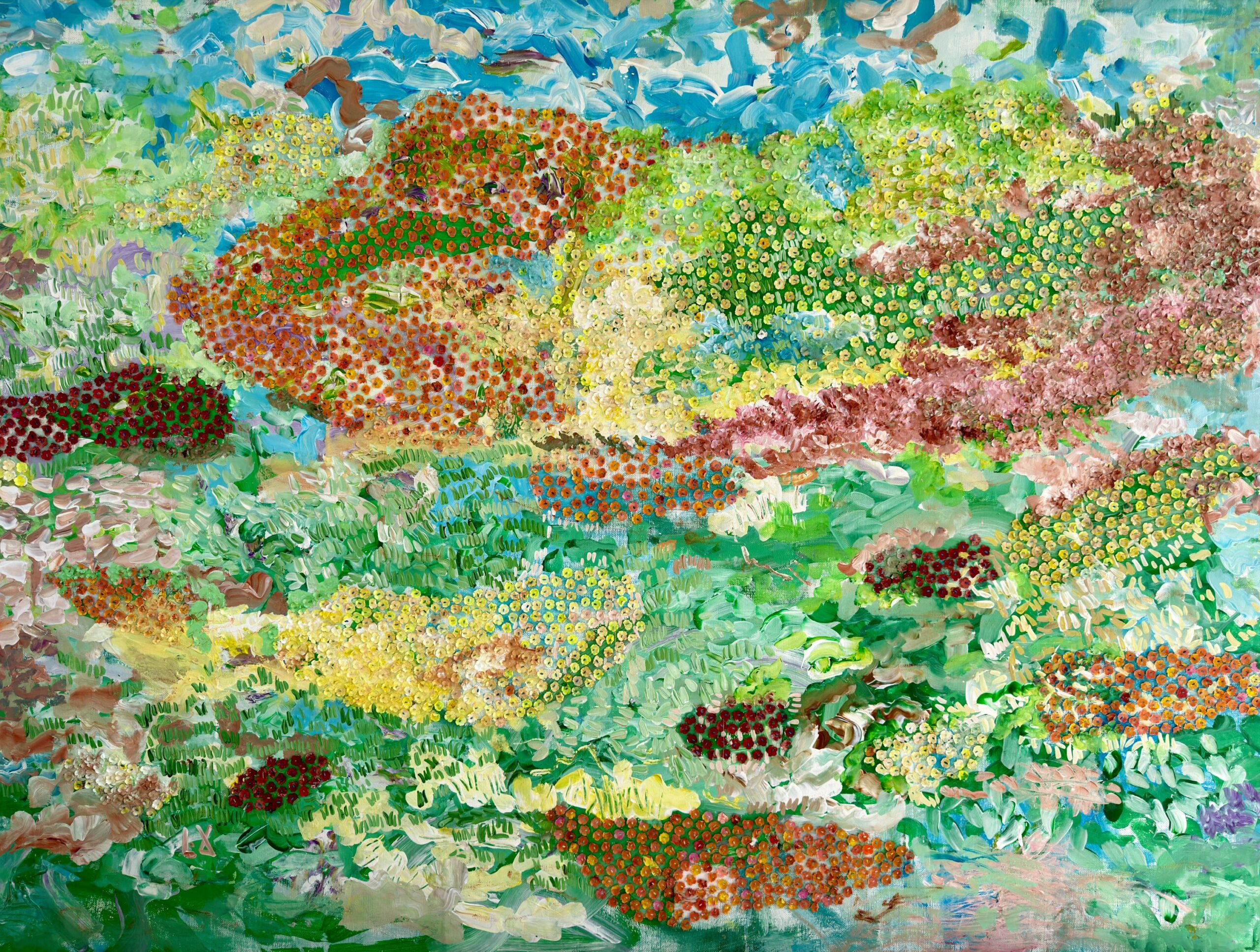
Lana Khayat’s great-grandfather, Mohamad Suleiman Khayat, spent his life working with his hands. A master craftsman who made his mark on the creation and restoration of traditional Syrian Ajami rooms, his work survives today in collections including the Metropolitan Museum of Art in New York and the Shangri La Museum of Islamic Art, Culture and Design in Hawaii. A family legacy followed in his footsteps. But Khayat would be the first woman in the family to turn that inheritance into a professional artistic path.
What seems to have travelled most faithfully across those generations is the hand itself. Khayat remembers learning patience from the men in her family, an attention to making that today surfaces through her painting, stitching, layering and repetition. “My great-grandfather restored things with his hands. I make things with mine,” she once said.
Inheritance becomes more interesting once it starts changing in the hand that receives it. Writing about her latest work, Khayat looks back to the ornament of her great-grandfather’s Ajami rooms, recognizing his patience in herself. Her response to that lineage is greatly telling. She “loosened” what she inherited, allowing the vines to climb out of the pattern and grow according to another logic. That image could almost stand for her work as a whole.
In her works, flowers, script, thread and landscape all show up carrying histories. Khayat lets each of them wander. Arabic calligraphy, Phoenician forms and Tifinagh recur throughout the pieces, sometimes as recognizable script and sometimes as shapes absorbed into the composition. Their curves, repetitions, and rhythms contain the memory of language even when the viewer cannot read a literal phrase.
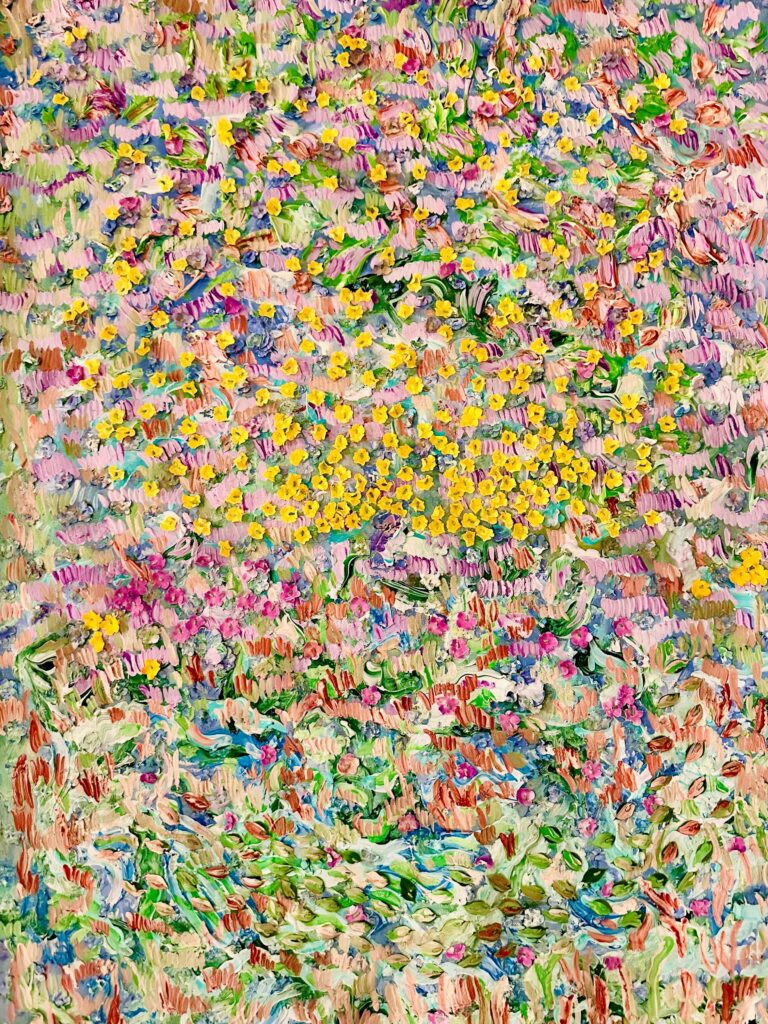
Violet Field
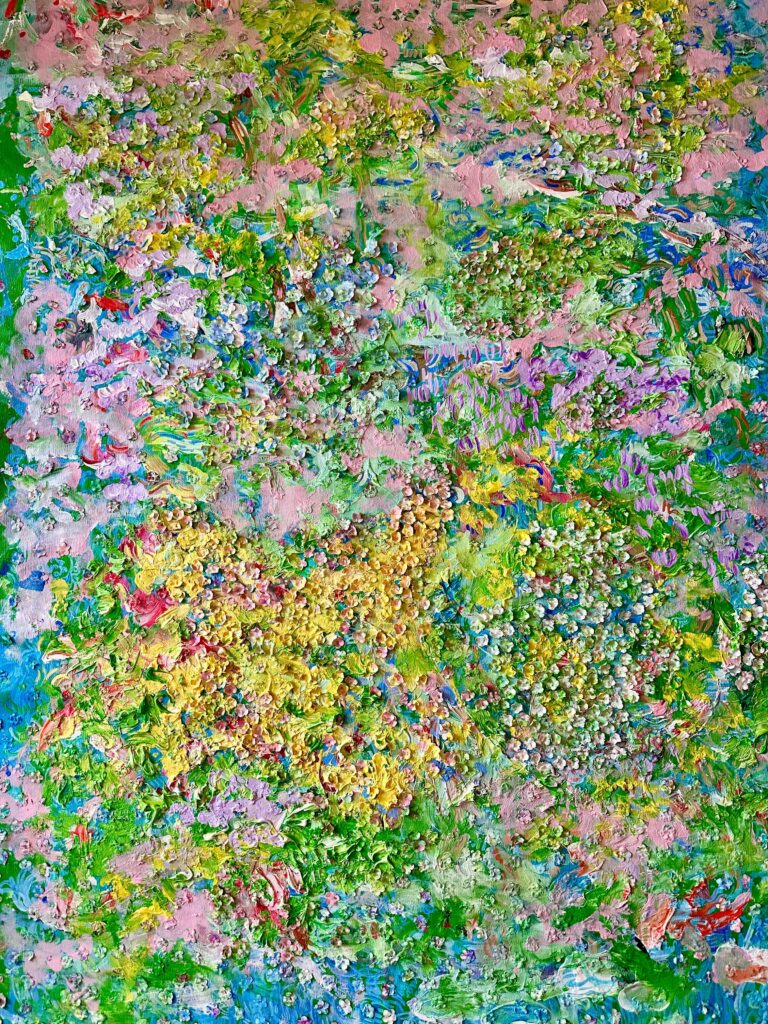
Raw Meadow
And in her hands, thread has become an even less predictable language. “I have always trusted the thread more than the word,” Khayat writes. Painting takes over where stitching reaches its limit. Thread continues where paint falls silent. She calls what emerges “half-calligraphy and half-wilderness”, an alphabet developed through the hand rather than planned in advance.
Across Khayat’s more recent works, that alphabet seems to change grammar from canvas to canvas. In Labor of Repair, including works such as Blue Ground and Scatter Field, thread can feel startlingly physical. Thick strands travel over already intricate painted surfaces, blocking details that might otherwise remain visible. The material places weight, commanding attention before allowing the eye to sink back into the painting underneath.
There is something intrusive in the act of stitching itself, which in Khayat’s hands, creates tension between what sits in front and what remains behind. Every repair must puncture the canvas first. The thread crosses, catches, and changes the painted surface. Khayat leaves that interruption visible.
In newer works, that physical act acquires emotional force. Repair can leave something less pristine and more whole. In Yellow Sun, a dense yellow field is formed through short-stitched marks. Here, thread begins to behave almost like paint, spreading across the surface like grass or undergrowth. Up close, each stitch can be seen as thread. From a distance, the marks begin to read almost like brushstrokes, forming a landscape of their own.
This is where Khayat’s thread becomes difficult to reduce to a signature device. Its meaning keeps moving. It can carry a wound, behave like a brushstroke, hint at a letter, trace a memory or accumulate into something close to landscape.
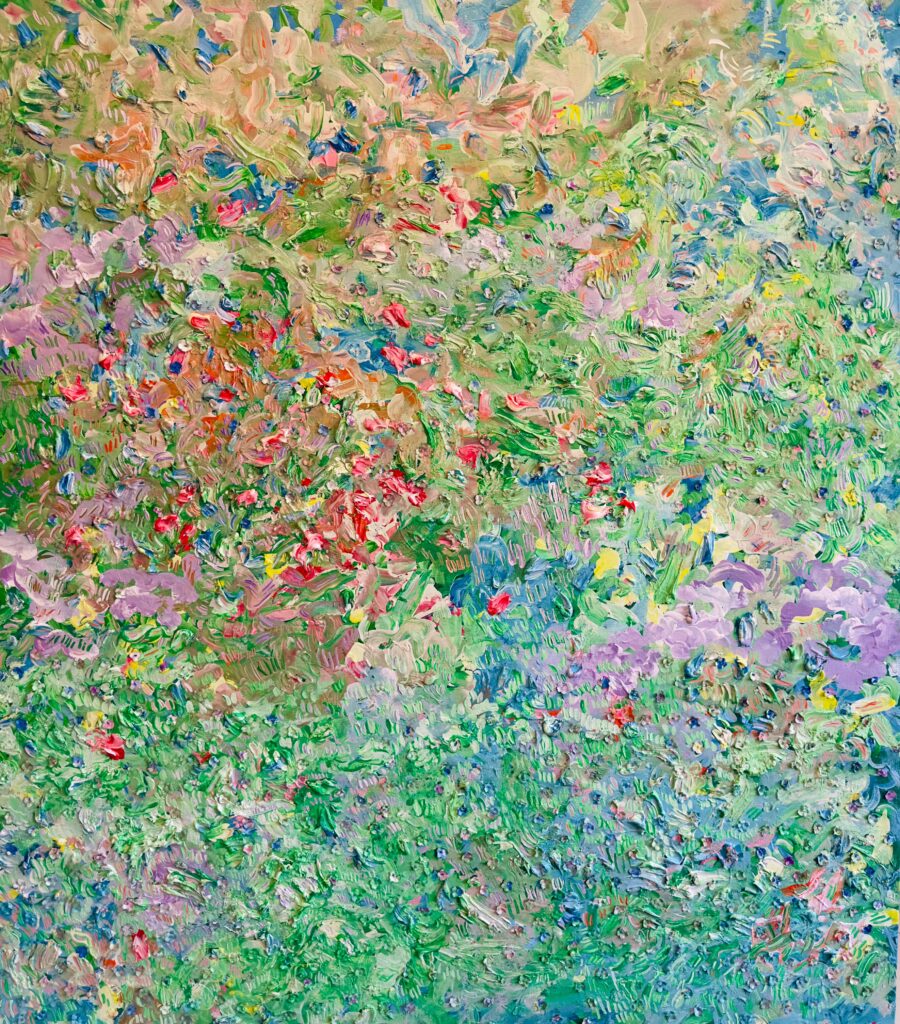
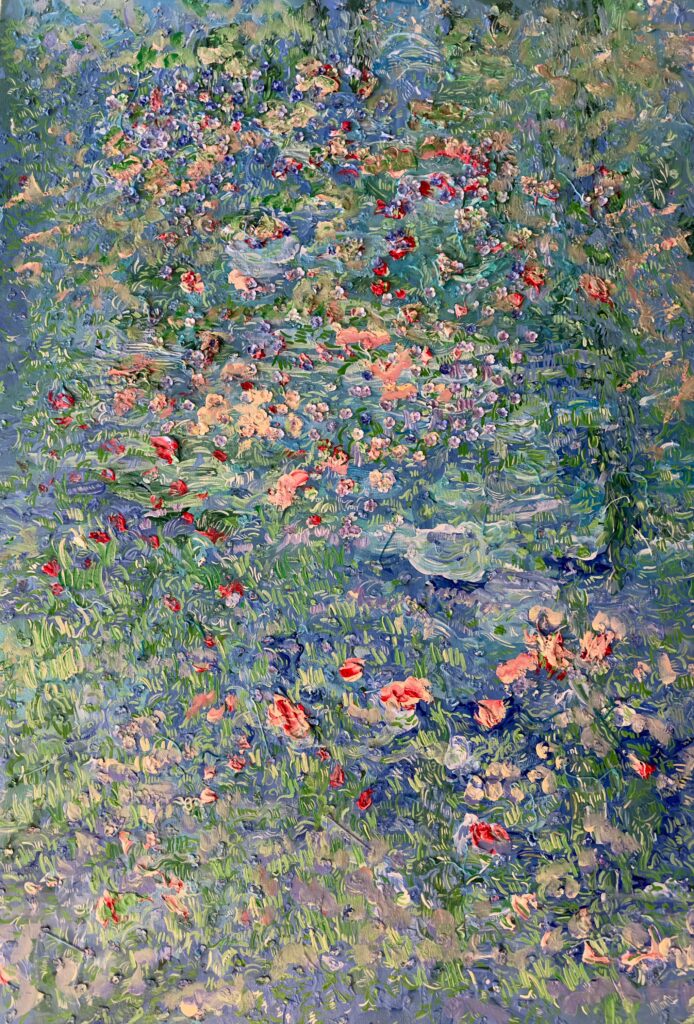
Scatter Field
Blue Ground
Rebellious Thread, as its title tells, leaves far more room between its threads. Against an open ground, pink, orange and green lines travel short distances, turn unexpectedly and occasionally close into shapes. Others stop before finding a partner. Distances remain between fragments that the eye instinctively wants to connect. This web recruits whoever is looking at it, inviting them to imagine continuations that Khayat has withheld. Some lines seem certain. Others simply set out.
That room for incompletion feels especially important in an artist so often discussed through ‘resilience’ – a dangerously tidy notion that rushes towards recovery and ignores whatever remains unresolved. Khayat’s surfaces and their propositions are far less reassuring. There is no urgency to tie up loose ends. Repairs change, rather than return the thing being repaired to its original state. And connections are laborious.
Khayat’s flowers have evolved differently. For years, the lily has lived in her works as a representative figure for women, renewal, and endurance. During her 2025 solo exhibition, The White Lilies of Marrakech: Women as Timeless Narratives, the artist pointed to a change in its behavior. While her earlier lilies had been “very shy”, the newer flowers moved forward, larger and more commanding. It is a fitting parallel to the change Khayat saw in herself; her confidence had grown, and her signature had become bolder.
It is tempting to read those changes together. Khayat once struggled with whether her art should remain private at all. New York, her time around the Guggenheim, and later Dubai became part of the long journey that allowed her work into public view. She had been repeatedly challenged to find her place within a male artistic lineage, and still can’t shake the feeling that she must “justify taking up space”.
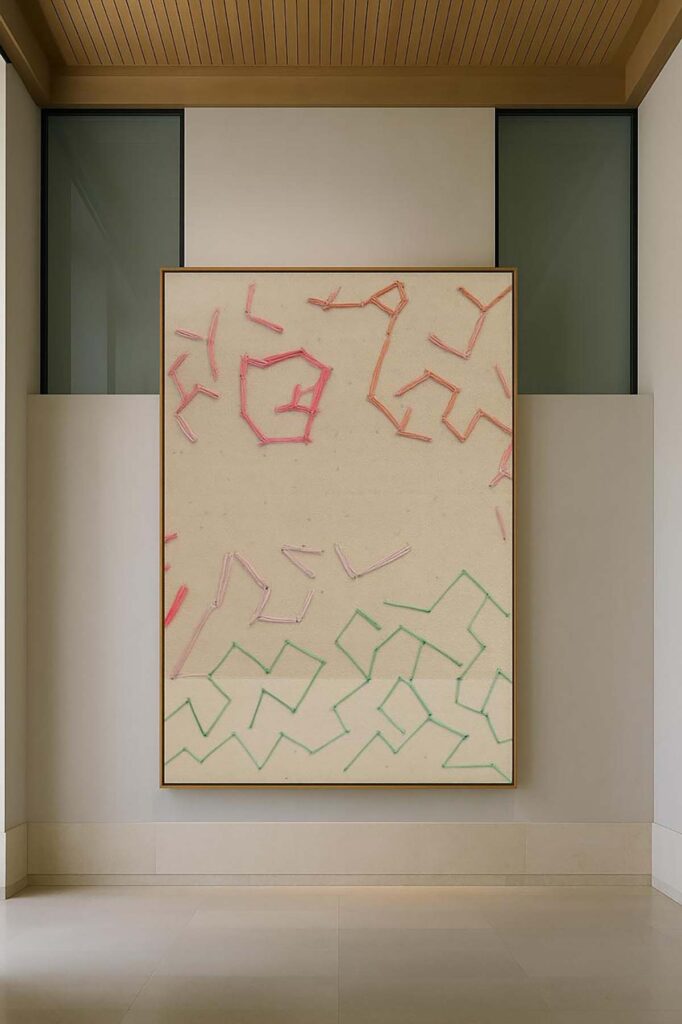
Rebellious Thread
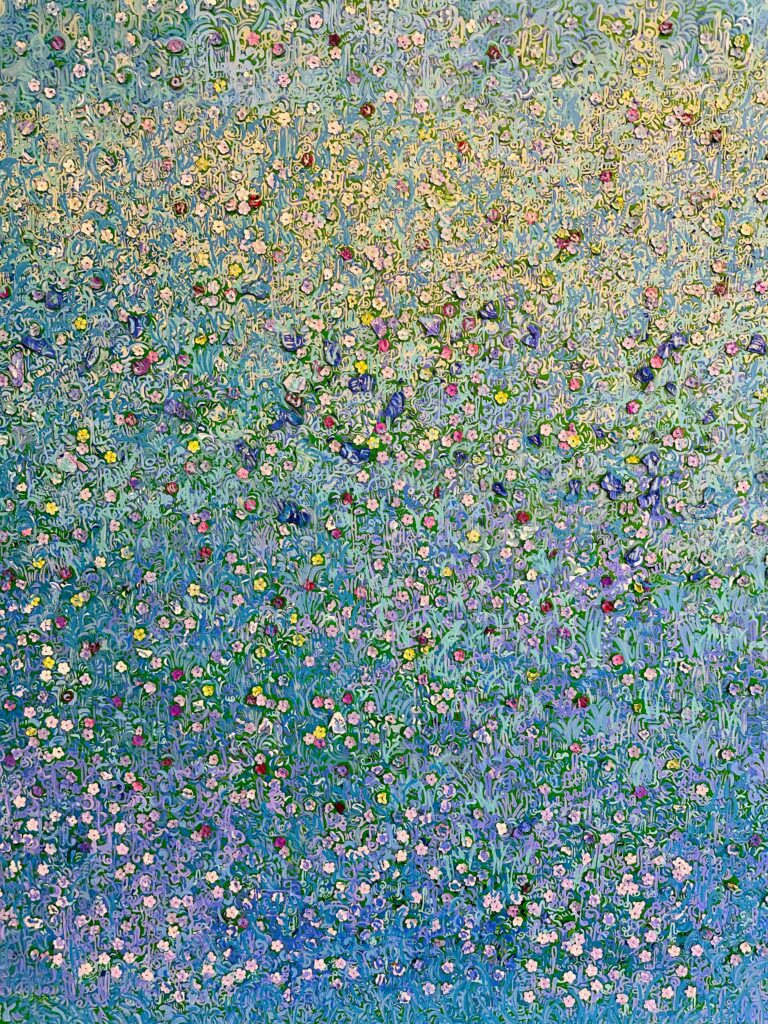
Mother Nature
The flower, meanwhile, has kept getting bigger. Its significance reaches beyond symbolism. Khayat’s description of femininity as “layered. Patient. Structural” tells more than any direct equation between woman and lily. She imagines it as a thread capable of carrying more weight than its appearance suggests.
Nature is where those ideas seem to settle into their calmest form. Khayat has long perceived herself to be more fluent with the natural world than with people. Her earliest remembered drawing was a tree, and she continues to speak of waves, wind, desert dunes, flowers and landscape as forms of communication.
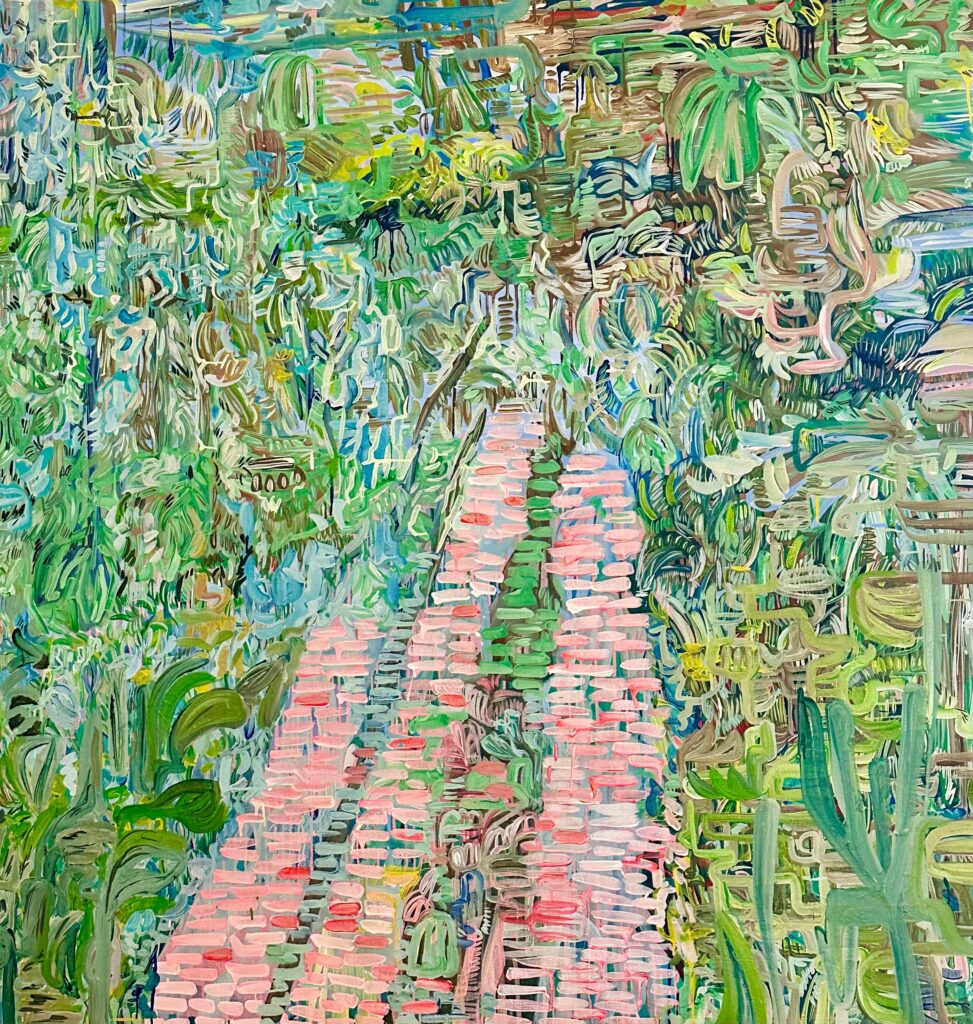
That fluency also seems to have brought clarity to Khayat’s work. In Mother Earth, dense marks cover the field, but the composition carries little of the searching quality found in the sparse stitched works. Everything seems to have found a place within the same environment. Individual gestures accumulate until they read as ground, weather, or growth. Khayat’s own reading on the series speaks of nature as a collaborator and describes a slow, intuitive process shaped by soil, roots, petals and air.
One of her Phytalo Blue project works makes the relationship between belonging and separation even more delicate. Its lower part gathers densely, almost as a collective body. Higher up, marks grow distant from one another. The blue gives them room to breathe. Fragmentation here feels spacious rather than catastrophic, and the individual is still anchored in the shared field.
By Architecture of Silence, the idea seems to reach a remarkable composure. Flowers, looping marks, fragments approaching script and layers of gesture crowd the image, yet the work feels peaceful. Complexity has found somewhere to live. Khayat describes the series through the quieter structures of the natural world, the “curve of a stem”, a “pulse beneath the surface”, the hidden order through which living things take form. Stitching becomes architectural in this context, slowly building a space capable of holding stillness.
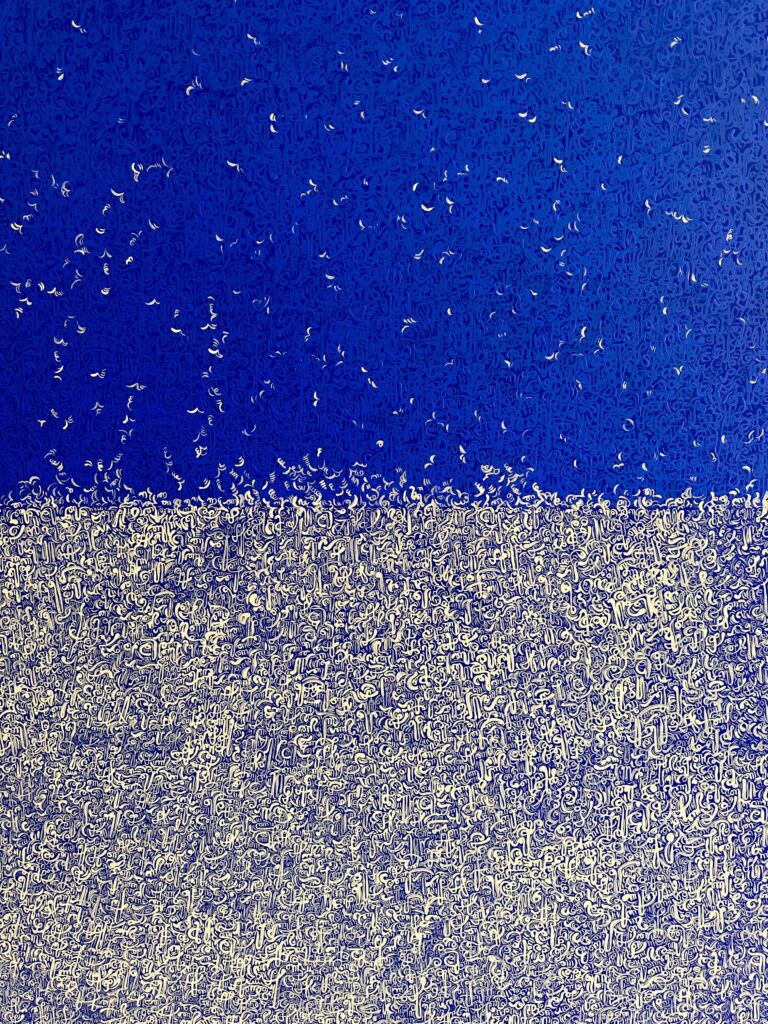
Phytalo Blue
Architecture of Silence
Perhaps peace, in Khayat’s work, looks something like enough structure for complexity to remain complex.
Her own landscapes carry similar layers. She lives between the UAE and Spain, while Lebanon remains part of the emotional geography of the work. She once described the Mediterranean as holding “the noise of everything that was” and the desert as carrying “the silence of what was never said.” These places enter the paintings through sensation and memory, through blue, heat, vegetation, rhythm and absence.
That makes her recent inclusion in Roots Before Petals, which opened at the Bassam Freiha Art Foundation in Abu Dhabi’s Saadiyat this month (17 October 2026 – 17 January 2027), especially resonant. Presented in dialogue with Etel Adnan and Helen Khal, the exhibition extends a longer Lebanese conversation around nature, memory, and the experience of carrying place across distance. For the show, Khayat presents Dessine-moi un pays, le Liban, a new body of work that imagines Lebanon through a botanical terrain shaped by memory rather than a recognizable view. The flower becomes carrier of place and experience – somewhere she has been, someone she has lost, or something still beyond naming.
By now, the web in Khayat’s work extends far beyond thread. It contains hands that started but not shaped her path, and the woman who had to make room within that inheritance. Landscapes carried between countries. Scripts relieved from the pressure of literal meaning. Flowers learning to occupy more space. Scars that remain visible after repair. Gaps she trusts enough to leave open.
It makes sense that Khayat trusts the thread more than the word. A word asks to be understood. A thread only asks where it might lead next.
Lana Khayat is represented by Hafez Gallery.
All images courtesy of the artist and Hafez Gallery.