
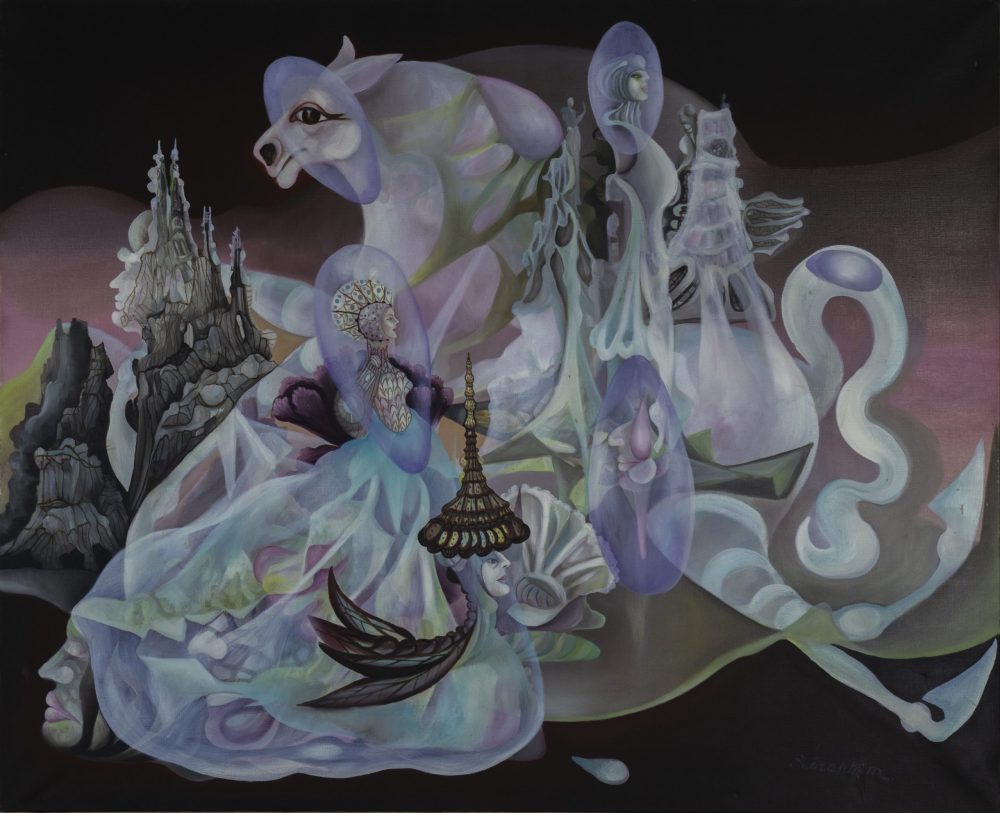
Flying Horse, date unknown. Courtesy of the Jordan National Gallery of Fine Arts.
Across four decades, Juliana Seraphim built a visual universe where women, nature, and the ethereal flowed into one another with intuitive ease. Hers is a universe ruled by sensitivity, spirituality, and surrealism, all defiantly her own.
Born in Jaffa in 1934, the Palestinian-Lebanese artist was raised between displacement and discovery. She moved to Beirut at the age of 14 with her family at the onset of the 1948 Nakba, and later pursued art studies in Florence, Paris, and Madrid. Madrid marked a defining moment for Seraphim’s artistic imprint, when art critic Carlos Ariane suggested she use India ink to bring her surreal imagination to life. Her exhibition at Sursock Museum’s Salon d’Automne in 1961 marked another: the beginning of her career as a professional artist.
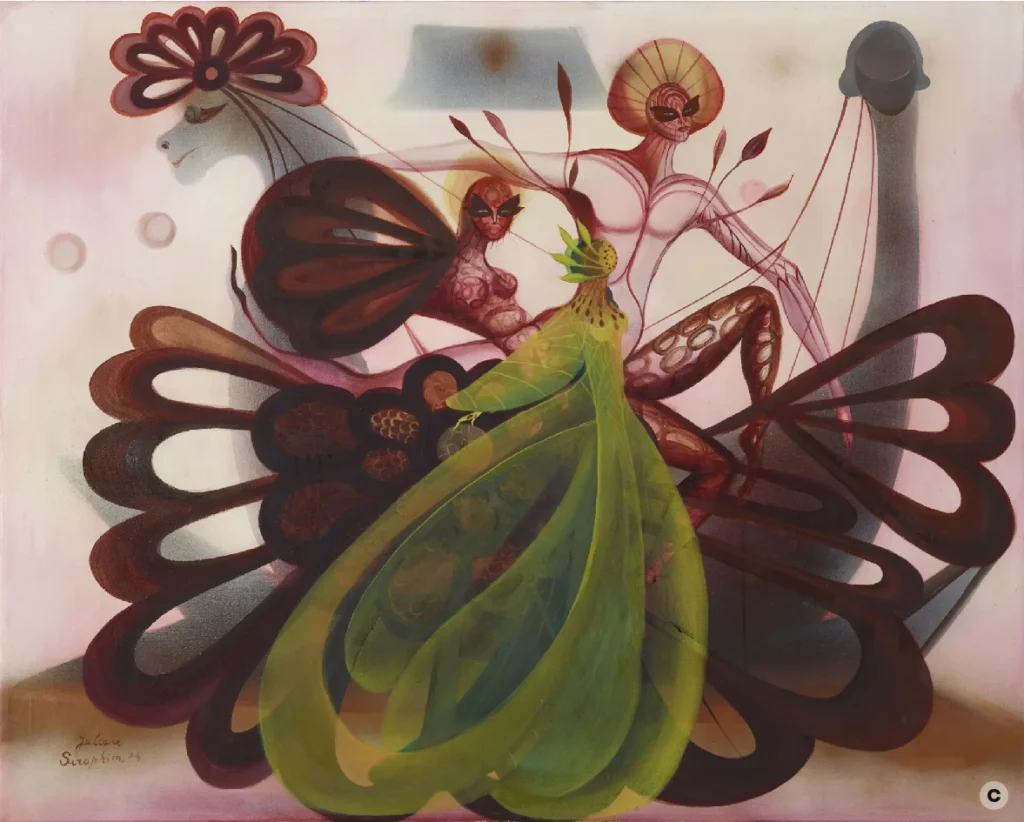
Untitled, 1979. Courtesy of Saleh Barakat, Agial Gallery.
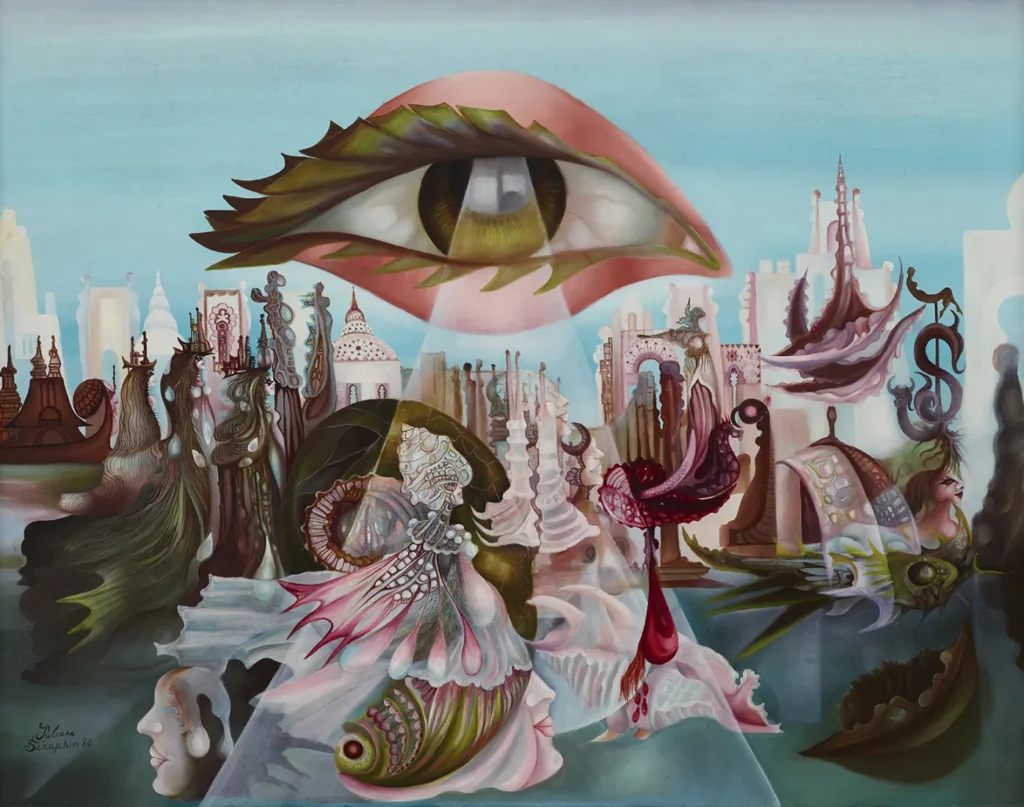
Untitled, 1980. Courtesy of Dalloul Art Foundation.
Many of Seraphim’s Palestinian contemporaries in Lebanon, often men who had shared her experiences of displacement, rallied their art around political iconography – earning the moniker “camp artists” by artist and art historian Kamal Boullata. She, however, opted to transform, rather than document themes of exile and loss. Her work moved inward, leaning into the subconscious, dream logic, and emotional clarity she believed could emerge only when the mind let its guard down. It was not escapism from brutal reality, but rather, refusal to be defined by it that was behind Seraphim’s choice. She built an artistic cosmos where ‘soft power’ ruled and femininity expanded far beyond its traditional confines. And far from shying away from sensitive topics, she used both to their full potential in addressing serious and deep-seated gender struggles.
Nowhere is this philosophy more palpable than in The Flower Woman. The exhibition, held at Bortolami Gallery’s 55 Walker space in New York in 2025, traced Seraphim’s evolution from the early 1960s to the late 1990s. In her early works, towering cityscapes tilt and spiral in impossible directions, their forms echoing frescoes from her grandfather’s Jerusalem home and childhood memories of Jaffa’s shoreline – a subtle and soft nod to her deep-rootedness in her homeland.
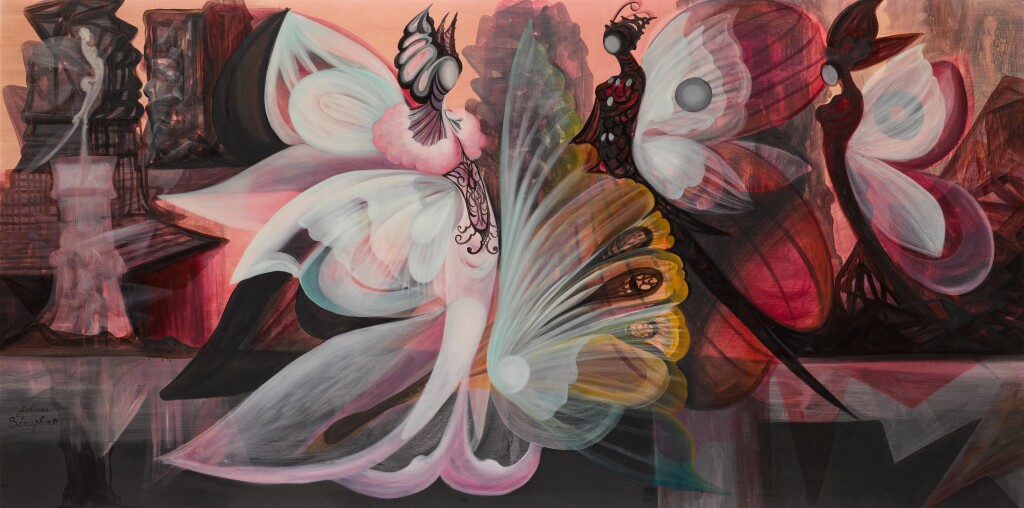
La Danse des Libellules, 1989.
By the 1970s, her forms grew more fluid and instinctive. Eyes, wings, petals, faces, and marine shapes merged seamlessly, engaging nature and the human in an ongoing conversation. In works such as Untitled (1979), women hover between states – part flower, part body, part dream. Rather than fragile or overtly triumphant, they mirror a fluid view of womanhood that resists categorization. Rather than impose, Seraphim’s women simply emanate.
Her floral motifs, often monumental and softly radiant, likewise do more than decorate her canvases. They become metaphors for emotional complexity, sometimes blooming, always shifting, protecting at times, and withholding at others. In some works, petals open into portals. In others, they echo the contours of a face or the curve of a figure. But without fault, they always insist on the idea that beauty, softness, and refinement carry their own authority.
By the late 1980s, Seraphim’s compositions had reached remarkable intricacy. Works such as La Danse des Libellules reveal beings who appear suspended between movement and stillness. Metallic lines, branching patterns, and layered transparencies give these later works a sense of tension, at once delicate and commanding.
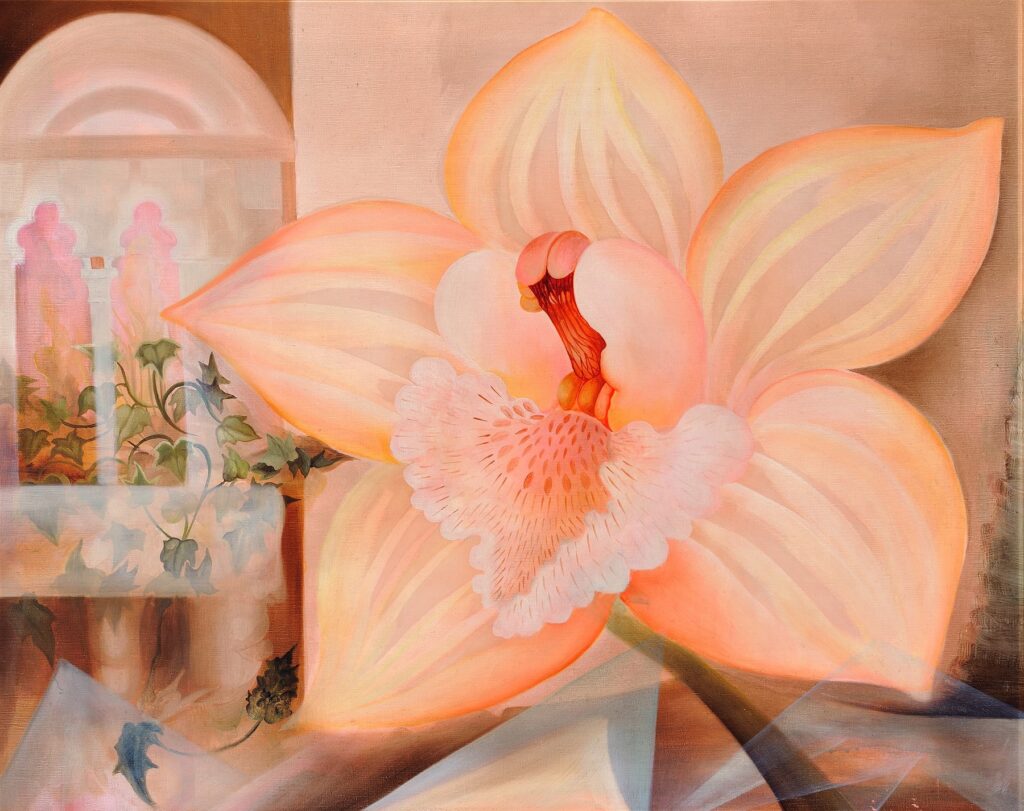
Untitled, date unknown.
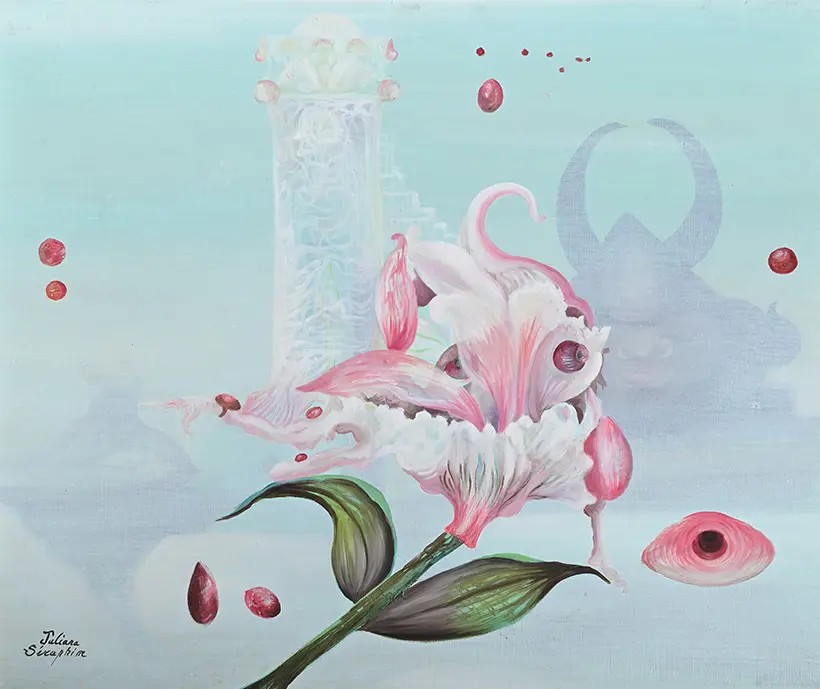
Il Pleut des Rubies, date unknown.
What remains consistent throughout her craft is a commitment to portraying feminine presence as layered, imaginative, and expansive. Even when coupled with architectural elements or fantastical creatures, her figures never collapse into symbolism. They operated as a vessel to Seraphim’s own view and experience of femininity – not decorative, never confined, and always a force capable of building and dissolving.
Her personal life mirrored this ethos. Seraphim resisted the expectations placed upon women of her generation, carving out a life defined by independence, travel, and unwavering commitment to her craft. Her refusal to be constrained socially, artistically, and conceptually transpires in her every canvas.
Nearly two decades after her passing, Seraphim’s work has reemerged in international exhibitions. including Arab Presence: Modern Art and Decolonisation at the Musée d’Art Moderne de Paris (2024) and The Golden Sixties at the Biennale de Lyon (2022). It is also part of museum collections such as the Metropolitan Museum of Art New York; the Jordan National Gallery of Fine Arts; and Beirut’s Sursock Museum.
The relevance of Seraphim’s works today lies in her prophetic sensitivity. She was attuned to nuances of identity, emotion, and imagination long before these conversations entered mainstream discourse. Her legacy lies in this gift. And her works are a reminder that the inner life, in all its strangeness, beauty, and quiet power, can be the most radical territory of all.