
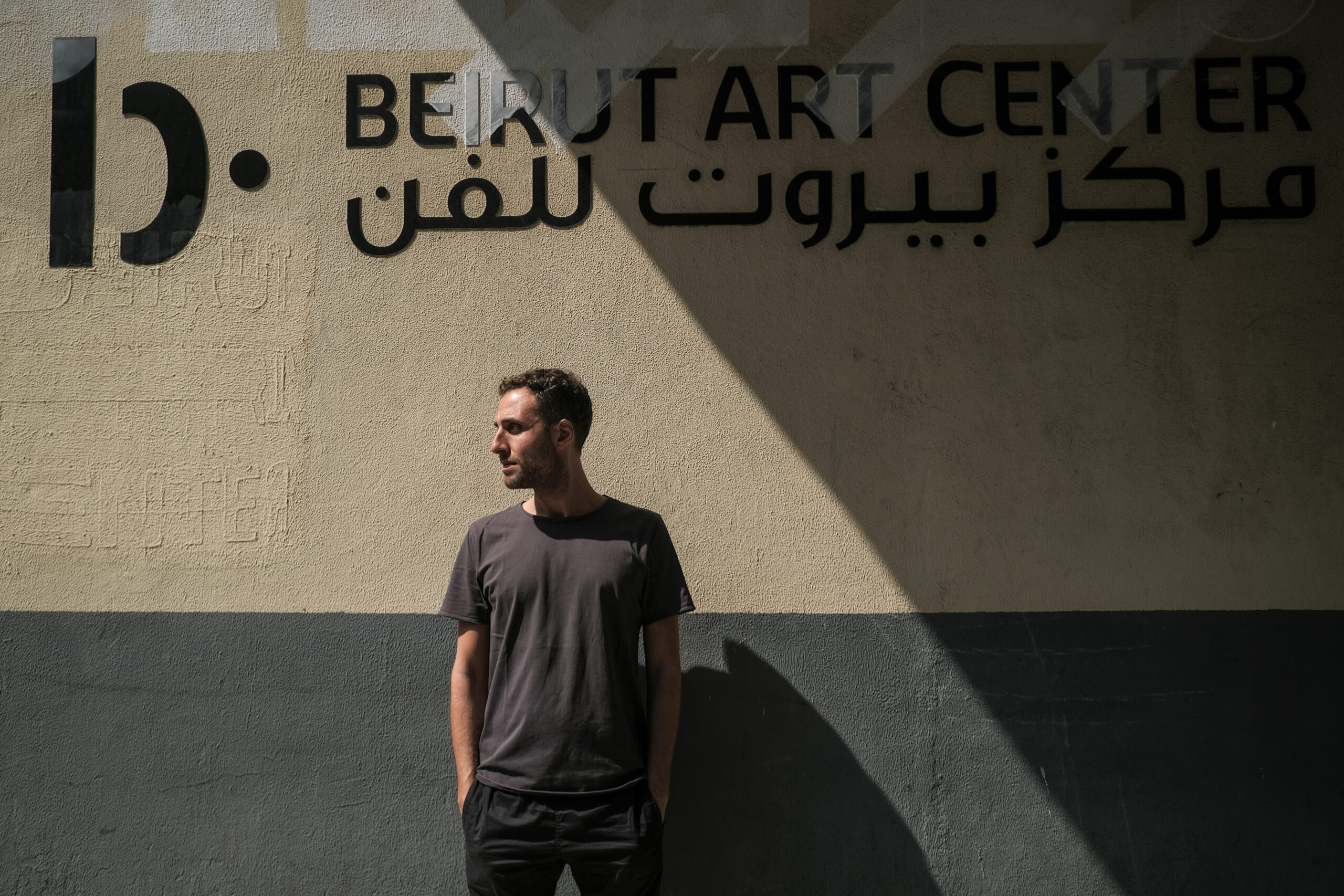
Portrait of Ibrahim Nehme, director of the Beirut Art Center. Photo by Joao Sousa.
Since it was established in 2009 as a non-commercial space for contemporary art, Beirut Art Center (BAC) has resisted reductive narratives of what it does, what it means, and how it keeps going. BAC has long operated as something deliberately open, shaped through its relationships with artists, context, and time. It holds space on its own terms, creating a community that extends beyond the institution itself, relationships with artists far from transactional one-offs, and a model built for continuity. Nowhere is this fluidity more visible and critical than in Beirut’s many episodes of instability. In this conversation, we speak to Ibrahim Nehme, BAC director, about the center’s commitment to protect artists and the conditions of their practice just as fiercely as it protects Beirut, refusing to let the city become a backdrop for artistic extraction.
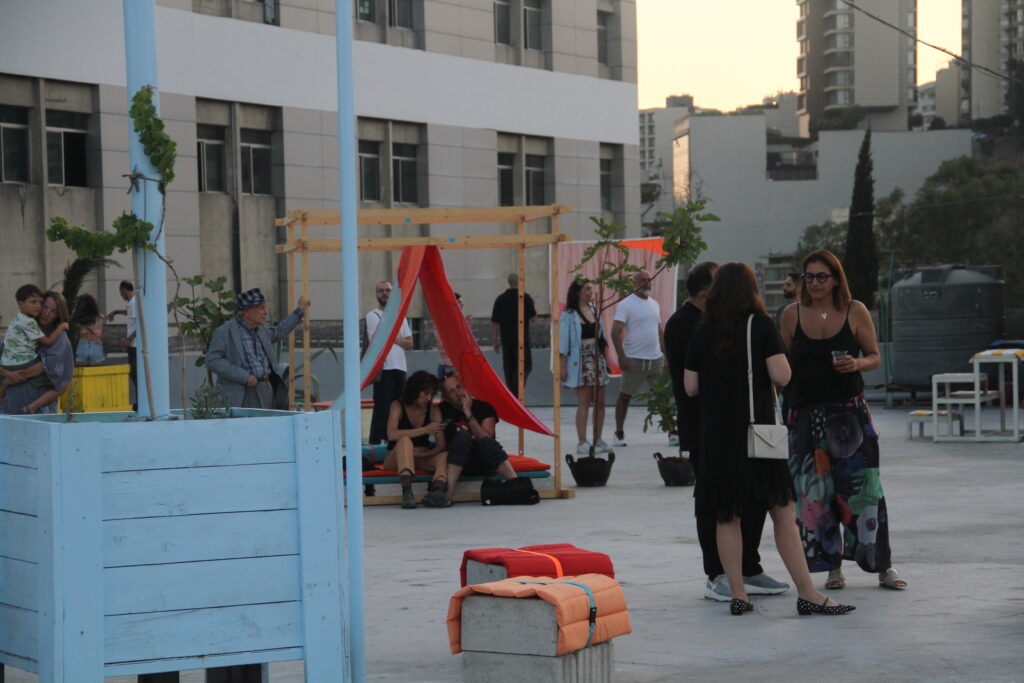
BAC rooftop installation by Nathalie Harb. Image courtesy of Beirut Art Center.
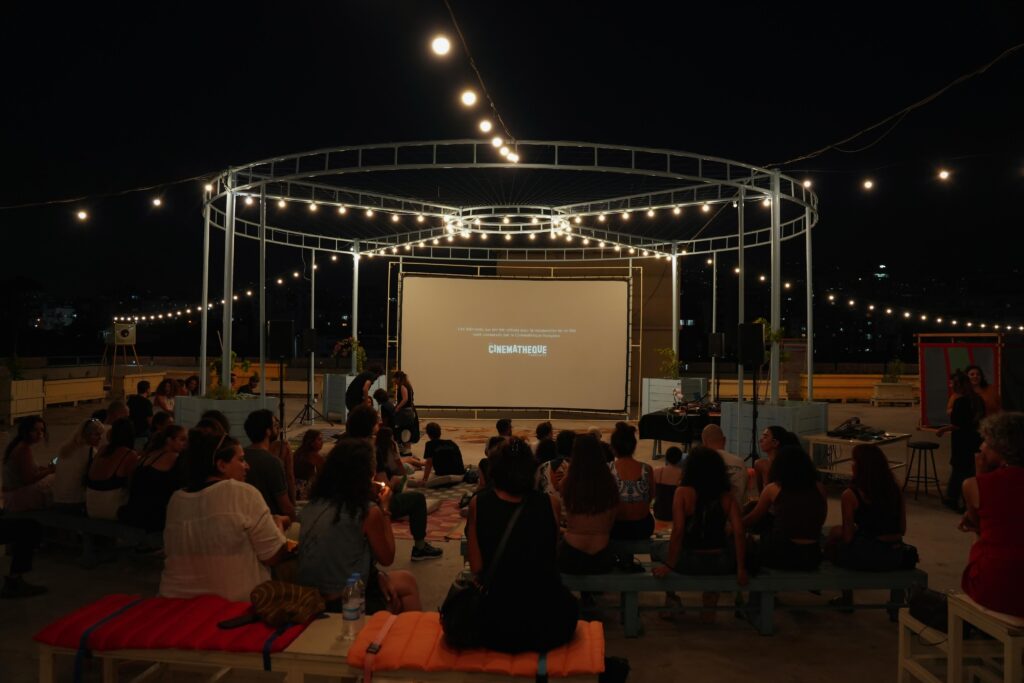
Liquid Images, Liquid Sounds – Cine Concert series. Image courtesy Beirut Art Center.
Beirut Art Center was founded as an independent space for contemporary art in Lebanon. How would you say its role and platform have evolved over the past 15-plus years since its establishment? At a time when the country is once again living through war and uncertainty, how do you see the role of the center today? Does a place like BAC take on a different meaning in moments like this? And how has it before, during the many periods that have tested Beirut and Lebanon’s art and creative community?
BAC was founded in 2009 with a specific proposition: that Beirut needed a dedicated, non-commercial space for contemporary art; a place that wasn’t a gallery trying to sell, nor a museum locked into a permanent collection, but something more open and more restless. In those early years, the work was partly about building an infrastructure that simply didn’t exist: a space where artists could research and experiment, where publics could encounter contemporary practice without it being mediated by the market.
What has shifted over fifteen years is less the core proposition than the complexity of what it means to hold to it. We’ve had to learn, through the protests of 2019, through the economic collapse, through the port explosion, through successive political paralysis, and now through another war, what it means to remain a functioning institution when the ground keeps moving. That education has been expensive, and not only financially.
I don’t think BAC becomes something different in moments of crisis. I think the crisis reveals what it always was. When daily life contracts, when people lose livelihoods, when futures become unreadable, culture is often the first thing declared non-essential. We’ve consistently pushed back on that. Not by programming around the crisis, as if art were therapy, but by continuing to insist that the questions artists ask are necessary ones, precisely because they resist the urgency of the immediate. Art doesn’t answer the crisis. But it holds open a space where the crisis can be thought rather than only endured.
What I’ve seen, repeatedly, is that artists in Lebanon don’t stop working in catastrophe. They work differently, often more urgently, sometimes more quietly. BAC’s role is to stay present alongside that, to remain a place where that work has somewhere to go.
At the beginning of the year, BAC likely had a particular program in mind. How has the current situation reshaped those plans? What has it meant, in practical terms, to continue, pause, or pivot programming at this point in time?
Yes, we had a program. Some of it has happened, some has been delayed, and some has had to be rethought entirely, both because of what’s happening in the country and because of what’s happening to the people involved in those projects. Also, funding landscapes have shifted almost overnight.
In practical terms, the decision to continue, pause, or pivot is never purely logistical. It’s also ethical. We think about what it means to invite an artist to present work in conditions where they may feel compelled to perform a kind of normalcy that doesn’t reflect their reality. We think about what audiences can actually receive when they are themselves navigating loss and displacement. These aren’t reasons to stop; they’re reasons to be more deliberate.
What we’ve learned across multiple crises is that flexibility has to be built into the institutional structure, not just improvised in the moment. That means maintaining enough financial breathing room to absorb disruption, and enough trust with artists and partners that programs can be genuinely rescheduled rather than simply cancelled. It also means being honest about what we can and cannot hold.
BAC has long supported experimental and research-driven practices. How do you discern between projects that feel necessary and relevant to present, and others that serve or fit longer-term ambitions? How do periods and contexts such as today’s impact these decisions?
The distinction between the immediately relevant and the long-term isn’t always as clean as the question implies, and I’d be wary of a programming logic that leaned too heavily on either pole. Work that is only responsive to the present moment risks becoming illustration. Work that is entirely indifferent to context risks becoming self-referential. The most interesting projects tend to hold both; they’re rooted in a specific question or urgency, but they open outward.
What guides us is less a checklist than a set of recurring questions: Is this project possible here and not somewhere else? Does it need the particular conditions, the histories, the tensions, the specific artistic community, that Beirut offers? Is the artist genuinely engaged with those conditions, or are they treating Beirut as backdrop? And what does the work ask of the audience, not in terms of difficulty, but in terms of genuine encounter?
Context like the current one does affect programming, but not always in the ways people assume. It doesn’t make us automatically gravitate toward work that is explicitly about war or crisis. Sometimes it makes us more protective of space for work that is oblique, speculative, or formally ambitious, precisely because those modes of thinking are harder to sustain when the immediate is so loud.
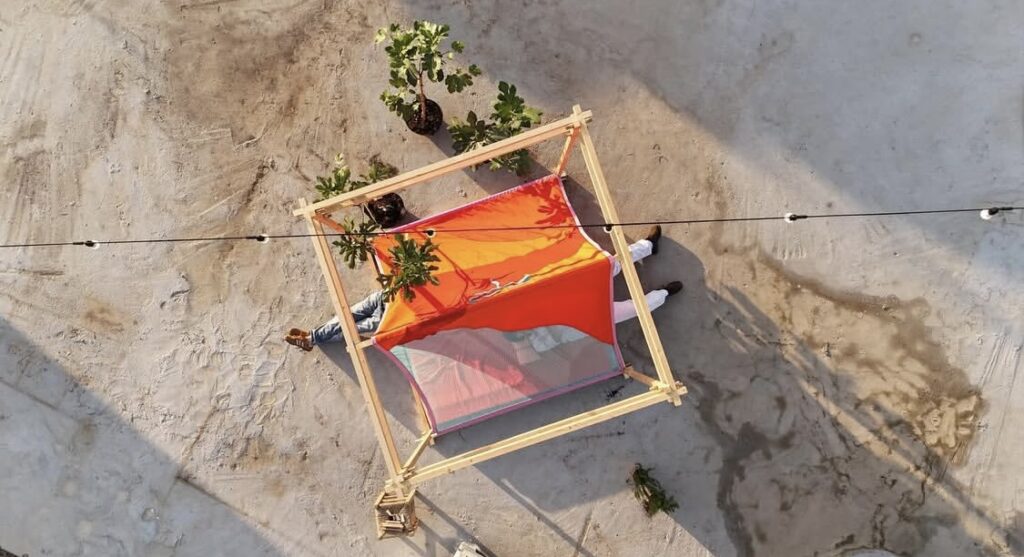
BAC rooftop installation by Nathalie Harb. Image courtesy of Beirut Art Center.
How do you reckon the relationship between BAC and artists has evolved over the years? And how has the evolution of this relationship impacted BAC’s own transformation as a platform, community, and institution?
The relationship has deepened in some directions and become more complicated in others. In the early years, there was an energy of shared discovery: artists and institution figuring out together what this space could be. Many of the people who were in the room at the beginning are still in conversation with us, but the conversation has matured. There’s more history between us, which means more trust but also more accumulated expectations.
What’s changed most is the range of what artists ask from an institution. Early on, the primary need was space (physical space, exhibition space, a platform). Now artists are asking more structural questions: about credit and attribution, about whose labor is made visible, about the conditions under which they’re invited to participate. These are good questions. They’ve pushed us to be more transparent about how we work and what we can actually offer.
BAC has been shaped by its relationships with artists more than by any single strategic plan. The directions we’ve moved in, the emphasis on research processes, the investment in long-term accompaniment of projects, the attention to how work is documented and shared, came largely from listening to what artists needed and found missing.
What kind of relationship do you hope artists develop with BAC today? Is it primarily a platform for presenting work, a place for dialogue and research, or something else entirely?
I hope it’s a place artists return to, not because they have to, but because something useful happens here. That could mean different things for different artists and different moments in their practice. For some, BAC is where a project gets its first public form. For others, it’s where they come to think before there’s anything to show. For others still, it functions as a community, a set of relationships with peers and with audiences that they don’t find elsewhere.
What I’m least interested in is a transactional relationship: artist delivers project, institution presents it, both move on. That model produces a clean program but not much of a culture. What we’re trying to build is something more reciprocal, where the institution is genuinely changed by the work it hosts, and where artists feel that being in relationship with BAC is itself generative, not just useful.
Practically, that means investing in accompaniment, being present with a project through its development, not just at the point of presentation. It means creating conditions where artists can take risks, including the risk of something not fully working. And it means being honest about the limits of what we can offer so that the relationship is based on something real.
BAC is connected both to Beirut’s local cultural scene and to international networks. How do you balance these local and global dimensions, and how do they influence the center’s choices and priorities?
I resist the framing of balance, because it implies two equal and competing weights. The local is not the opposite of the international, it’s the ground from which any meaningful international connection is made. BAC is interesting to the wider world precisely because it is rooted in a specific place with a specific history. The moment we become generic in order to be legible internationally, we lose the thing that makes us worth connecting to.
That said, the international dimension is genuinely important to us, and not only for reasons of funding or visibility. Artists here need to be in conversation with practices and ideas that are being developed elsewhere. Audiences here deserve access to work they wouldn’t otherwise encounter. And the questions that Lebanese artists are working through, about displacement, about the relationship between art and politics, about how to sustain a practice under conditions of institutional collapse, are questions that resonate far beyond Lebanon.
What we try to avoid is the extractive logic that can creep into international partnerships: the version where Beirut is a context to be mined for its intensity and then left. We look for relationships where the exchange is genuine, where what we bring to the table isn’t just local color but intellectual and artistic substance, and where what we receive in return is more than money or visibility.
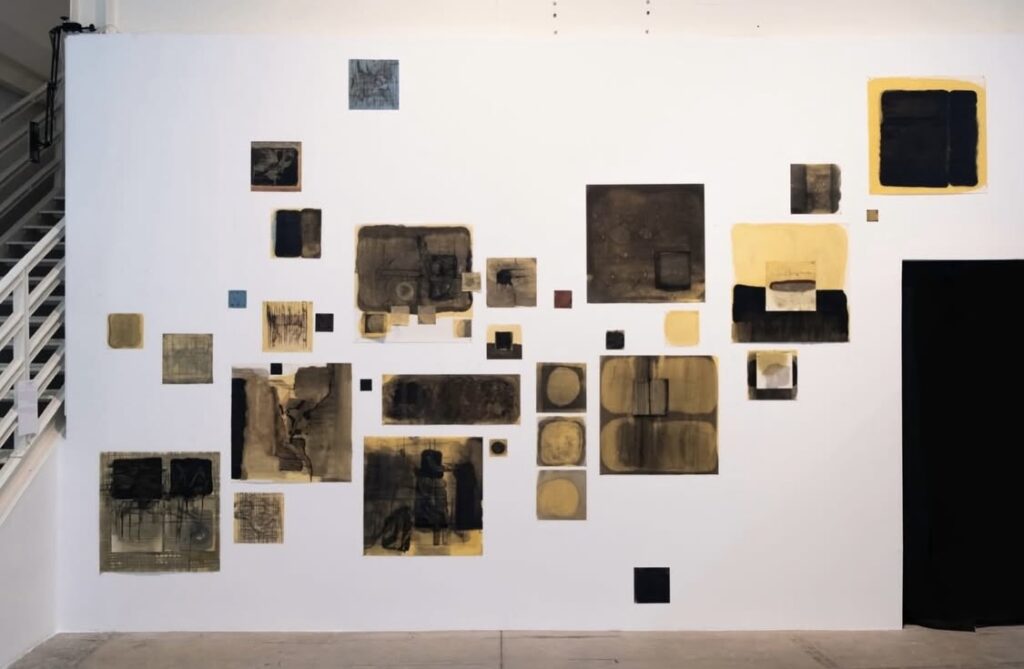
Souraya Salwan Hammoud, part of the collective exhibition Slow Burn.
Image courtesy Beirut Art Center.
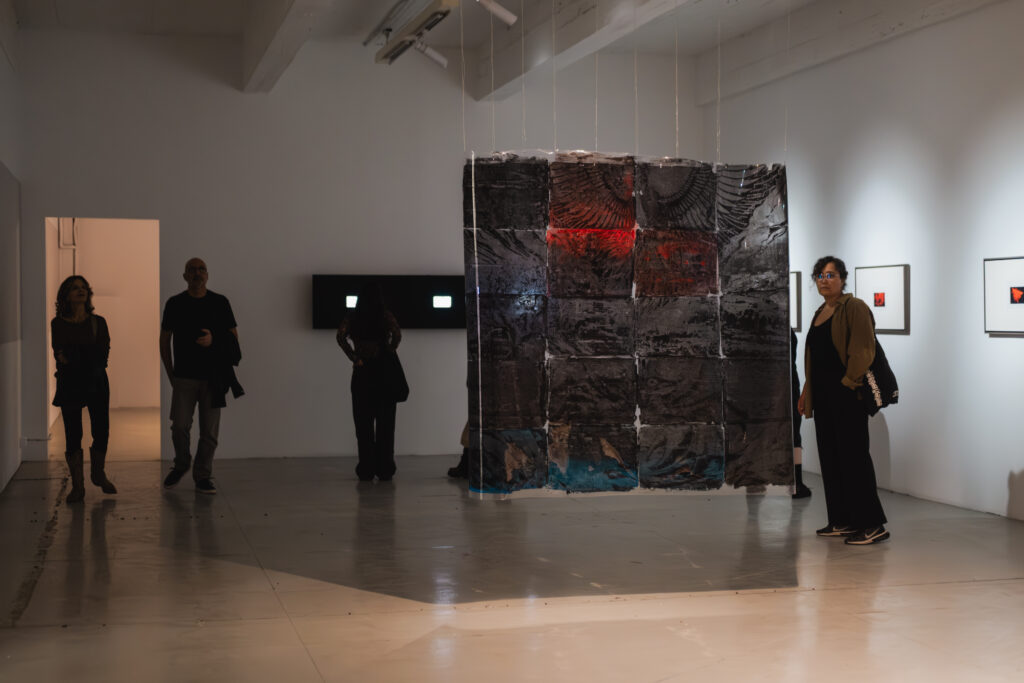
Tala Asmar (foreground), Aya Abdullah (background), part of the collective exhibition Slow Burn.
Image courtesy Beirut Art Center.
Running an independent art institution in Beirut today involves navigating constant change. What have the past few years — and the present moment — revealed about sustaining a space like BAC, both institutionally and personally?
What these years have revealed, institutionally, is the fragility of any model built on assumptions of stability. Assumptions about a functioning banking system, about the availability of spaces, about the continuity of a local audience, about the reliability of international funding cycles, all of these have been tested, and most have broken at some point. What has held is something more intangible: a community of people, inside and outside the institution, who believe that what BAC does matters and have been willing to hold it through conditions that would have closed most comparable institutions elsewhere.
That’s not a management lesson. It’s something closer to an ethical observation. Institutions are sustained by relationships, not systems. When the systems fail, and in Lebanon, the systems have comprehensively failed, what remains is the question of who is willing to stay in the room.
Personally, I’ll say that these years have demanded a kind of flexibility that I didn’t anticipate when I came into this role. The work of leading an institution in conditions of ongoing crisis involves holding uncertainty without transmitting panic, making decisions with incomplete information, and staying present with people, colleagues, artists, board members, who are themselves navigating enormous difficulty. I don’t think you learn to do that. You just do it, and then you understand a little more about what it required.
Looking ahead, what feels most important to preserve about BAC’s identity, and where do you see possibilities for new directions?
What feels most important to preserve is the intellectual seriousness and the genuine independence. Those two things are related. The seriousness is what makes BAC a place worth being for artists and audiences who have other options. The independence is what allows us to maintain that seriousness, to program based on what we believe matters rather than what is easiest to fund or most legible to international audiences. Both require constant protection, because both are constantly under pressure.
We are approaching our twentieth anniversary, and this is a moment to think carefully about what the next chapter looks like. We’re in the middle of a significant strategic process around that, thinking not just about programming but about infrastructure, about how we reach different communities, about our relationship to the archive of what we’ve built over two decades. Twenty years of work is a significant body of knowledge, and we haven’t yet fully understood how to make it live rather than simply preserve it.
As for new directions: I’m interested in deepening our investment in younger artists and practices that are only beginning to find their form. I’m interested in the question of how BAC’s presence extends beyond its physical space, not in a digital-expansion sense, but in terms of genuine relationships with communities and institutions that aren’t already inside our orbit. And I’m interested in what it means for an independent institution to have genuine longevity in a place like Beirut, not survival at any cost, but survival on terms that are worth something.
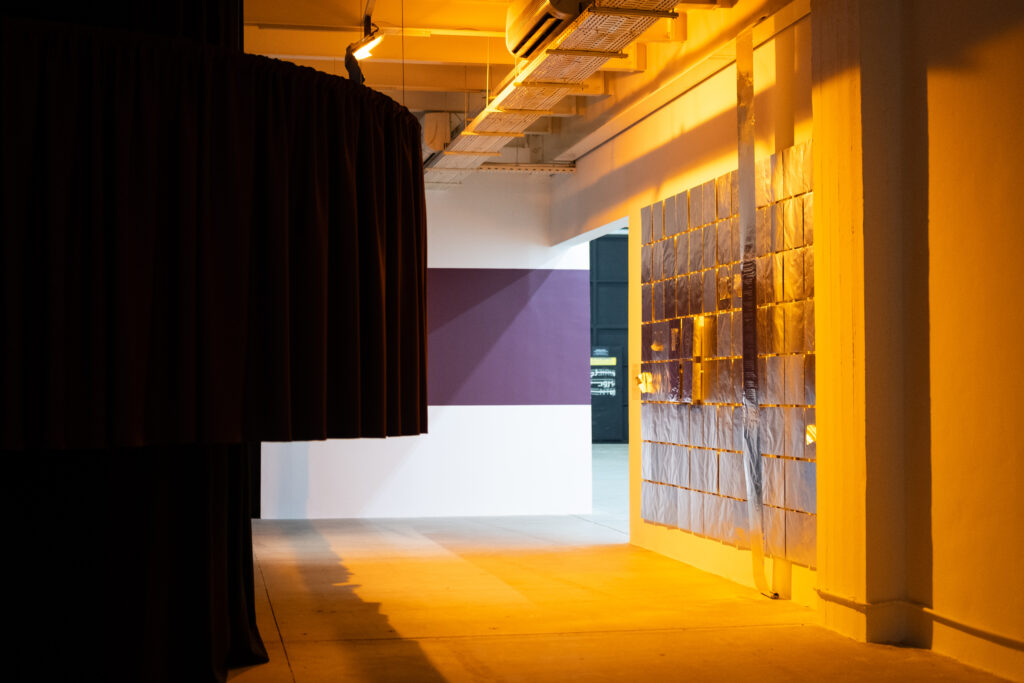
Elie Mouhanna, part of the collective exhibition Slow Burn. Image courtesy Beirut Art Center.