
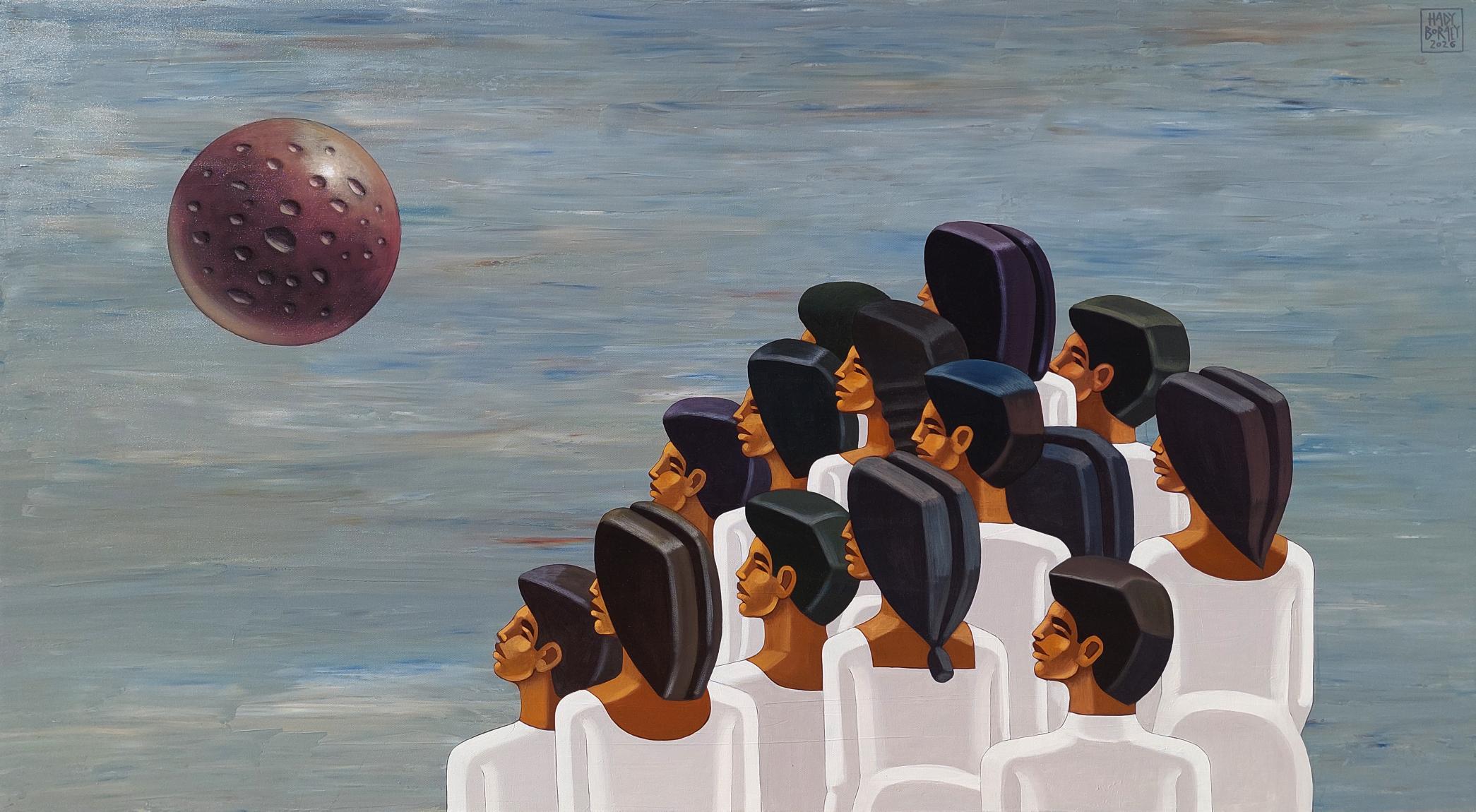
Hady Boraey met the world first through drawing. Words later. He was three when he began making images in a house in the Egyptian Delta, with the Nile nearby and the quiet rhythm of fields, animals, and farmers around him. That first sense of belonging has remained beneath his work, even when the paintings turn toward distant borders, imagined destinations, or spiritual uncertainty.
No one around him initially encouraged that impulse. Boraey remembers drawing on any scrap of paper he could find, driven by something he felt unable to ignore. He speaks of the community in which he grew up as an extended family, lived close to nature and held together by relationships he would continue carrying into his work.
Boraey’s practice is often discussed through migration: the person who leaves, the frontier ahead, the expectation that life must improve elsewhere. His paintings reveal a broader concern. Across more than fifteen years, he has repeatedly reconsidered the form people take when faced with uncertainty. Sometimes, one figure confronts it alone. Elsewhere, two bodies steady one another, or a group gathers around a shared task. His recurring subject may be less the destination than the human arrangements that make the journey possible.
His 2010 paintings carry a somber, devotional gravity, with bodies that seem closer to witnesses, mourners, or figures drawn from an icon than to the travelers of his later work. Their tragedy is worn openly. In the years that follow, Boraey retains the solemnity but gradually removes the spectacle around it. By 2014 and 2015, a more personal visual vocabulary has gathered: frontal bodies, birds, boxes, necklaces, stones, and figures that seem carved rather than casually observed.
The stones are connected to the histories people carry wherever they go, while Boraey has described roots and ancestral memory as forces that guide, rather than simply anchor him.
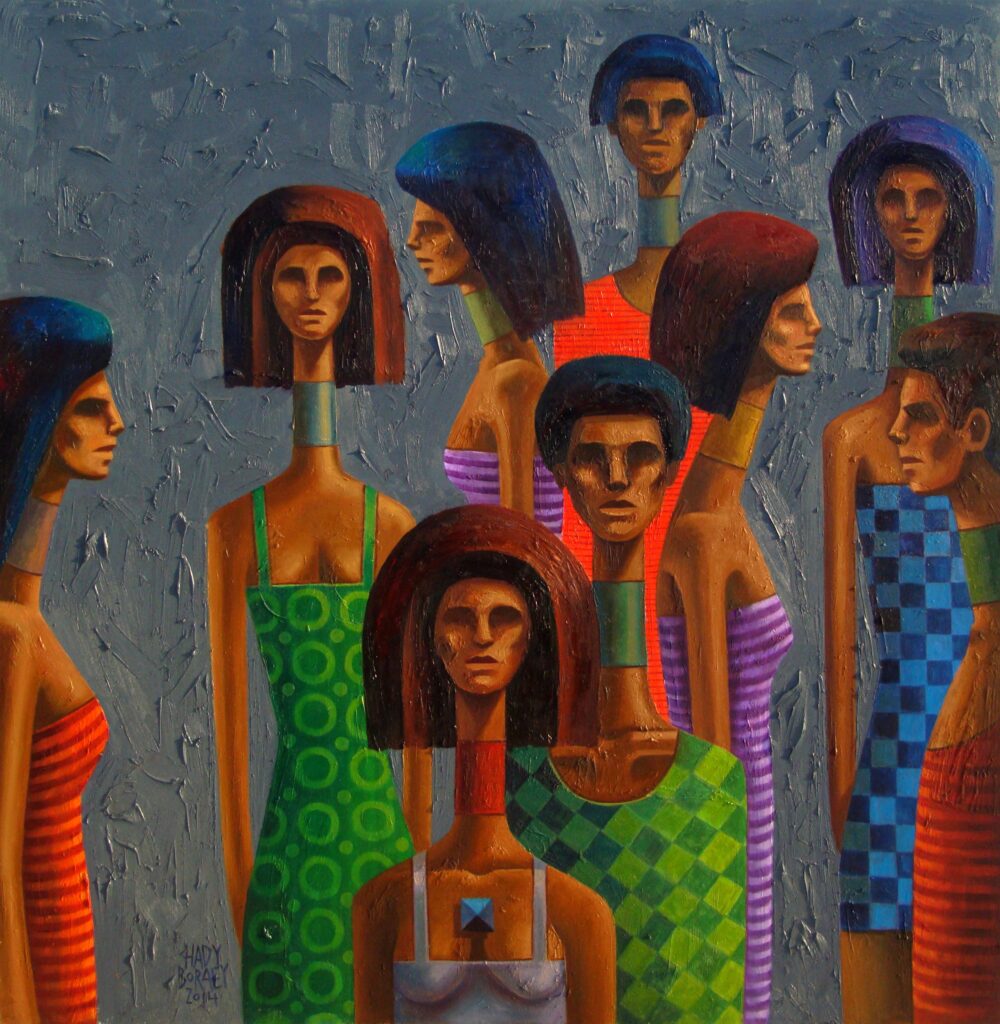
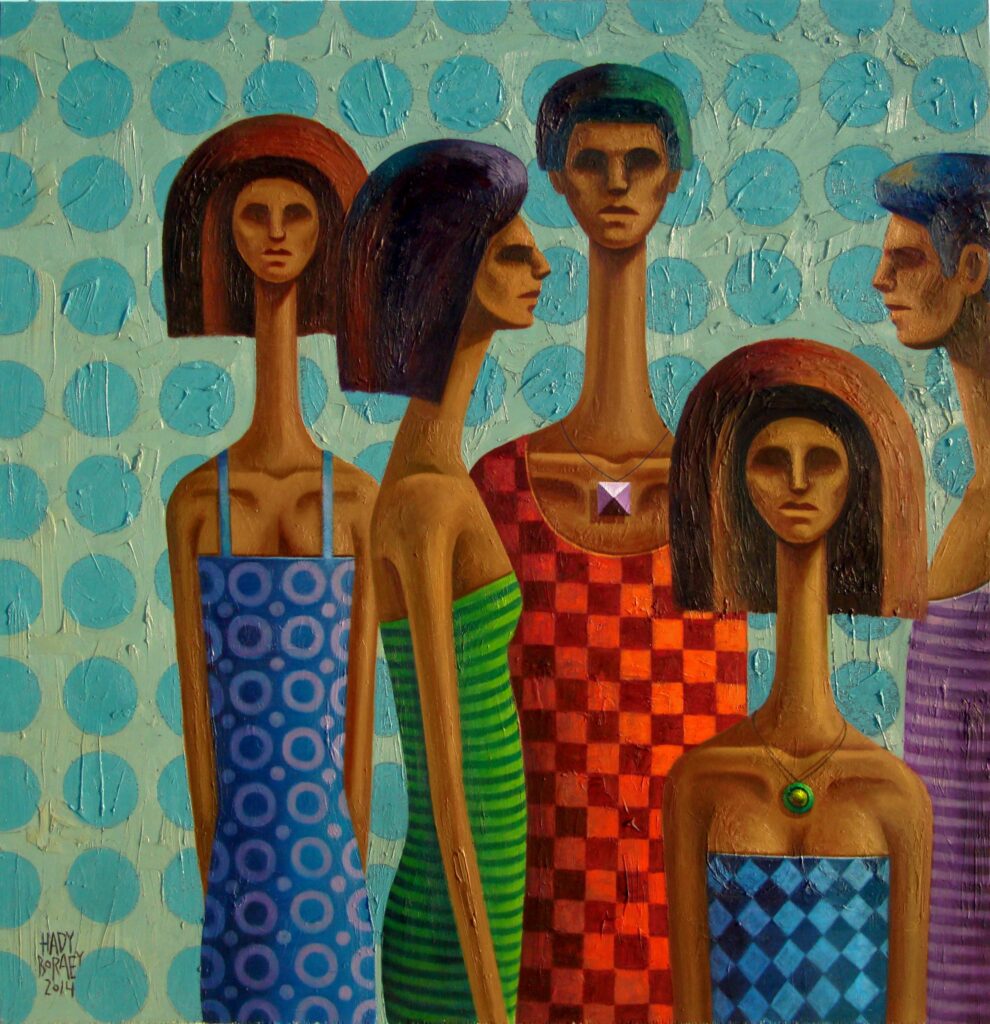
Hady Boraey, from the series Towards the Unknown, 2014, Oil on Wood, 122 x 122 cm.
© Courtesy of the artist.
Hady Boraey, from the series Towards the Unknown, 2014, Oil on Wood, 122 x 122 cm.
© Courtesy of the artist.
In his work, movement does not require abandoning the past. The burden may slow the traveler, but it also prevents arrival from becoming a form of erasure.
His sketches and sculptural experiments help clarify how that stillness is constructed. Once his figures leave the painted surface, they remain weighted and frontal. Rather than fundamentally change their behavior, it confirms how sculptural the paintings had been all along. The sketchbook, meanwhile, offers the restless counterpart: line searching before the body settles into its ceremonial pose.
With Beyond Borders and Towards the [Un]Known, the frontier becomes explicit. As he told CairoScene, Boraey once assumed that people elsewhere were happier, until travelling taught him that dissatisfaction simply changes location. He conceived Towards the [Un]Known as an extension of Beyond Borders, imagining travelers reaching the apparent edge of the world only to encounter the same questions they had carried with them. They eventually return because their memories cannot be found at the destination. Distance changes the scenery while memory travels intact.
There is a revealing willingness from Boraey to revise himself in that admission. The child who imagined distant lands as answers became an adult prepared to acknowledge that geography could not settle an inner dissatisfaction.
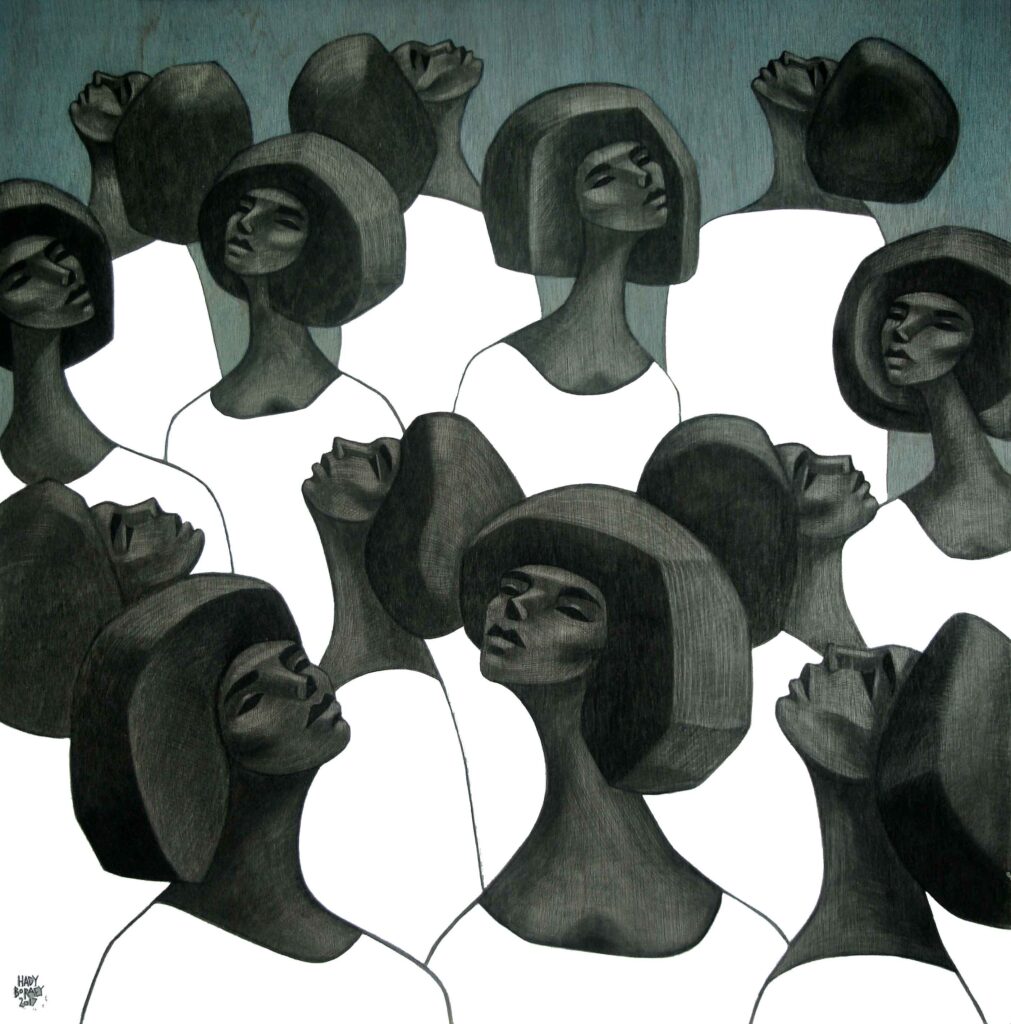
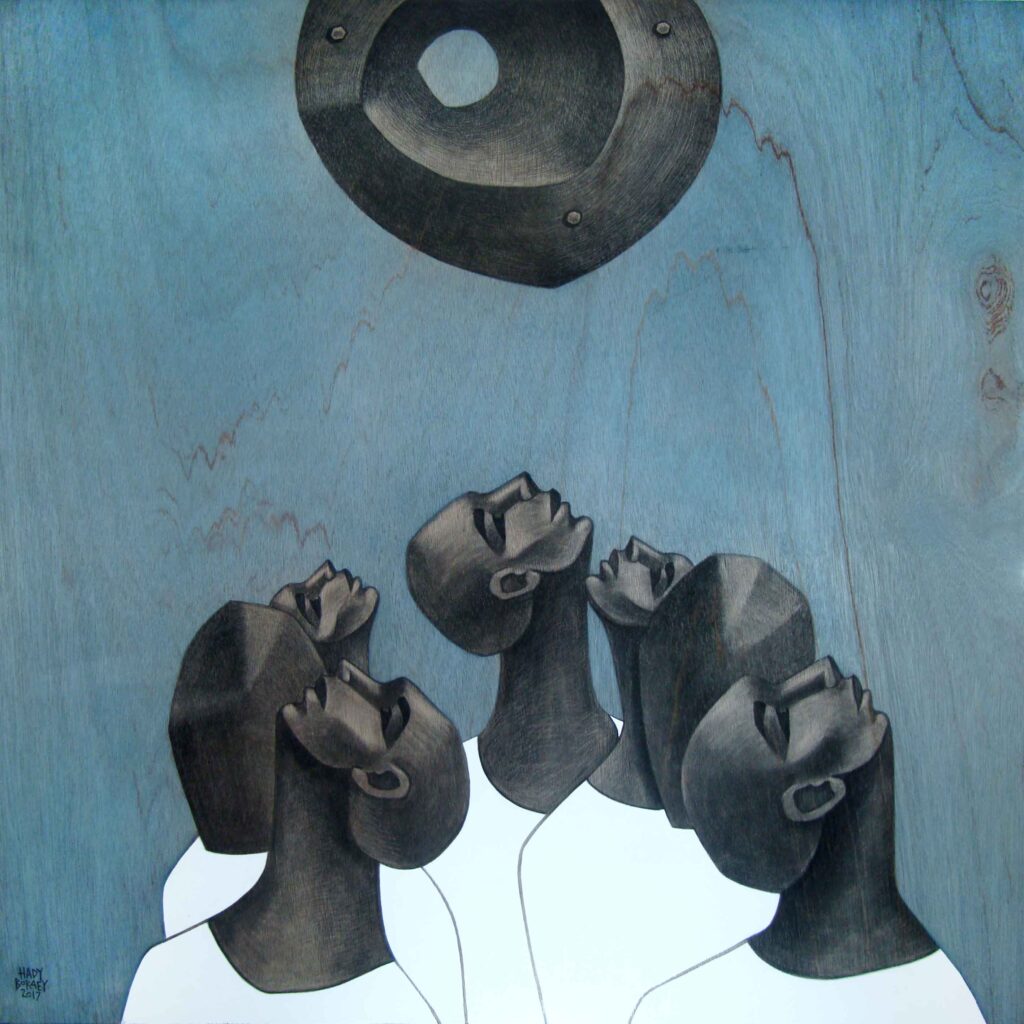
Hady Boraey, Hope is a Traveller, 2018, Acrylic on Wood, 80 x 80 cm.
© Courtesy of the artist.
Hady Boraey, Hope is a Traveller, 2018, Acrylic on Wood, 100 x 100 cm.
© Courtesy of the artist.
By 2017, something stranger enters the figure itself. The bodies become increasingly elongated, impassive, almost extraterrestrial. The effect bridges two apparently opposite references: they look archaeological and futuristic at once. Boraey no longer needs to place his people in unfamiliar territory, because the body itself has become unfamiliar.
The decisive consolidation arrives in Hope Is a Traveler, held in Egypt in 2018. The exhibition brought together approximately thirty oil paintings on wooden board and four papier-mâché sculptures, using a cooler palette of grey, black, white, and diluted blue. Here, Boraey’s central contradiction becomes fully legible: his bodies are built like monuments, while the titles are filled with movement. In Anchored I, birds cross the upper part of the painting horizontally, contradicting the apparent fixity of the title. In the title work, Hope Is a Traveler, a crowd carries a large creature in what resembles a collective ritual. Eternal Search compresses figures into a tight group while each looks in a different direction; in Hope Is a Seed, grey bodies are distributed more loosely across the surface. Hope moves more easily than the human body, yet Boraey repeatedly suggests that it gains force when carried between people.
The pandemic interrupts that horizontal journey. Line of Descent, created in 2020, is visually harsher and psychologically more compressed than much of the surrounding portfolio. In The Tree, Boraey isolates Adam and Eve at the moment before tasting the fruit. In The Confusion, crows stand for thoughts about existence and human purpose. Guiding Light connects the stars above the figure to spiritual direction, while Blue Hope asks whether rescue remains possible as the world appears to sink.


Hady Boraey, The Tree, 2020, Mixed Media on Hard Board, 50 x 35 cm.
© Courtesy of the artist.
Hady Boraey, Guiding Light, 2020, Mixed Media on Hard Board, 50 x 35 cm.
© Courtesy of the artist.
Symbols that once accompanied the body now seem to enter it. Birds swarm across faces, clouds press downward, and spiritual signs become physically invasive. The traveler has nowhere to go, so the work reorganizes itself vertically. One can sink or look up.
During lockdown, Boraey described feeling terrified and helpless, while maintaining contact with old friends, meditating, cooking, reading, and beginning a project on transparent paper that layered text, maps, photographs, and drawings.
He did not understand the artist’s role in that crisis as purely private. Boraey argued that artists inherit a responsibility to study how earlier generations responded to catastrophe, document its psychological effect on society, and translate a shared event through distinct perspectives. That process offers a useful context for the density of Line of Descent. When the world became difficult to read, he placed several ways of reading it on top of one another.
His brighter 2021 portfolio does not simply cancel the darkness of 2020. But color returns before certainty does. Eden Dance, born from the pandemic and the desire to reconnect with nature, surrounds stoic figures with cacti, leaves, budding plants, birds, stars, and sunlight. The bodies remain recognizably Boraey’s, but the world around them has more air. In 2022, he begins testing the figure itself more openly, altering its treatment rather than relying on one fixed template.
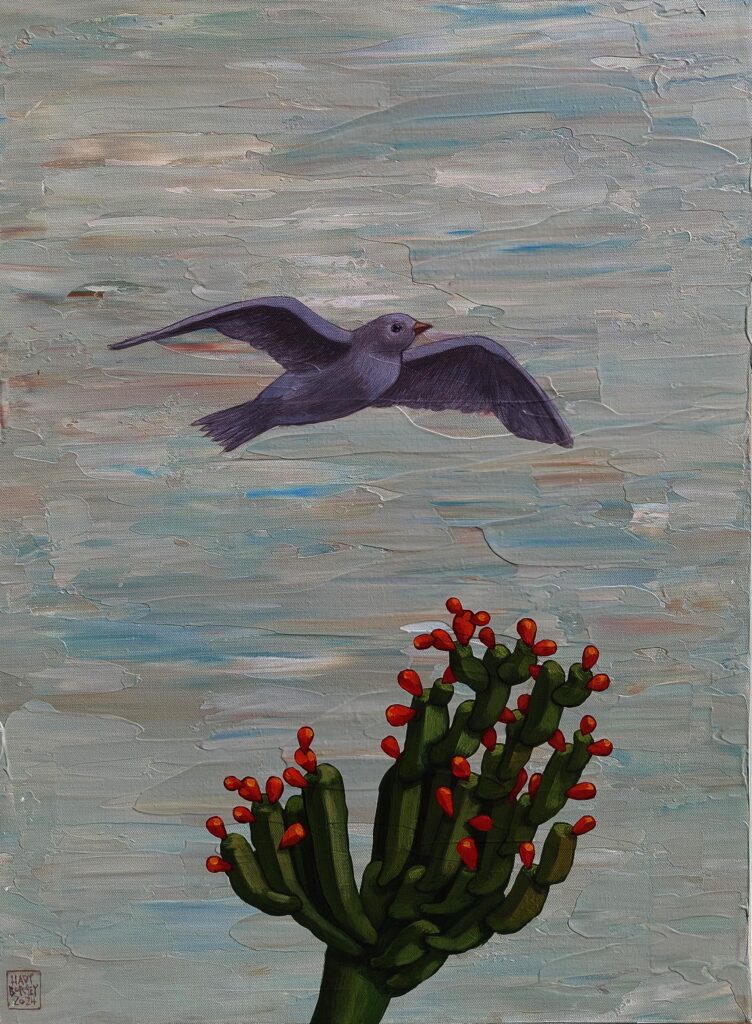
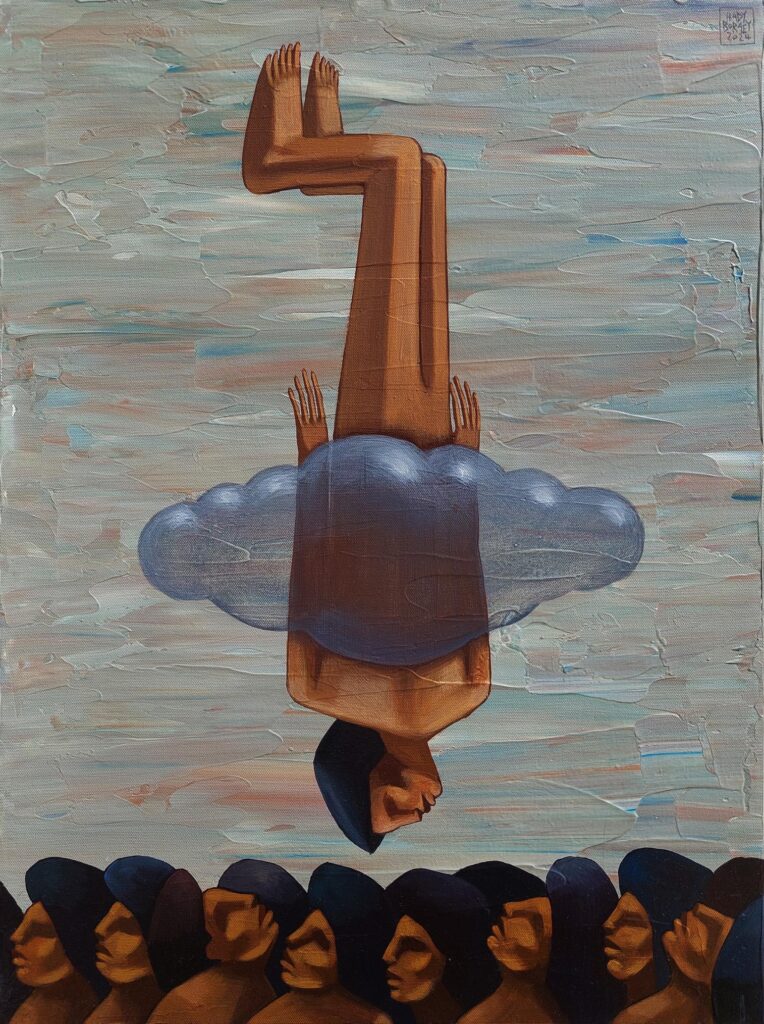
Hady Boraey, From Mud to Sky, The Dove’s Return, 2024, Acrylic on Canvas, 61 x 46 cm.
© Courtesy of the artist.
Hady Boraey, The Prophet’s Gaze, 2024, Acrylic on Canvas, 61 x 46 cm.
© Courtesy of the artist.
The 2024 body of work, exhibited in 2025 as Migrants to the North, shows this long process at its clearest. The series grew from Boraey’s childhood memories of his father’s library and stories of sailors, immigrants, snow, forests, and distant northern lands. He has recalled believing those illustrated stories as though they were historical events and imagining himself as their hero.
The Pharaonic inheritance remains, but it has changed function. It is no longer announced through historical costume or quotation. Frontality, profile, symbolic scale, and hieratic calm now organize contemporary scenes of migration. The past has stopped appearing as subject matter and begun operating as structure.
Across the untitled 2024 paintings, Boraey works in vertical, square, panoramic, and four-panel formats. The wide compositions are particularly revealing. They give people room to travel beside one another, carry together, or face a common direction. Some figures retain faces and vivid color. Others are pale, faceless, or absorbed into the group. Anonymity is carefully measured rather than universally imposed.
Boraey appears to think about humanity at three scales: the solitary person who must confront the unknown, the pair that makes endurance possible, and the group capable of moving what one body cannot. His figures may be anonymous, but they are rarely unrelated.
His spiritual outlook is equally expansive. A practicing Muslim, Boraey has described the impulse behind his work as humanistic, viewing different faiths as pathways toward the divine and peaceful coexistence.
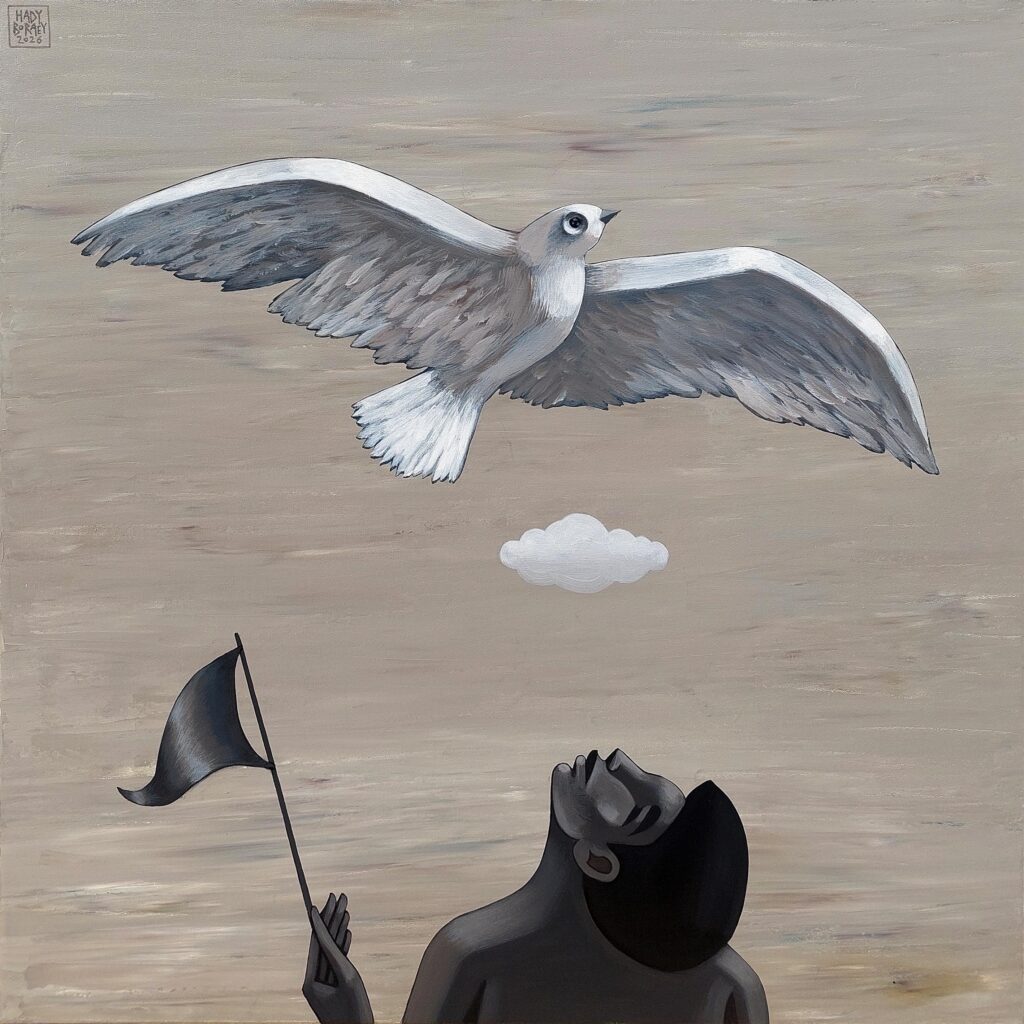
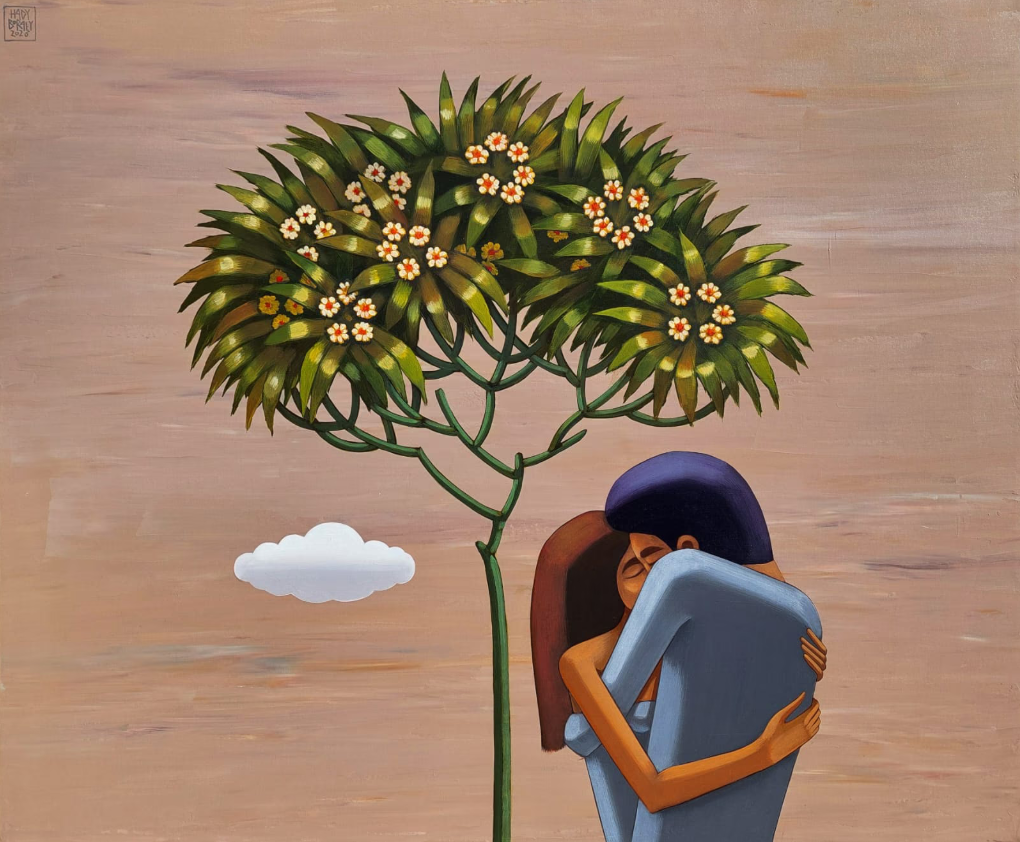
Hady Boraey, Untitled, 2026, Acrylic on Canvas, 90 x 90 cm.
© Courtesy of the artist.
Hady Boraey, The Kiss, 2026, Acrylic on Canvas, 105 x 95 cm.
© Courtesy of the artist.
By 2026, white dominates the portfolio. Peace is one possible reading, though the white is too overwhelming to behave as simple calm. It creates a shared visual field while threatening to absorb the differences between the people inside it. In NOAH: A Future Hope, Boraey is one of three artists from Judaism, Christianity, and Islam responding to the flood narrative and humanity’s responsibility toward the earth; each artist created eight paintings. The whiteness can therefore suggest cleansing, mourning, aftermath, or the difficult blankness of beginning again.
Boraey began as a child drawing beside the Nile and built a practice around people who keep searching without surrendering what they carry. His figures once looked beyond the border, then upward for guidance. Increasingly, they look beside themselves. Hope still travels in Boraey’s work, but its most convincing vehicle may be the people who learn to move together.