
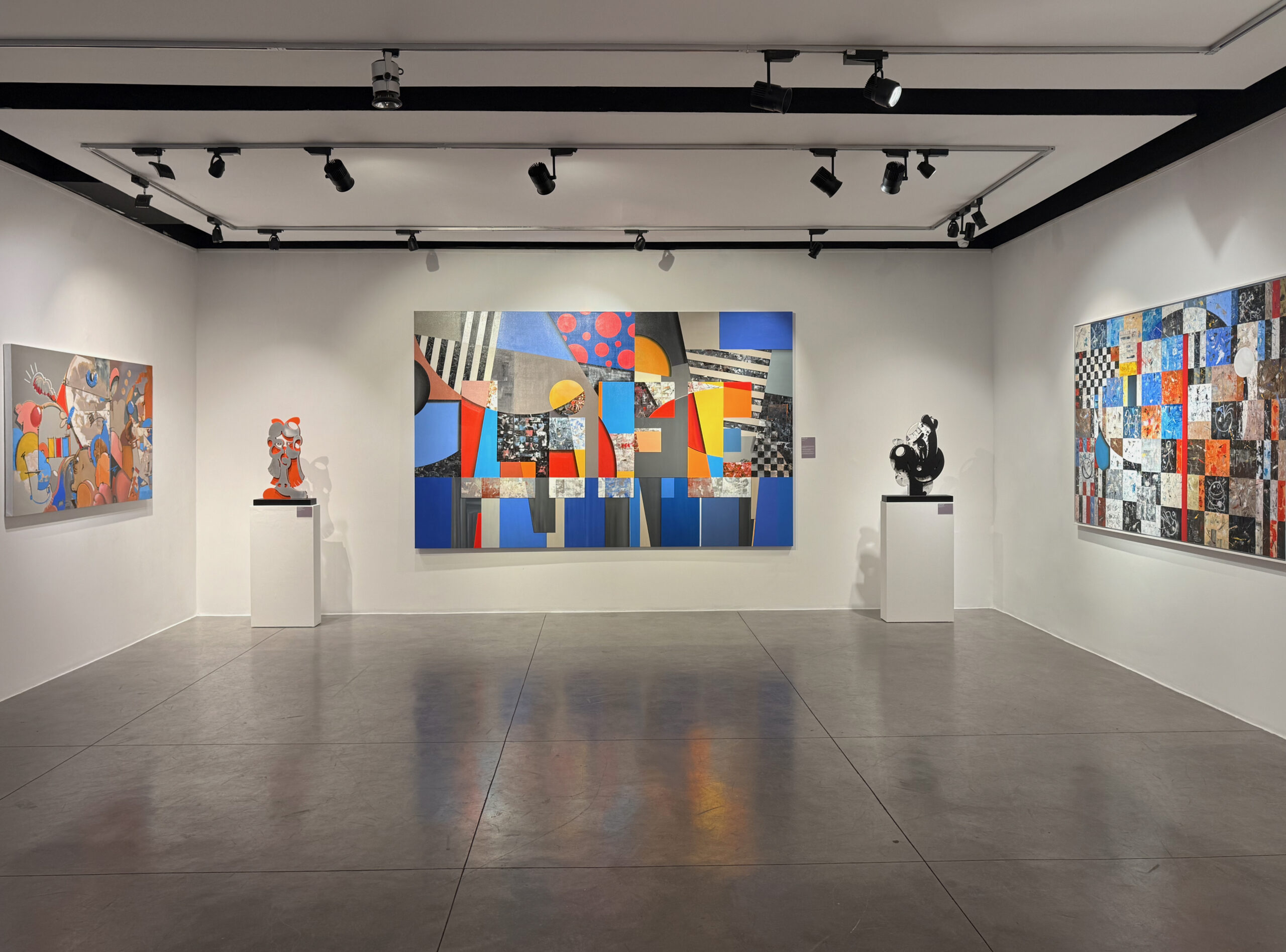
Ghazi Baker’s work doesn’t unfold so much as it deliberately unravels – and this, always with a sly sense of self-awareness. Born in Beirut in 1967 to Iranian and Armenian heritage, Baker grew up in a city where fragmented reality and contradiction were simply the default setting. His early years, marked by civil war, escape routes through Europe, and a steady search for beauty amid instability, created both the lens and fissures of his world view. It is perhaps no surprise that he would become first an architect, trained for order, and then a painter, consumed by the seductive pull of chaos.
This dichotomy would become the defining feature of his works. As a self-taught artist who came to exhibiting relatively late, Baker approaches the canvas with the discipline of blueprints and systems, and the rebellious instinct of someone who distrusts both. Among the references that surface across his work – Basquiat’s brashness, Bacon’s distortion, Moebius’s line – there is also the unmistakable imprint of Derrida, Foucault, and Merleau-Ponty.
Baker often describes his process as a kind of ongoing argument with himself. He resists tidy narratives, and even more so the expectation of self-explanatory work. In media conversations, he repeatedly jokes that his paintings are “conversations I lost track of halfway through”. But the truth beneath the humor is that Baker is not interested in resolution. The ‘unfinished’ is the point.
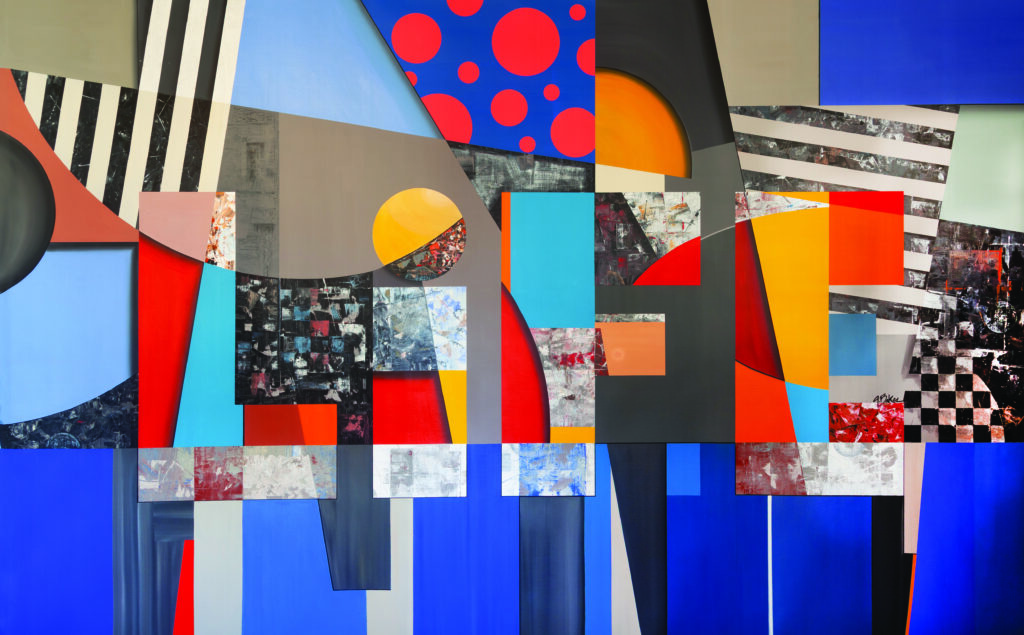
Nowhere is this more evident than in In Entropy, the exhibition that took two years of “meticulous unplanning”, as he puts it. Baker speaks of the show as something excavated rather than produced, shaped by overthinking, insomnia, and an ongoing flirtation with the absurd. Here, “dyslexic architecture” becomes a form of rebellion – structures leaning, misbehaving, refusing to submit to the rationality he was taught as an architect. Baker constructs cities where the grid is exhausted, perspective takes detours, and geometry negotiates with its own instability. In his universe, meaning buffers, memories glitch, and the façade is often the only thing holding the composition (and perhaps the subject) together.
The environment where he paints is equally complicit, he’s said; his studio floor becomes a physical record of decisions, miscalculations, and color trails that never make it to the canvas.
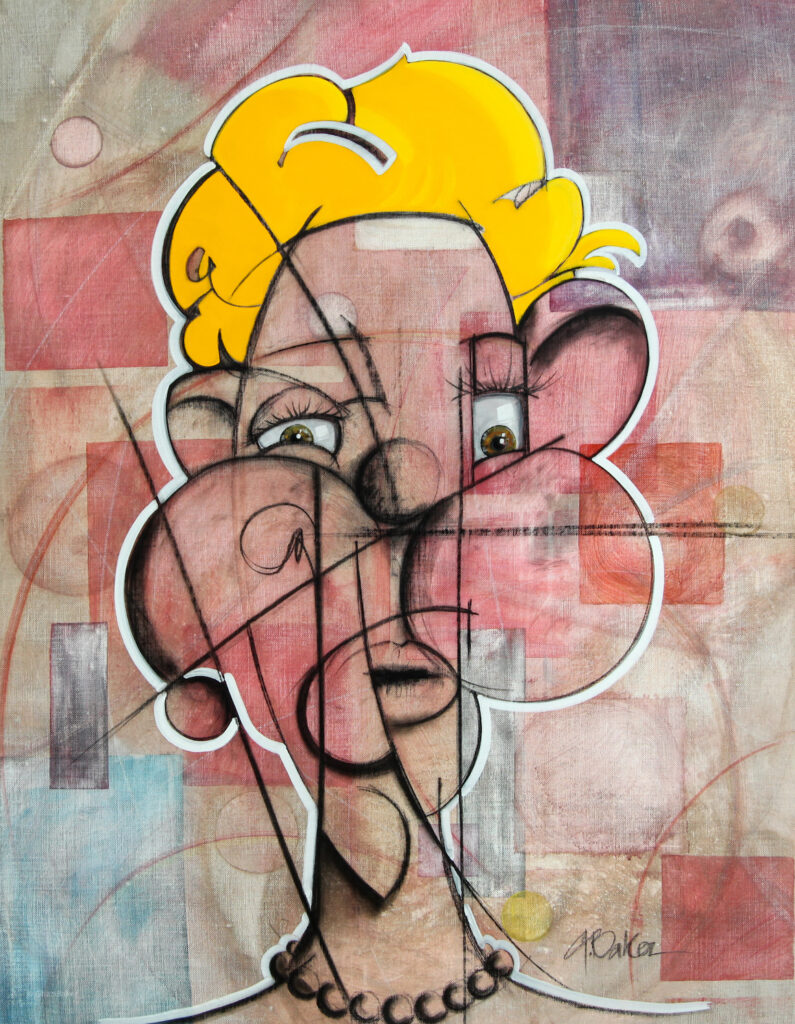
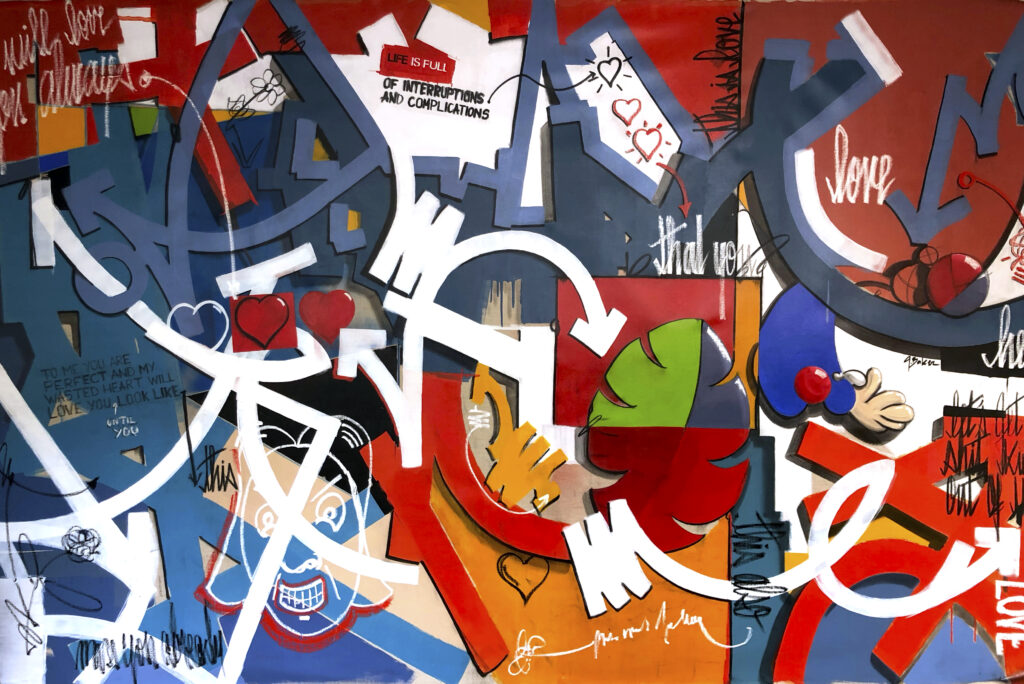
Despite the cerebral core of his work, Baker’s imagery often carries a playful, even mischievous visual energy. There are echoes of comics, signage, graffiti, speed, machines, anatomy, and industrial design. His aesthetics lean into the absurdity of contemporary life. Yet beneath the satire lies more tender curiosity and honesty. Baker is not simply observing, but rather living inside the condition he’s describing; Beirut’s beauty and volatility, its unending negotiation between destruction and invention, run through his work.
In recent years, Baker’s trajectory has been marked by institutional attention, international exhibitions, collector demand, and a growing presence in Europe and the Gulf. His works have entered foundation collections in Beirut, Dubai, Paris, New York and beyond. He’s been invited to show at the Rijksmuseum. And his paintings consistently exceed auction expectations. Yet he remains decidedly more interested in the glitch than the gesture, more committed to the failure of systems than their perfection.
In a world increasingly obsessed with clarity, branding, and curated coherence, Ghazi Baker paints the cracks, the overlaps, the misfires, and the half-truths. His art sits with the chaos, uncomfortable as that may be. And it lets entropy be.