
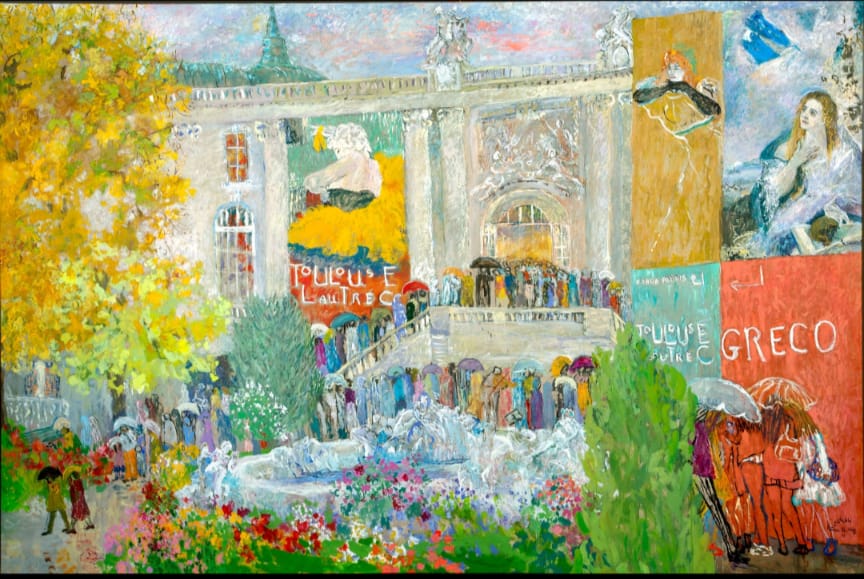
In the final pages of Candide, Voltaire arrives at the deceptively simple conclusion that we must cultivate our garden. After a long journey through human suffering, philosophical arguments, and the absurdities of existence, the garden offers a place where thought gives way to action, and where meaning can be harvested through patient, deliberate work.
Lebanese painter Fatima El Hajj has spent much of her artistic life cultivating gardens of her own with extraordinary command of color. Some belong to places she has known, from the hills of South Lebanon to the parks of France, Morocco and Yemen. Others exist only in memory or imagination.
Yet there is something about El Hajj’s paintings that makes the Voltaire parallel especially compelling. The apparent serenity of her gardens conceals a much more complicated emotional landscape. There is, certainly, pleasure. But there are also equal parts of loss, longing, doubt and the hard labor of making sense of one’s experiences.
To understand how those worlds came to inhabit her canvases, it helps to return to a little girl who could usually be found hiding between two bushes or climbing a tree.
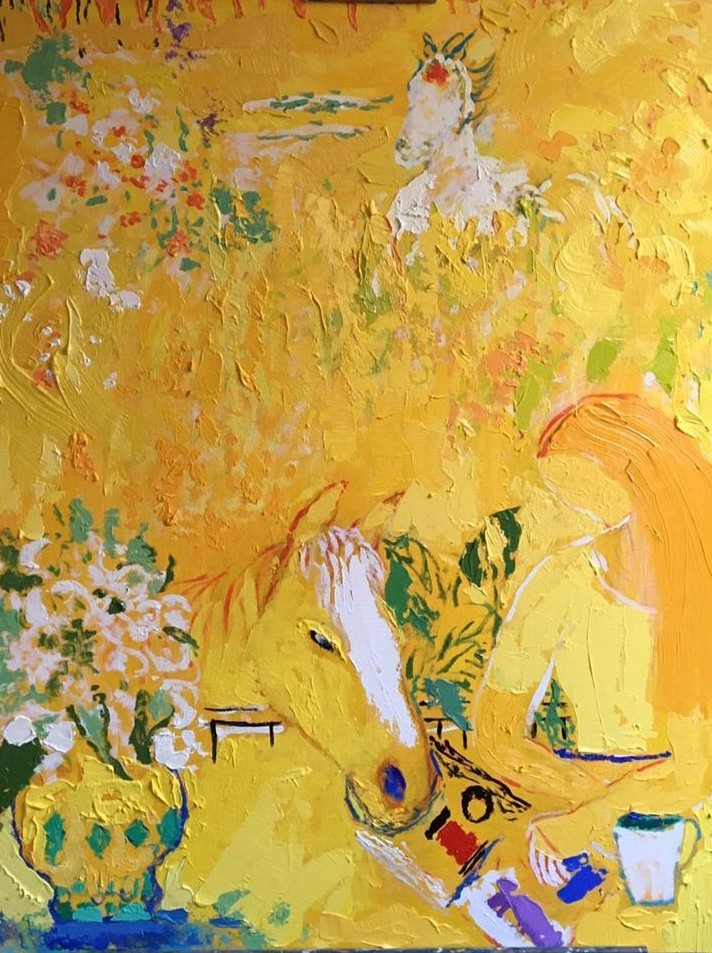
La Lecture, La Sérénité (2025)
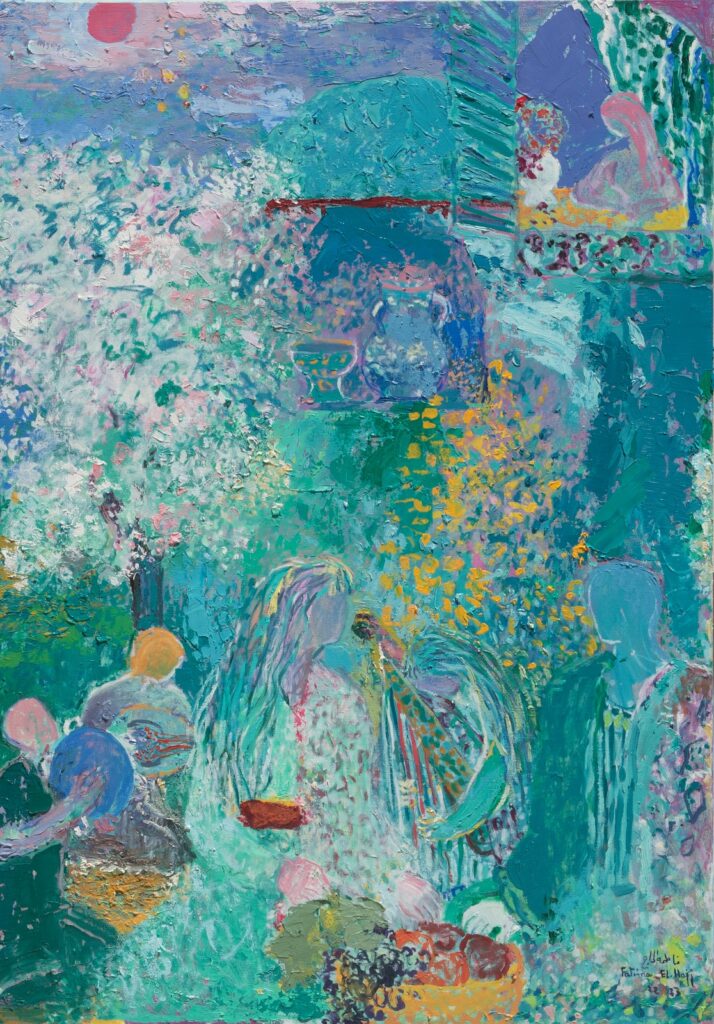
Le Pavillon Turquoise (2022-23)
Growing up in Rmeileh, near Saida in Lebanon, El Hajj spent her summers in Wardanieh, where olive harvesting brought entire families together. Her childhood was filled with plants she tasted, identified and committed to memory. These were years of absorbing the scents, colors and textures of the landscape, long before she knew they would become the substance of her painting.
Her curiosity extended beyond botany. Fascinated by her elder brother’s experiments in biology, El Hajj initially intended to study medicine, an ambition eventually ruled out by its cost. Painting offered another outlet for that same instinct to observe and investigate, more so after a school assignment challenged her to reproduce the precise colors of another artist’s work.
That curiosity never entirely disappeared. Her later gardens often seem to combine the attention of someone studying nature with the freedom of someone willing to reinvent it.
In one composition, two pale horses emerge from an expansive yellow field, their bodies almost absorbed into the surrounding vegetation. In another, human figures seem to surface from layers of blue, turquoise and white. In both, El Hajj leaves the boundaries between subject and setting unsettled.
The eye moves between recognition and abstraction, much as memory shifts between what we can recall and what we can only feel.
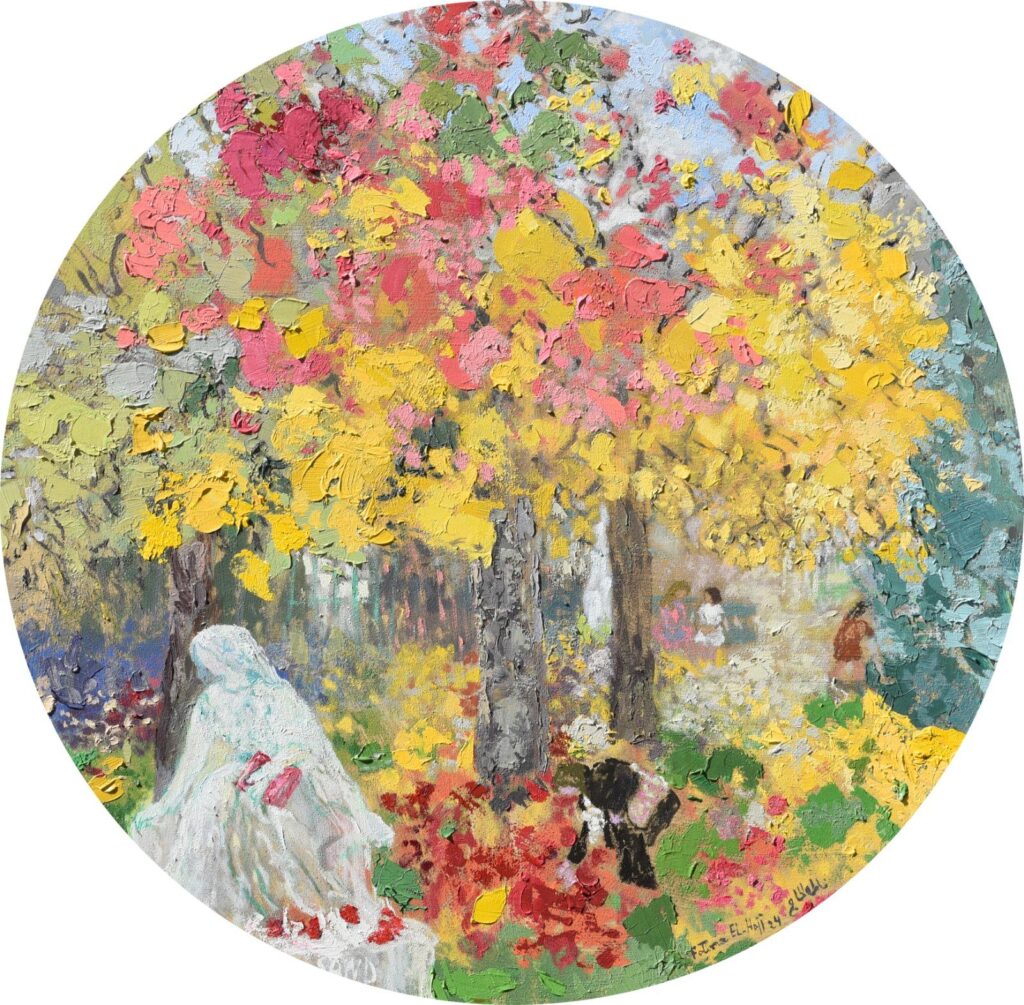
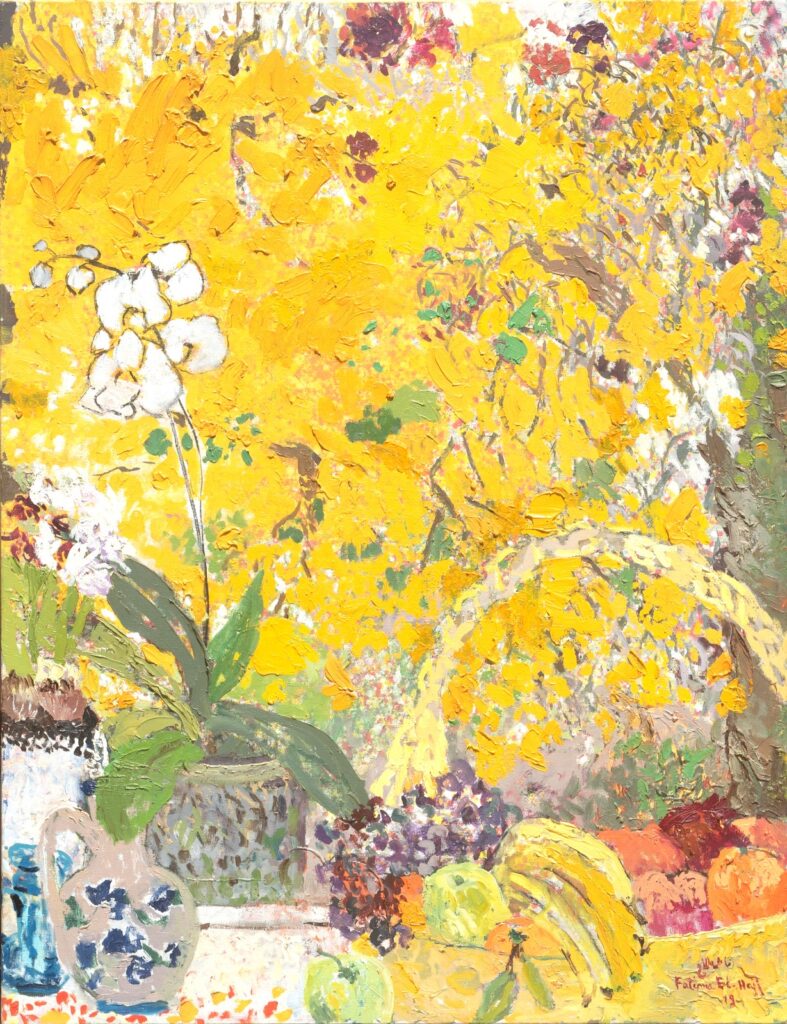
George Sand à Luxembourg (2024)
Image courtesy of the artist and Anima Gallery
De ma Fenêtre à Créteil (en automne) (2019)
Image courtesy of the artist and Anima Gallery
That freedom was hard won.
El Hajj studied at the Lebanese University’s Institute of Fine Arts before continuing her training in Leningrad and, later, Paris. Her experience in Leningrad was far from smooth sailing. The rigorous emphasis on anatomy and technical drawing left little room for the expressive freedom she had known in Lebanon. She felt suffocated by the curriculum, longed for the colors of her garden, and confronted a professor whose criticism of a drawing inspired by her brother’s wedding struck her as dismissive of her culture. Paris offered a different atmosphere, one in which experimentation and artistic independence could flourish.
For El Hajj, color has always represented a form of personal and cultural expression she was unwilling to surrender.
Her relationship with her teachers reveals another important dimension of that artistic independence. Among the artists who shaped her early development were Amine El Bacha and Shafic Abboud. The former was her guide to thinking and the latter, her guide to action.
That interplay between thought and practice continues through her work. While her admiration for Abboud, Bonnard, Vuillard and Matisse is evident in her treatment of color and intimate scenes, El Hajj developed a different visual language in which landscapes, people and memories increasingly inhabit the same painted space.
Music forges another relationship between color and feeling. El Hajj’s paintings frequently feature instruments, musicians and people gathered in moments of leisure or contemplation. One review drew a parallel with Baudelaire’s Correspondances, where perfumes, colors and sounds communicate through a shared sensory language.
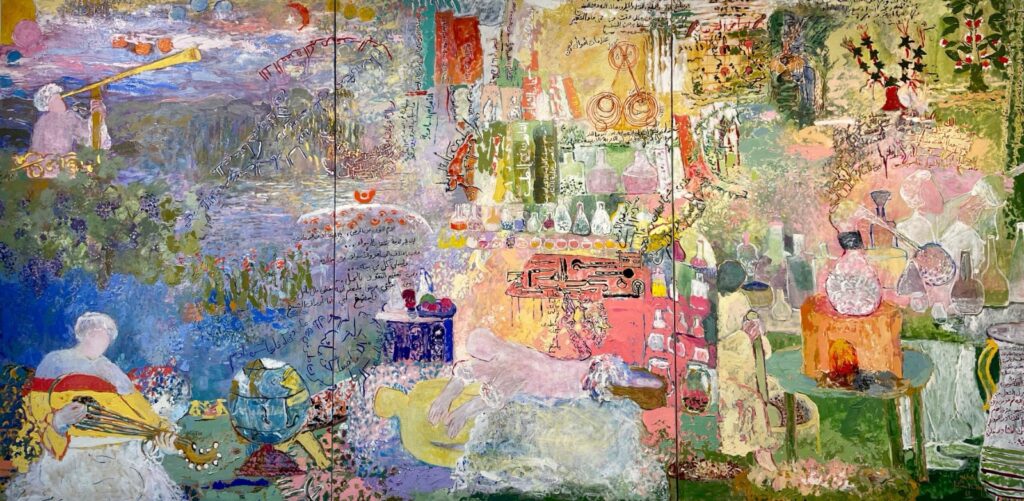
Avicenne – triptych (2021)
Image courtesy of the artist and Mark Hachem Gallery
For all their color and apparent lightness, however, El Hajj’s works are not always places of uncomplicated happiness.
In a 2019 interview, she described a period when grief had made painting almost impossible. Her sister had died after a long illness, leaving young children behind. Following a violent storm, El Hajj discovered that the banana trees in her garden had been uprooted. One branch still held several bananas, and the sight brought her sister and her children immediately to mind. She returned to drawing, translating that painful association into an image whose meaning would remain invisible to anyone unfamiliar with its origin.
The story complicates the peace of El Hajj’s gardens. What looks like an ordinary study of nature can conceal an intensely personal history. The abundance of color is not the absence of grief.
This is palpable in the historical and mythological subjects that entered her work in response to more recent events. It was during the COVID-19 lockdown in Paris that El Hajj learned of the Beirut Port explosion. The event triggered a profound spiritual estrangement, and she began developing a series of works informed by Lebanon’s history, poetry and mythology. In her Balades Levantines exhibition, figures including Elissar, Europa, Avicenna and characters inspired by the Persian poet Nizami appeared in an imagined world connecting histories and cultures.
Her painting Elissar (2020) is revealing. El Hajj was drawn to the figure who, according to the legend she recounts, chose to establish a new civilization rather than perpetuate a destructive conflict. The subject offered a way to consider catastrophe through the possibility of renewal. The garden had expanded into a place where myth, historical memory and contemporary anguish could meet.
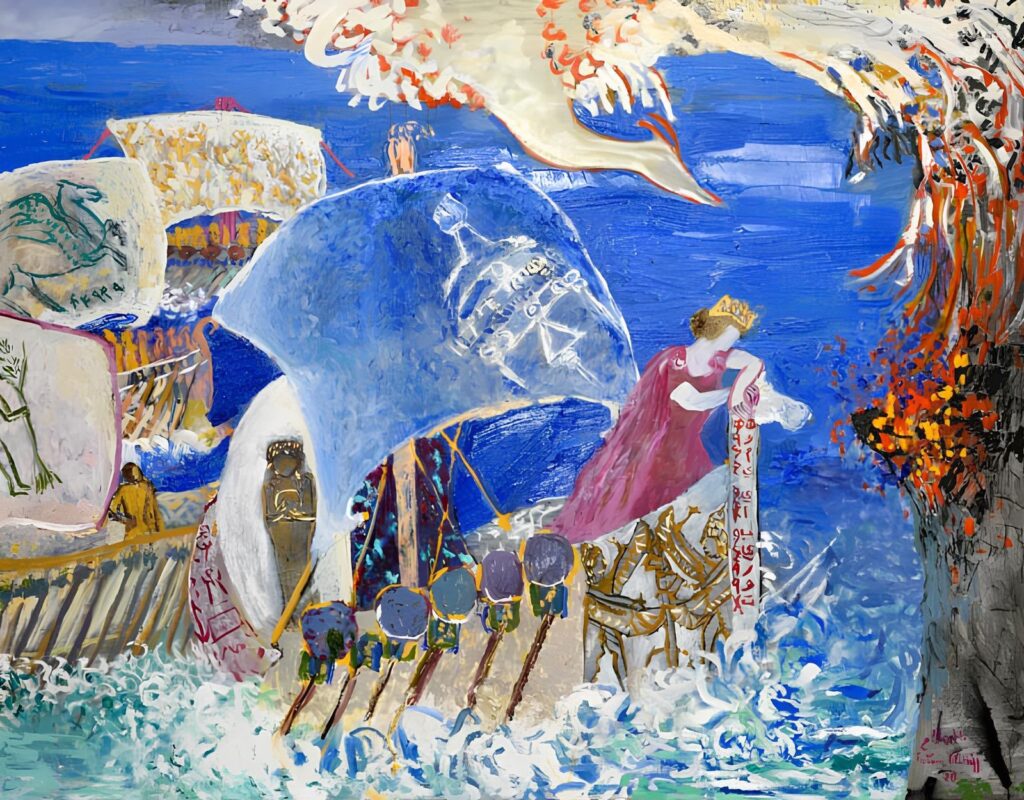
Elissar (2020)
Image courtesy of the artist and Mark Hachem Gallery
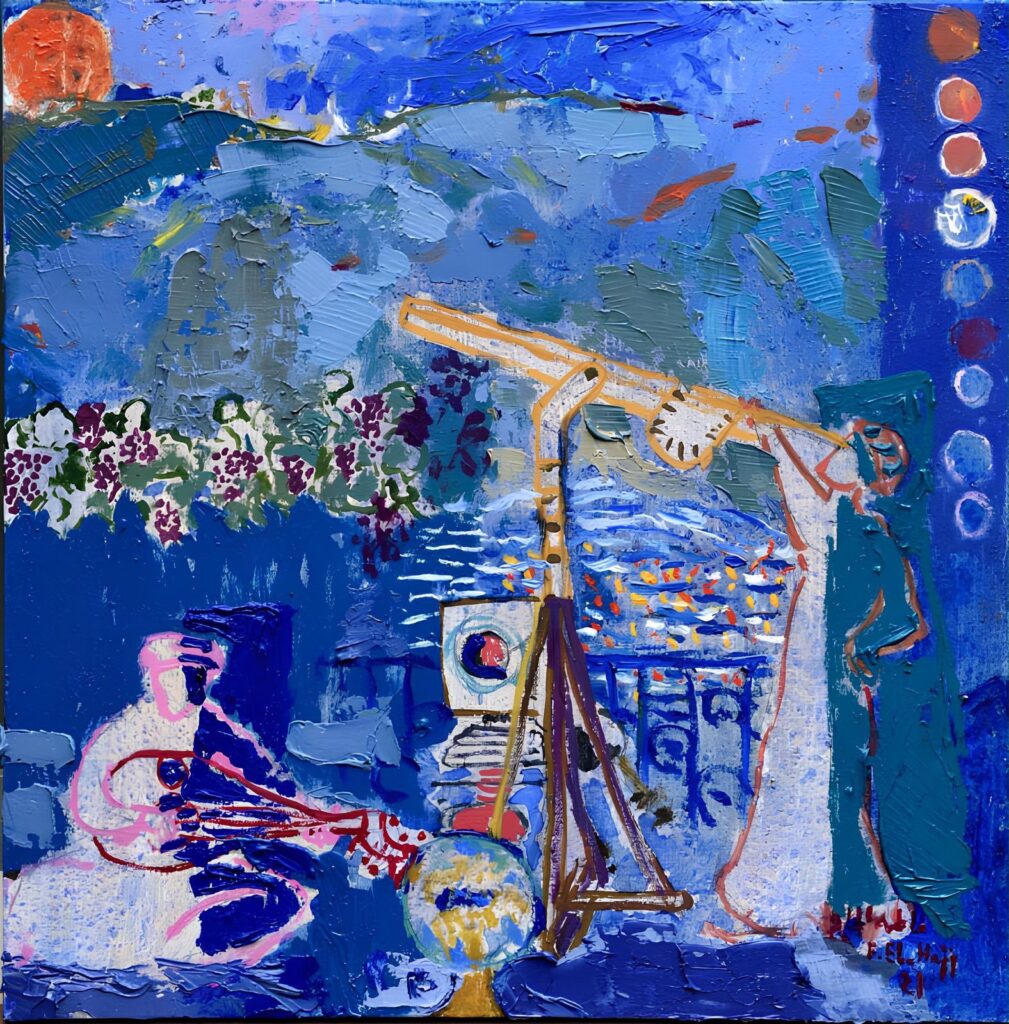
Etude pour Avicenne (2021)
Image courtesy of the artist and Mark Hachem Gallery
Works such as Le Pavillon Blanc (2020) and Etude pour Avicenne (2021) carry her familiar layering of color into imagined historical and intellectual settings. The garden has expanded, accommodating figures and stories drawn from different cultures without abandoning the visual language she spent decades developing.
That continuity becomes even clearer when looking at her more recent exhibitions. Une Promenade dans la Nature (2023), La Robe des Saisons (2024) and Musique et Lecture (2025) return, at least in their stated themes, to nature, seasonal change, music and the intimate pleasures of contemplation.
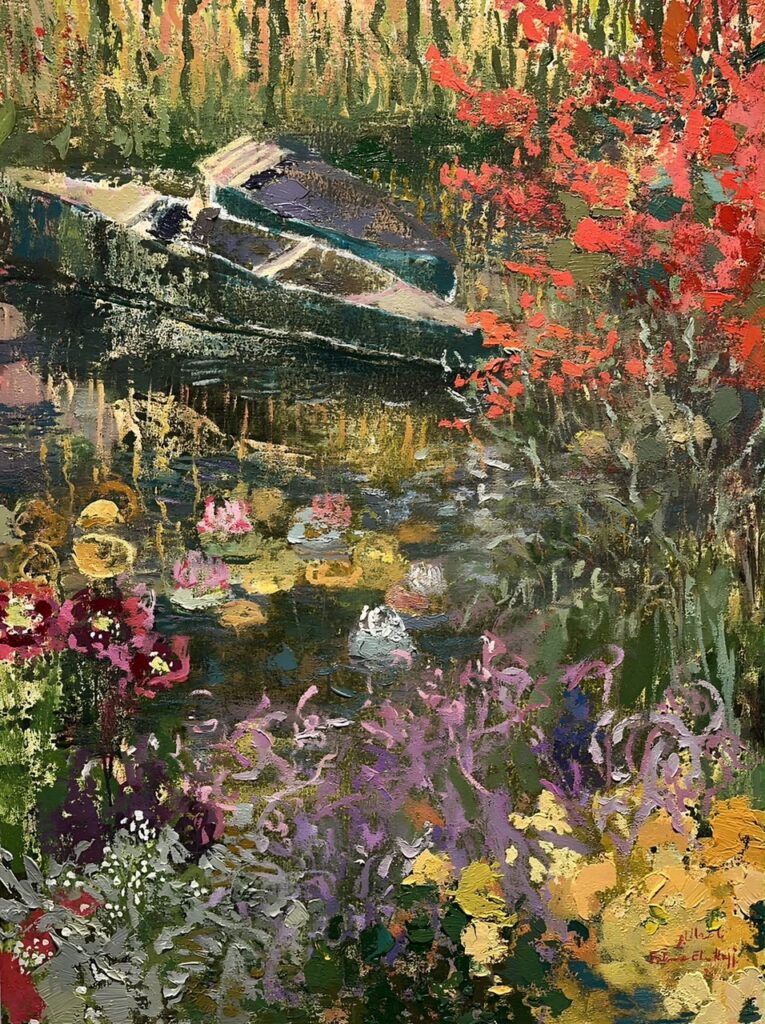
In Barques à Giverny (2025), a boat is partially obscured by dense vegetation and bursts of red, pink, yellow and green. The subject almost disappears into the surrounding color, while the accumulated marks produce a landscape that feels both observed and remembered. The painting suggests that the garden remains open to reinterpretation. Perhaps this is where the philosophical significance of El Hajj’s work becomes most apparent.
Voltaire’s garden was a proposition about how to live in a world that could never be fully understood or controlled. El Hajj’s paintings seem to ask a related question: what can we cultivate within ourselves when the world outside refuses to remain still?
Her answer might be contained in one of her most revealing responses. Asked what she would place in a garden holding her entire life, she chose only a blank canvas and tubes of color.
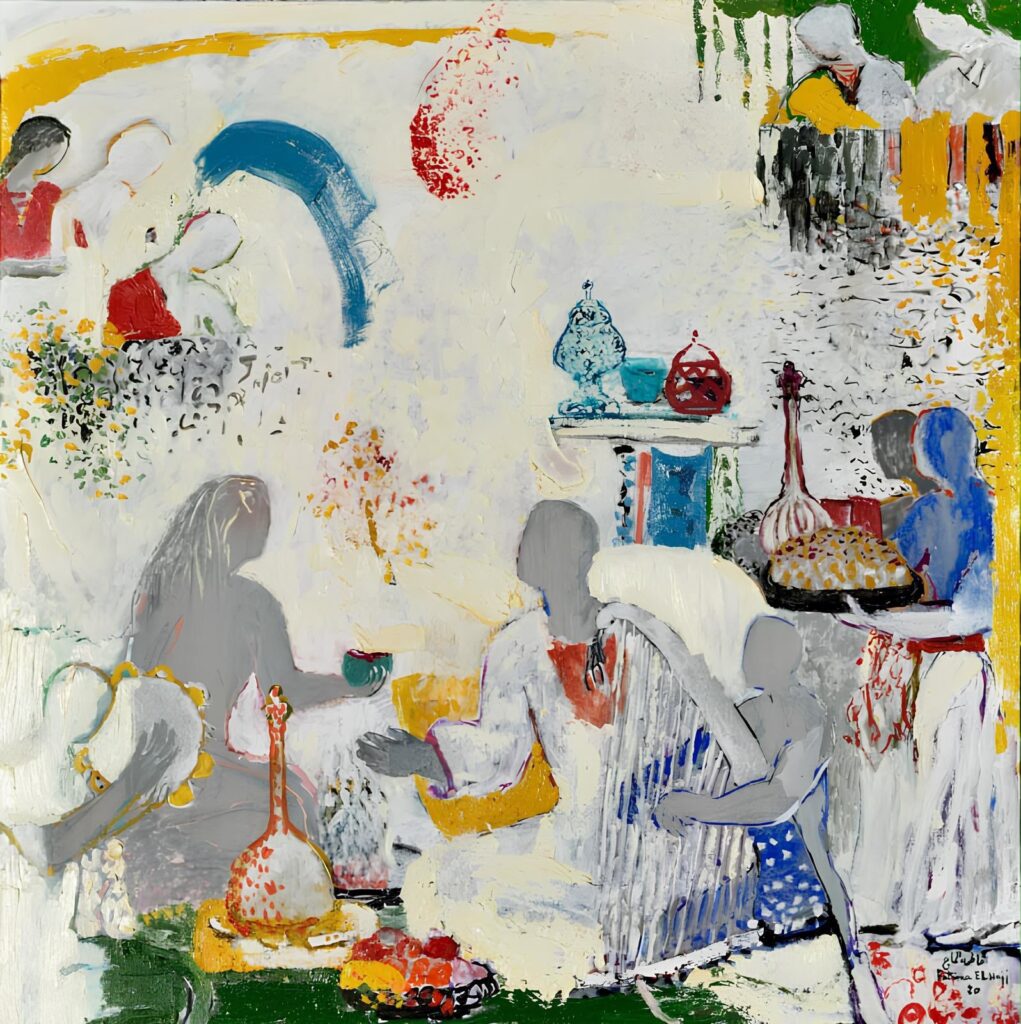
Le Pavillon Blanc (2020)
Image courtesy of the artist and Mark Hachem Gallery
Barquesà Giverny (2025)
Image courtesy of the artist and Mark Hachem Gallery