
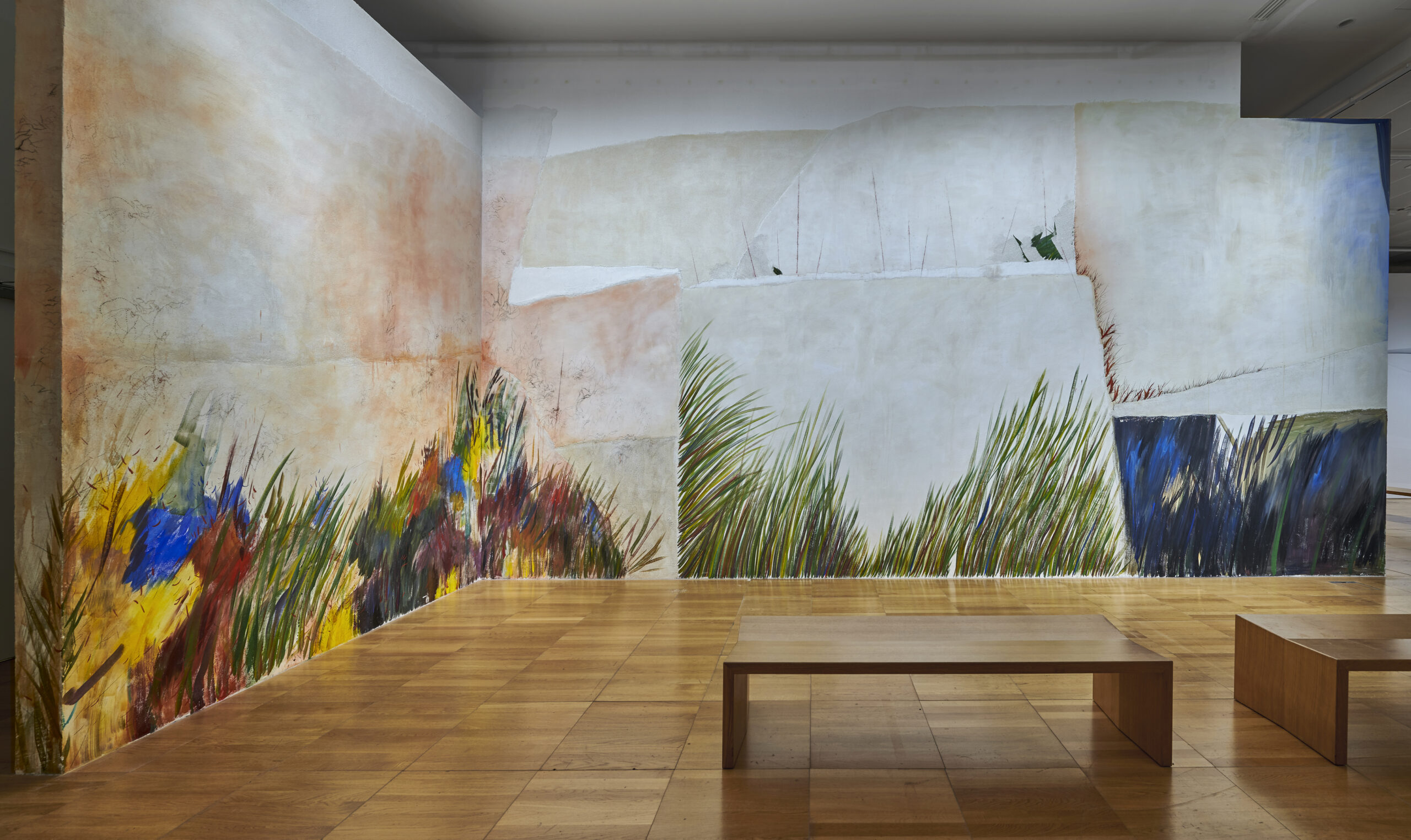
Breathing Grounds, 2024, Fresco on wall. NYU Art Gallery, Abu Dhabi. Curated by Maya Allison.
Before Chafa Ghaddar paints on surfaces, she listens to what they remember, what they conceal, and what they choose to let go of. Wall painting and surface finishing sit at the heart of her practice, not only as technique, but also as temperament. The kind you develop when you grow up watching a home age in real time. In Ghaddar’s world, wall is skin, weather, damage repaired, and time made visible.
Ghaddar’s story begins far from Beirut, in a part-village, part-coastal town in the South of Lebanon. She recalls her family’s house being the only one on a hill in the 1980s, surrounded by nature’s rawest and wildest, with no fence separating “outside” from the landscape. That early relationship to open space would shape her instinct for scale and physical intimacy with matter – both of which would strongly translate in her later works.
But the South also taught her another language: fragility. Her family home was severely damaged by surrounding armed conflict when she was only two months old. It burned, it remained standing, but it was wounded. And over time, that wound kept speaking. Humidity seeped into the walls, layers peeled, paint shifted chemically, surfaces weakened and demanded constant care. Watching deterioration become a cycle, and repair become a ritual, heightened her sensitivity “to surfaces and textures” – now a defining feature of her artistic vocabulary.
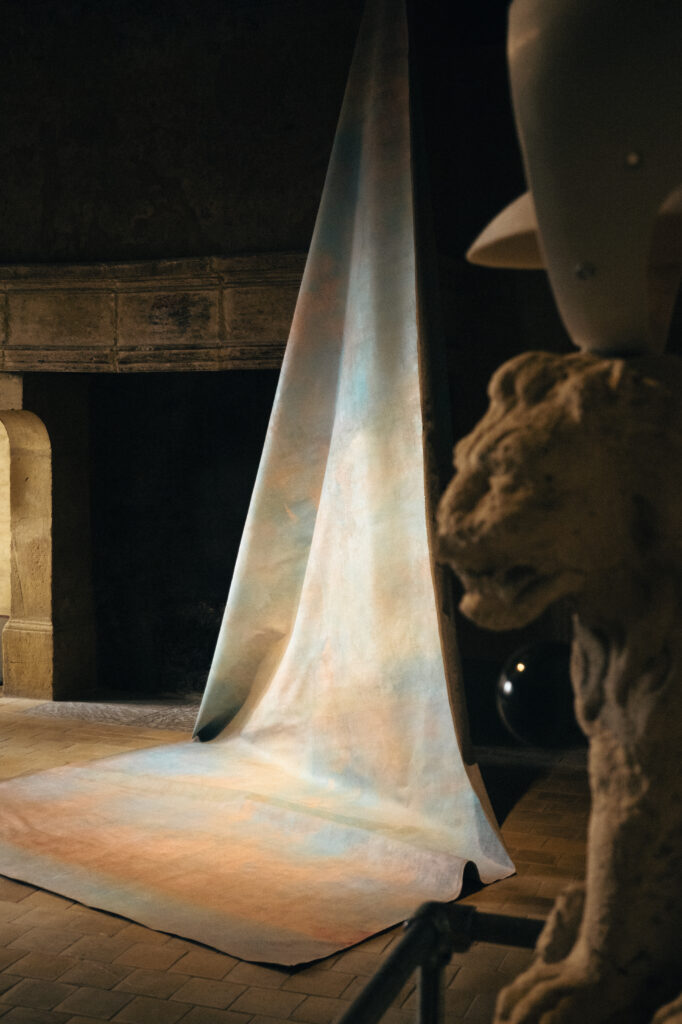
Exhausted Forms, 2022, Mixed Media on Linen Canvas, 680 x 280 cm.
Exhibited at the Lugdunum Museum and Roman Theatre. Photo Credit: Blaise Adilon & Biennale de Lyon.
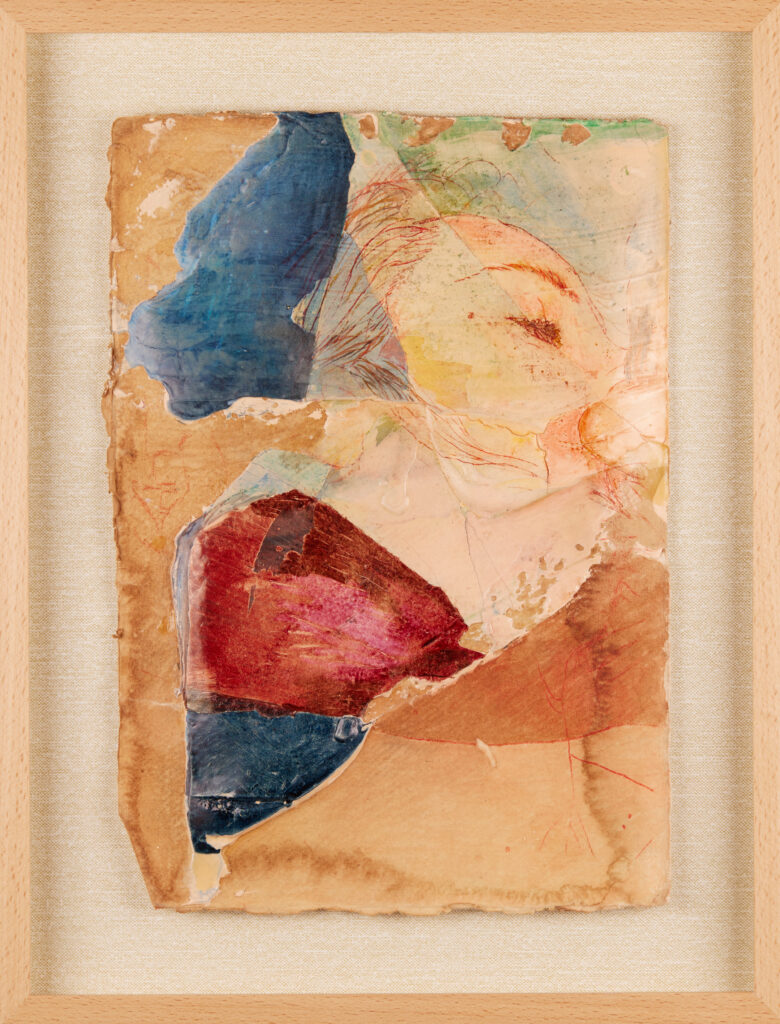
Lips, 2022 – 2023, Mixed media on Paper, 39 x 30 cm.
It makes sense, then, that her chosen medium is one that is both timeless and vulnerable. Fresco, historically associated with permanence, is for Ghaddar a paradox you can build a life around – that between construction in the early stages, and the inevitable degradation and decay of time. Ghaddar’s relationship to fresco traces back to her earliest years, assisting industrial painters and plastering walls upon graduating from the Academie Libanaise des Beaux-Arts (ALBA). Later, an intensive course in Florence deepened the tradition, but it was her lived relationship to wounded architecture that gave fresco its emotional gravity.
This relationship transpires even in her earliest works. In Spectrum (2012), her first fresco on an immense scale, she describes to Sandy Times feeling like “the little girl on the playground” offered a 12 x 6 meter wall, taking it all, extending the fresco “like a stretched skin”, a nod to the fire that perforated her house during the war.
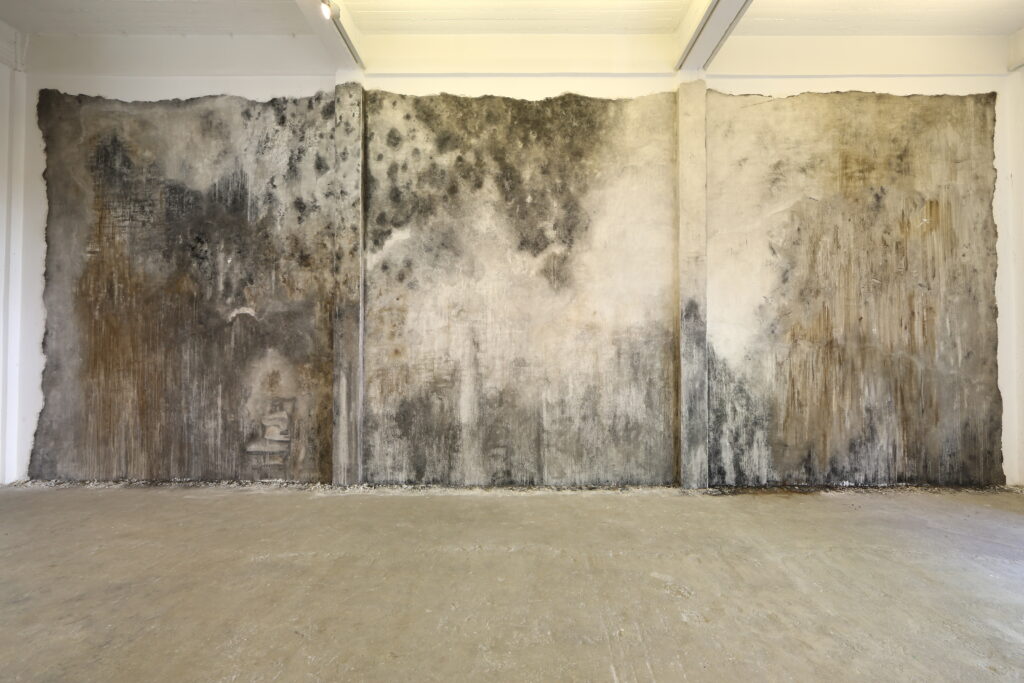
Spectrum, 2012, Fresco on Wall – Charcoal, ashes, and erosive iron powder on fresh lime mortar, 12 x 6 m.
Part of the collective exhibition Exposure, Beirut Art Center, Lebanon, 2012.
If Lebanon gave her the first vocabulary of land and damage, Dubai, where she moved in 2018, gave her the space to refine the questions. She speaks about the city as a kind of “elsewhere,” a portal that expanded, rather than replaced, the themes she carried from Beirut. She became deeply interested in atmosphere, haze, and fragmentation. She also made a deliberate decision to step away from commercial work, choosing instead to dedicate years to research, theory, and the slow cultivation of a language that is unmistakably her own.
Later works continue that insistence on surfaces as witnesses. In Beneath Latent Skies (2023), which also drew inspiration from her Southern home, she strips works away from the wall, presenting them on Indian cotton paper layered with coffee and tea, on wood, on fabric, allowing them to exist as both surface and object, both image and residue.
But perhaps because time transforms wounds, more cautious optimism and a sense of pragmatism are unraveling in Ghaddar’s more recent stories – and perhaps the realization that all things, good and bad, must come to an end. Nowhere is this more evident than in Your Sun that Kept Setting (2024), which saw the artist also returning to pre-Renaissance fresco techniques. In this series, she invites viewers to look at fragments as entities, rather than residue. She portrays landscape as a forever incomplete notion. And she draws inspiration from her own fascination with sunrises and sunsets, the markers of perpetual beginnings and ends.
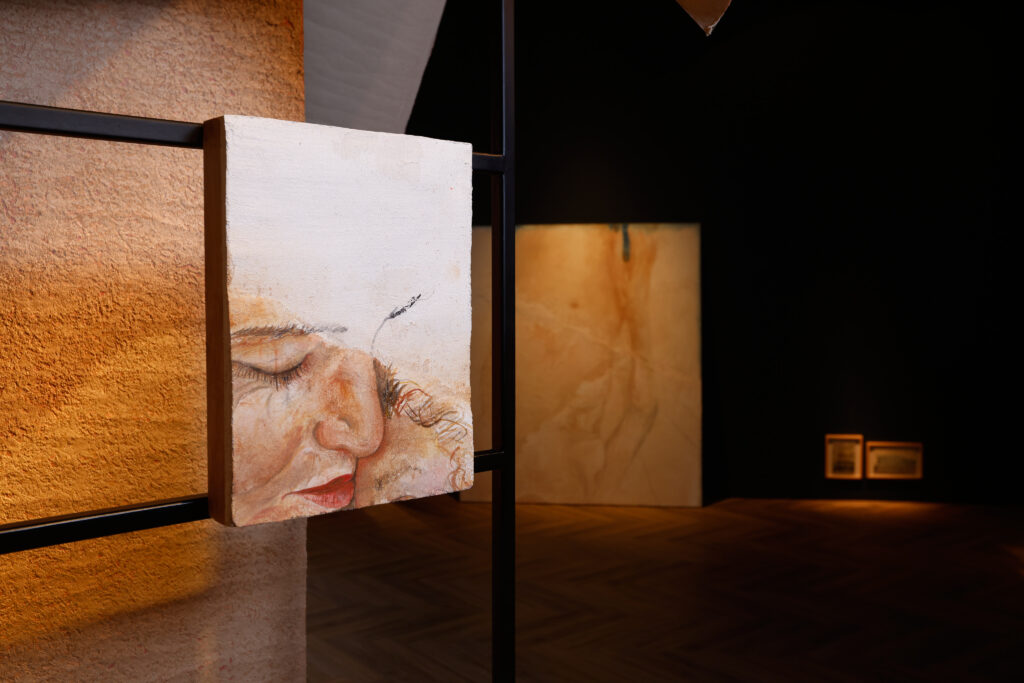
Embrace, 2022-2023, Fresco on Wood, 43 x 32 cm.
Part of the artist’s solo exhibition Beneath Latent Skies, at Tabari Art Space, Dubai, 2023.
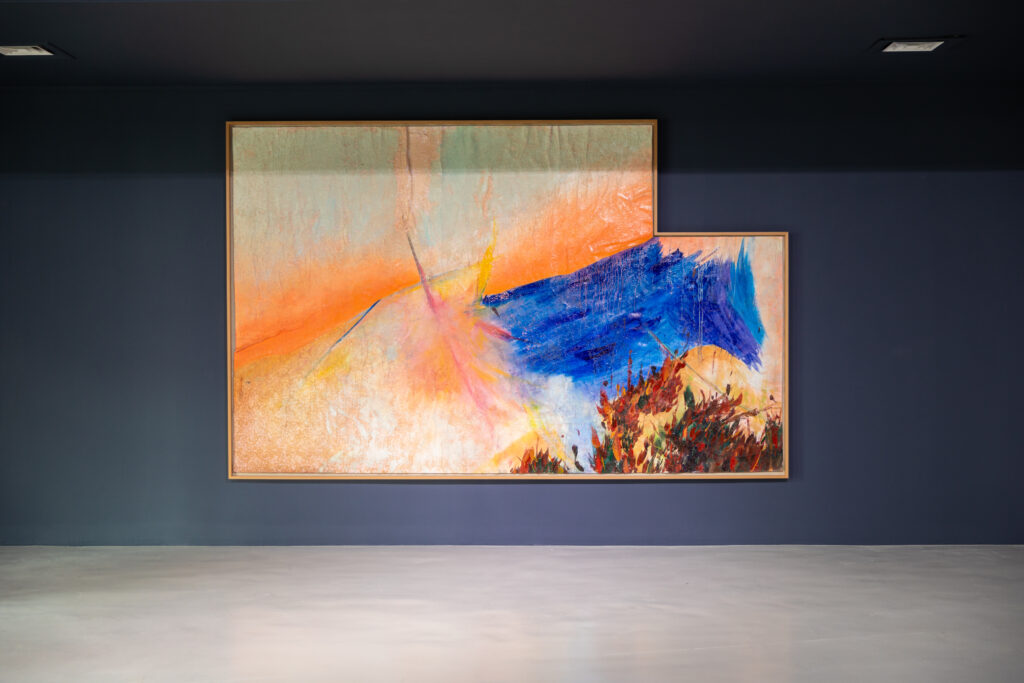
Land Filled, 2024, Mixed Media on Canvas, 185 x 223 cm.
Part of the artist’s solo exhibition Your Sun That Kept Setting, at Maraya Art Center, Dubai, 2024.
This anchor in the present has also extended to the public scale, where her biography and her medium meet the city directly. The tile mural I Am Still Learning, commissioned for Al Safa Public Library in Dubai, is a perfect Ghaddar gesture: a work about regeneration, surfaces becoming themselves over time, a building learning its next form. It is also, quietly, a statement about heritage in a young landscape, about what deserves preservation, and about the tenderness required to keep a surface alive. What makes Ghaddar’s practice so compelling is that it refuses the clean separation between place and person, between medium and memory. She speaks about the “manifestation of time on surfaces – physically, emotionally, almost psychologically”. The wall absorbs secrets. The wall holds trauma. The wall protects. The wall fails. The wall becomes a body, and the body becomes a landscape, and the landscape becomes a fragment that can somehow stand on its own, complete even in its incompletion.
In Ghaddar’s world, nothing is fixed forever, and that is not a threat. It is the point. It is how a surface proves it has lived.
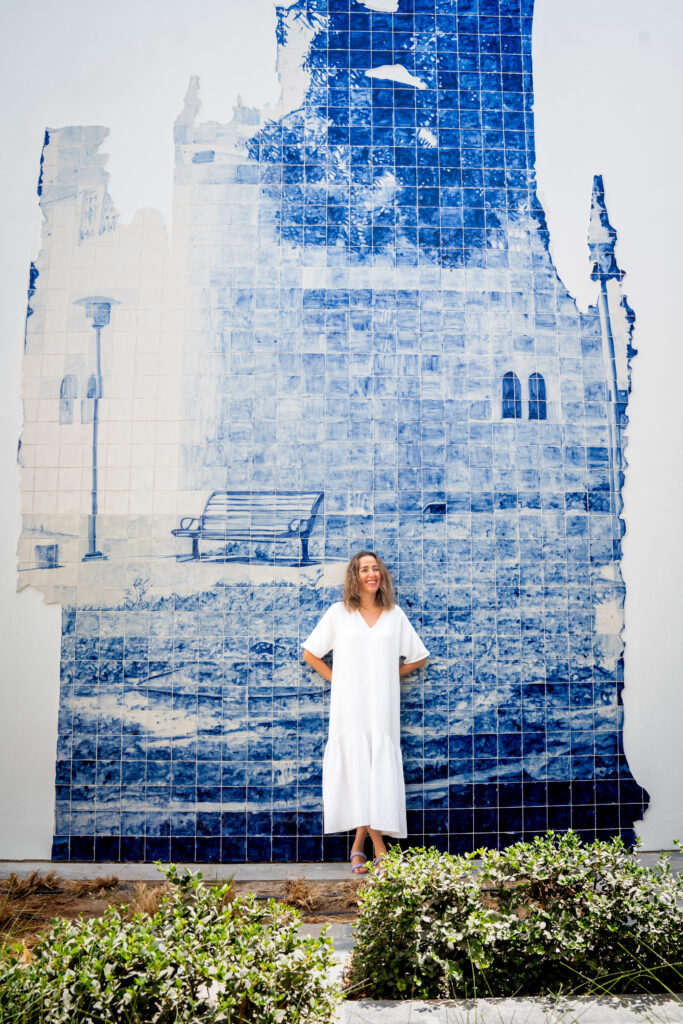
I Am Still Learning, Tile Mural, 6.20 x 3.74 m.
Public Art Commission, Al Safa Public Library, Dubai; curated by Amanda Abi Khalil.