
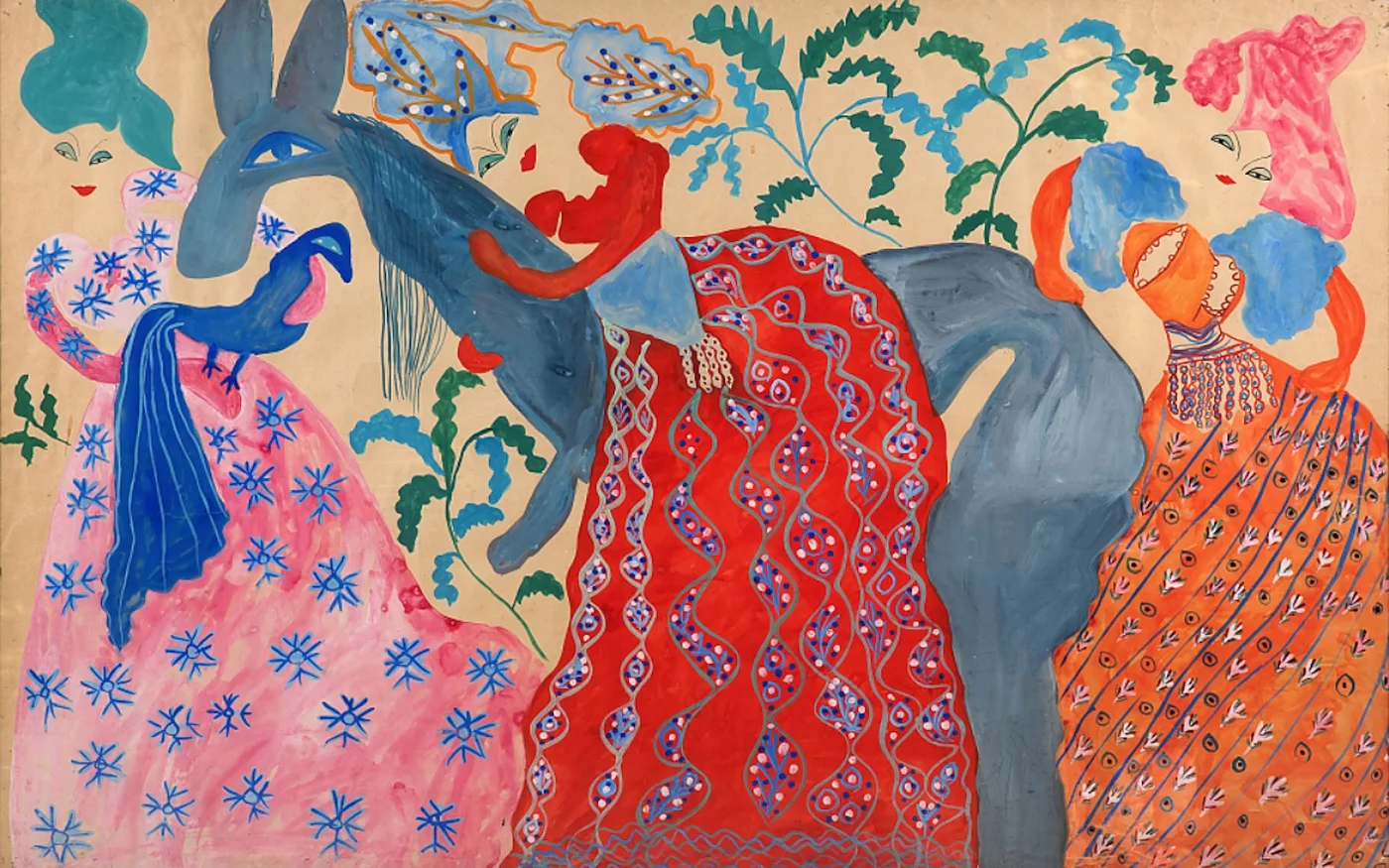
BAYA, L’âne bleu, 1948, Gouache and watercolour on paper, 100 × 150 cm. Collection Kamel Lazaar Foundation, Geneva / Tunis © Baya Estate, Courtesy Mennour, Paris. Photo: © AGUTTES – Rodolphe Alepuz.
Baya Mahieddine’s journey has unfolded with a problem the art world still has not solved. Where, exactly, does one place her? “Surrealist”, “naïve”, “primitive”, and “modernist” are all labels that stuck with her work over decades. And they are all reductive qualities that she would have, no doubt, objected.
Born Fatma Haddad in 1931 her name change carries the instability of her life story and shifting identity; a poor orphaned child, a teen prodigy, a wife, a mother, a modern artist – not necessarily in that order, and never in the same order.
Orphaned by the age of five, Baya lived with her grandmother before being taken in at around eleven by Marguerite Caminat Benhoura, a French painter and collector in Algiers. Depending on who you ask, Benhoura was her guardian, mentor, enabler, employer, or all at once. Despite the ambiguity of their relationship, Benhoura gave Baya access to art materials, encouragement, and her own prized collection of works by Braque and Matisse.
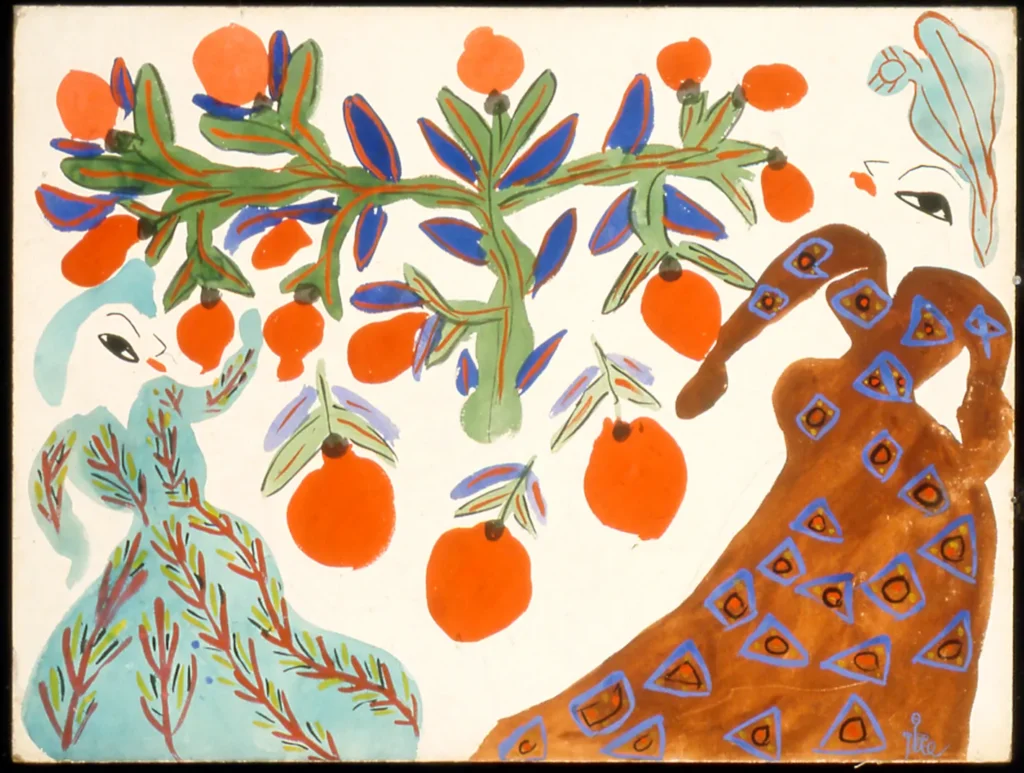
BAYA, Femmes et Orangers Fond Blanc, 1947, Gouache on board, 47.9 × 62.9 cm.
Collection Isabelle Maeght, Paris. Photo: © Galerie Maeght, Paris.
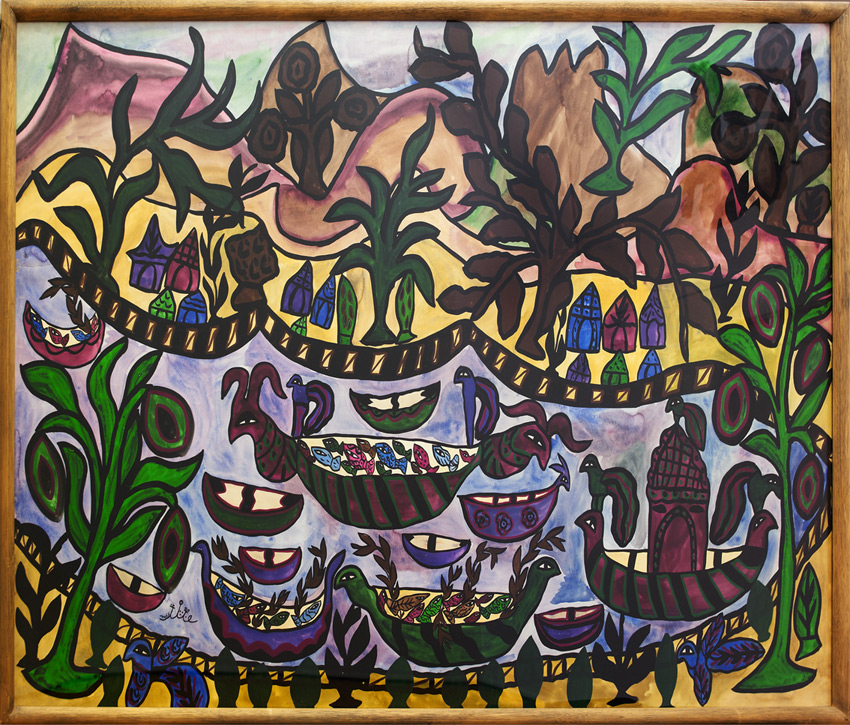
BAYA, Untitled, 1966, Gouache on paper, 100 x 150 cm.
Courtesy Musée du Quai Branly – Jacques-Chirac, © Othmane Mahieddine, © CNA.
By the time she turned sixteen, Baya had already made it to – and some would argue, in – Paris. In 1947, French art dealer Aimé Maeght presented her work in a solo exhibition at Galerie Maeght, while surrealism co-founder André Breton included her in the Second Surrealist Exhibition, even writing the preface to her catalogue for her Galerie Maeght exhibition, Derrière le miroir. At staggering speed, the self-taught Algerian teenager was embraced by the European avant-garde, praised by Breton, later associated with Picasso, and framed by critics through words that, today, speak more of their gaze than of her work: “naïve,” “primitive”, and “childlike”.
Baya’s work was celebrated, but often through the wrong doors. The same European circles that praised her originality also seem to have cast her in the role of exotic, instinctive genius. Breton saw in her the beginning of a new age, but his language was often riddled with Orientalist undertones and cultural stereotypes. In other words, Baya was visible, admired, collected, but not necessarily read or understood.
Pablo Picasso’s presence in her life and work further complicated this reality. Baya met him in Vallauris, where she worked on pottery. Some accounts connect her visual world to his later Women of Algeria series. Others claim that Picasso was not simply influenced by her, but “jealous of her abundant creativity”. Fact or myth, these stories have unsettled Picasso’s usual hierarchy with women, with him at the center and younger muses in his orbit.
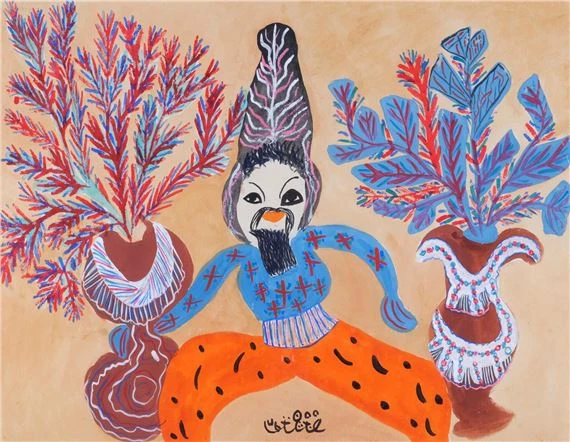
BAYA, Dance, 1946, Gouache on paper, 47.5 x 62.5 cm.
Courtesy Mathaf: Arab Museum of Modern Art.
Still, to frame Baya through Picasso – or even Eurocentric circles – is to fall into the very trap her work escapes. Long before these encounters, Baya had already built a world that answered to its own rules. Her early clay figures and gouaches, including works such as Dance (1946), already show a refusal of Western spatial logic. Rather than sitting inside perspective, figures command the surface. Pattern becomes structure instead of decorating form. And color defines, not fills, the space.
Across the decades, that world grows denser, stranger, and more deliberate without losing its signature. A recurring vocabulary emerges in works such as Les deux musiciennes (1966) and Nature morte à la harpe (1967); women, birds, flowers, fruit, instruments, leaves, vessels, and ornamental rhythms are constantly rearranged by Baya as language. Music structures the composition. Birds are companions, extensions, and interruptions. Vegetation overtakes, rather than frames the scene.
This is why the “naïve” label quickly collapses when one actually looks at the paintings. In Baya’s 1966 and 1967 gouaches, for instance, the entire surface is active. There is no empty background, obedient perspective, or single focal point. Boats, trees, instruments, flowers, leaves, and vessels are all alive and equally charged.
In this world, Baya’s painted women govern from the front, still, composed, and surrounded. This is perhaps the path of most resistance in Baya’s work; in a life repeatedly shaped by colonialism, guardianship, gender roles, and artistic categorization, her women inhabit spaces where no one seems to ask for permission.
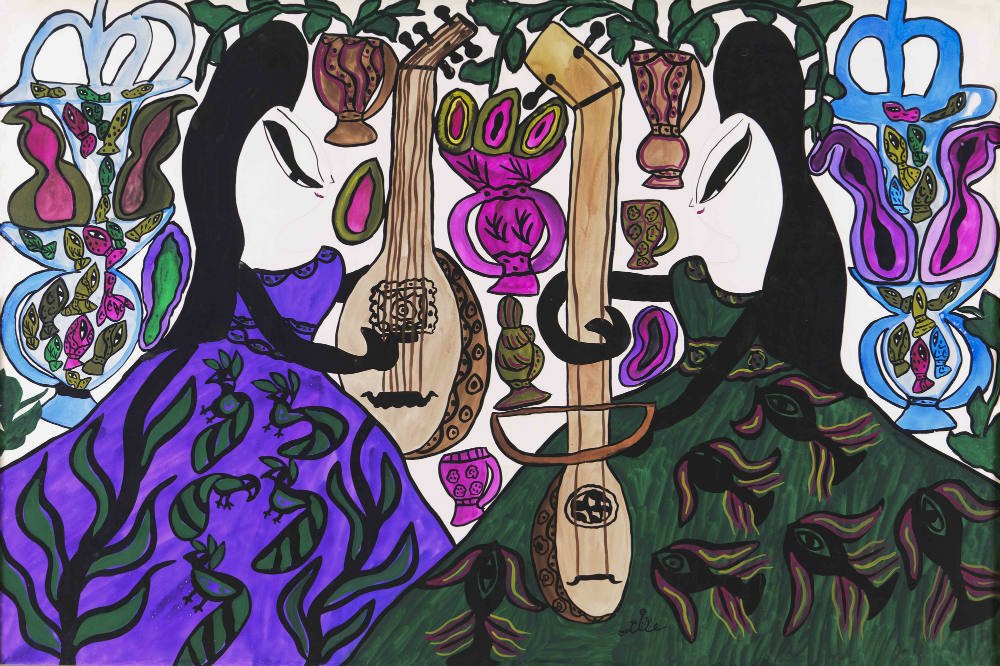
BAYA, Les Deux Musiciennes, 1966, Gouache and graphite on paper, 99 x 148.5 cm.
Courtesy of Mathaf: Arab Museum of Modern Art.
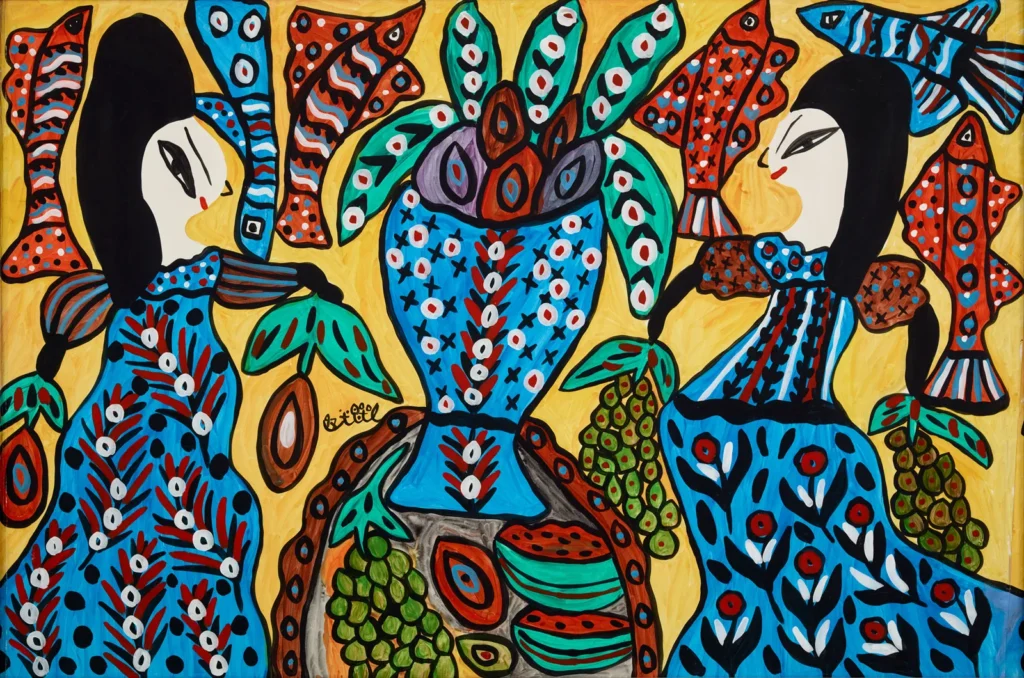
BAYA, Deux Femmes avec Vase Fond Jaune, 1997, Gouache watercolor on paper, 98 x 147.5 cm.
Collection Dalloul Art Foundation.
For roughly a decade after she entered her arranged marriage with Mahfoud Mahieddine, a period that coincided with the Algerian War of Independence and the birth of her six children, Baya would stop painting. Franco-Algerian author Assia Djebar would later imagine this period as a “forced retreat into tradition”. The free spirit who had entered Parisian art circles at sixteen suddenly folded back into domestic life, at the very moment Algeria itself was fighting to emerge from colonial rule.
In the early 1960s, friends and Jean de Maisonseul, the future director of Algeria’s National Museum of Fine Arts, encouraged Baya to resume painting around the period of Algeria’s independence. She did, but she did not fit neatly.
In Algeria’s new art order, she was marginalized, clubbed with “painters of spontaneous popular expression”, despite her strong affiliation with the Aouchem group – formed as an art collective to decolonize Algeria by bringing ancestral, deeply culturally rooted symbols together with modern art. In France, Baya had been too “indigenous” and too open to Orientalist interpretation. In Algeria, she was not easily absorbed into the dominant post-independence visual language. Again, she found herself everywhere and nowhere.
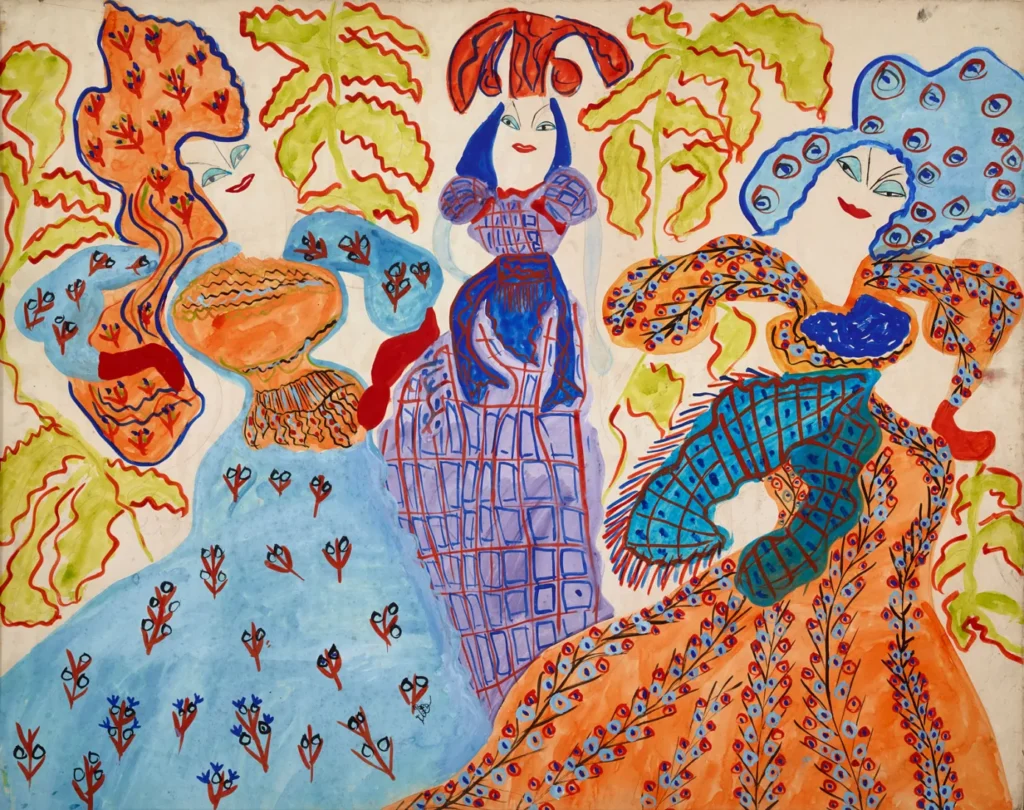
BAYA, Trois Femmes et un Palmier, 1947, Gouache on paper, 71.5 × 90.5 cm. Collection Dalloul Art Foundation.
That is why her posthumous exhibitions feel like a course correction. Baya: Femmes en leur jardins at Marseille’s La Vieille Charité challenged the tendency to frame Algerian cultural development through the French connection, returning attention to the North African material traditions that informed Baya’s visual language. The exhibition also staged a comparison between a woman-shaped vase by Picasso and a sculpture by Baya from the same period. Albeit subtly, this juxtaposition raises questions around her underrated, perhaps even undermined, influence on Europe’s art movements and circles.
These questions reemerge in her institutional momentum today. Since her death in 1998, Baya’s work has returned with force. Recent showcases include Baya, icône de la peinture algérienne at the Institut du Monde Arabe in 2022; Baya, une héroïne algérienne de l’Art moderne in Marseille in 2023; exhibitions at Fondation Maeght and the Grande Mosquée de Paris in 2025;
But Baya’s story is not one of belated recognition. She was recognized early, misread too early, and interrupted prematurely. Her paintings are joyful but not innocent, feminine but not fragile, and rooted but never fixed. Containment was never in her language, her name, her life, or her compositions. If art history kept trying to decide where she belonged, Baya had already answered differently.