
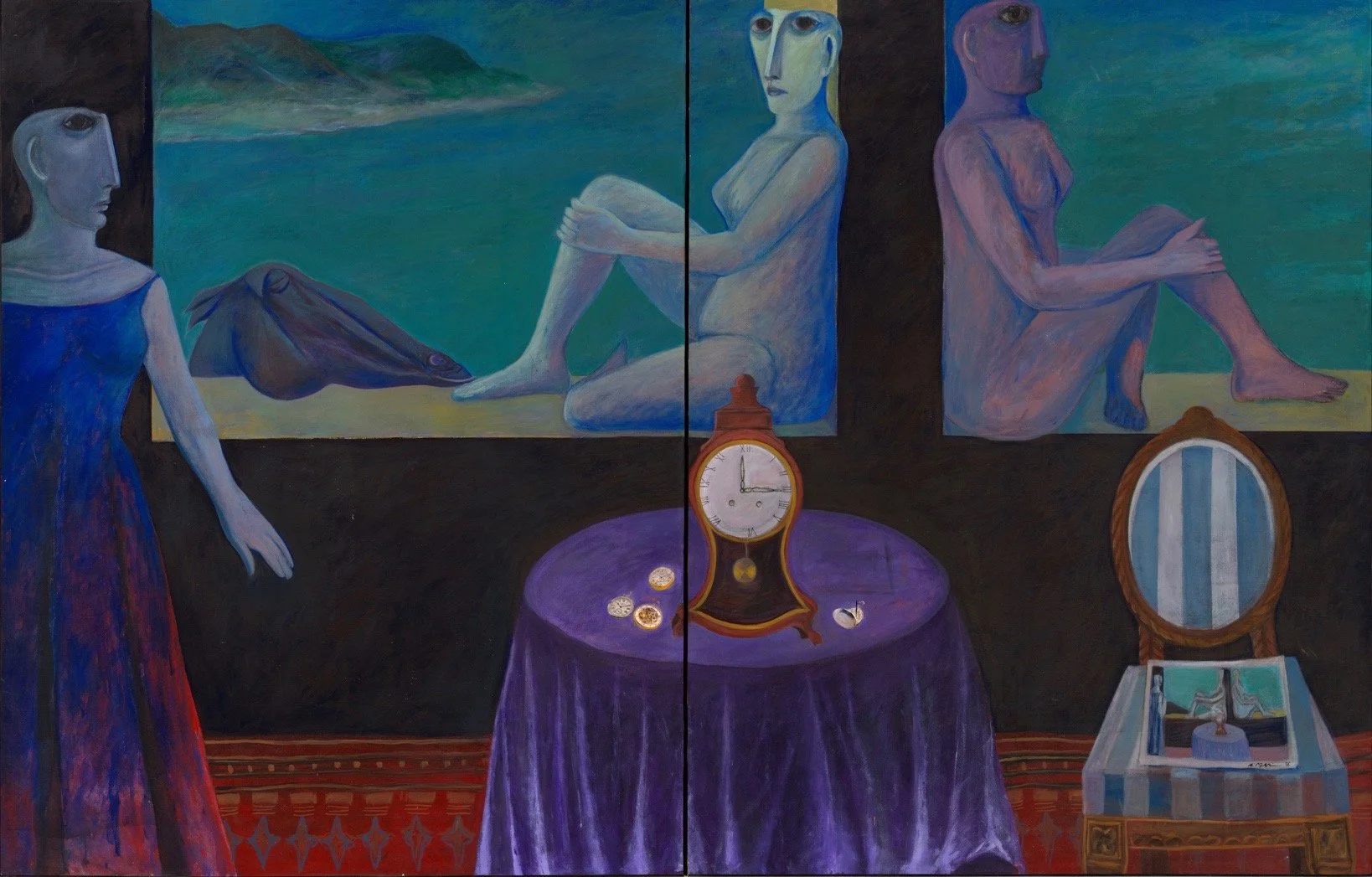
Seaside, 1987, Acrylic on Canvas, 235 x 360 cm. Image courtesy Ahmed Morsi.
Ahmed Morsi has spent a lifetime painting a place he cannot locate. And that is both by choice and by design. “My Alexandria is a city of my youth and also myth and legend. This is the “home” that has fueled my imagination, spilling into my poetry notebooks and pouring over my canvas. Don’t look for this Alexandria on your maps,” he once told Art News.
Born in Alexandria in 1930, Morsi came of age in a city that was itself a convergence of worlds – mostly Egyptian but also Mediterranean, Hellenic, and cosmopolitan in equal parts. A port city where languages and cultures overlapped, Alexandria offered him a lot, and a lot more than a fixed identity can carry. This plurality would become less a backdrop than a condition of being. His foray into the art world was no exception. What Alexandria lacked in formal art education in the 1940s, Morsi learned drawing under the Italian artist Silvio Bicchi. By 1949, he had already opened his own drawing studio. These foundational years would bring him into what was dubbed the “Alexandria School”, a loose constellation of artists and writers in Egypt with surrealist tendencies in the 1940s. True to his nature, Morsi joined the movement, not the club.
Long before Morsi’s displacement became physical, it was already internal. As a teenager writing poetry in Arabic while reading in English and teaching himself French to access Rimbaud, Morsi was, in his own words, “a part-time resident of another place and another time”. Painting would come as an extension of this state.
If anything, Morsi’s trajectory is not one of exile in the conventional sense, but of an ongoing negotiation with a self that never fully settles. From the outset, his practice outright rejected categorization. Influenced by Rimbaud, he adopted surrealism not as an aesthetic affiliation but as a mode of existence. This fluidity between past and present, self and other, image and word would transpire in his work across decades and geographies.
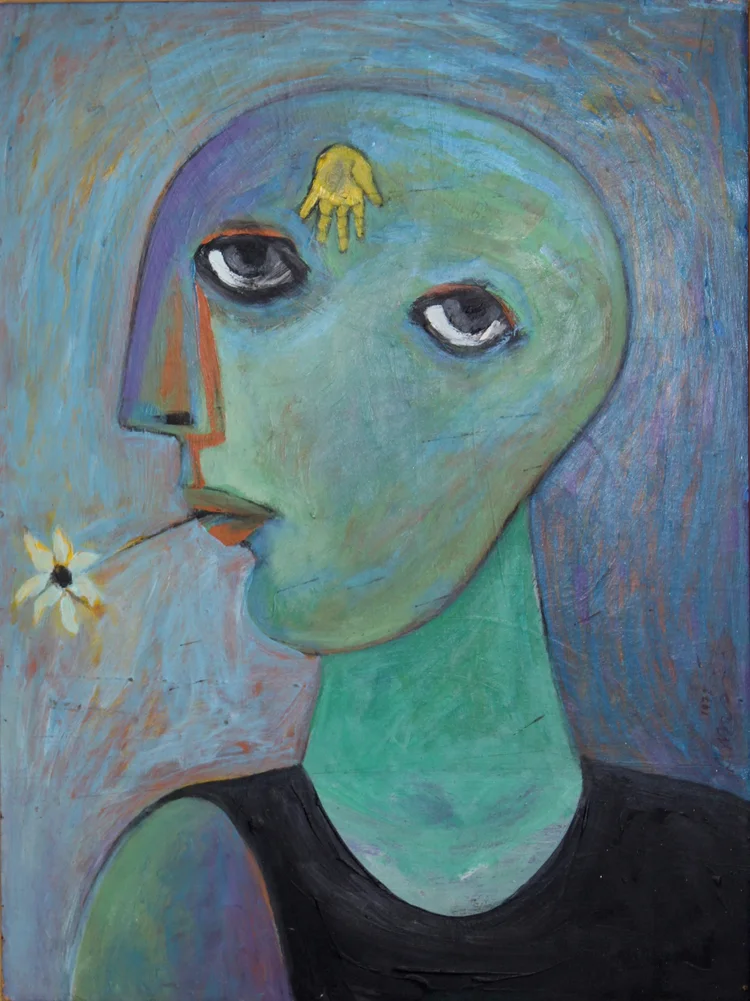
Woman’s Head, 1972, Oil on Wood, 52 x 46 cm.
Image courtesy Ahmed Morsi. Collection of Sharjah Art Foundation, Sharjah, UAE.
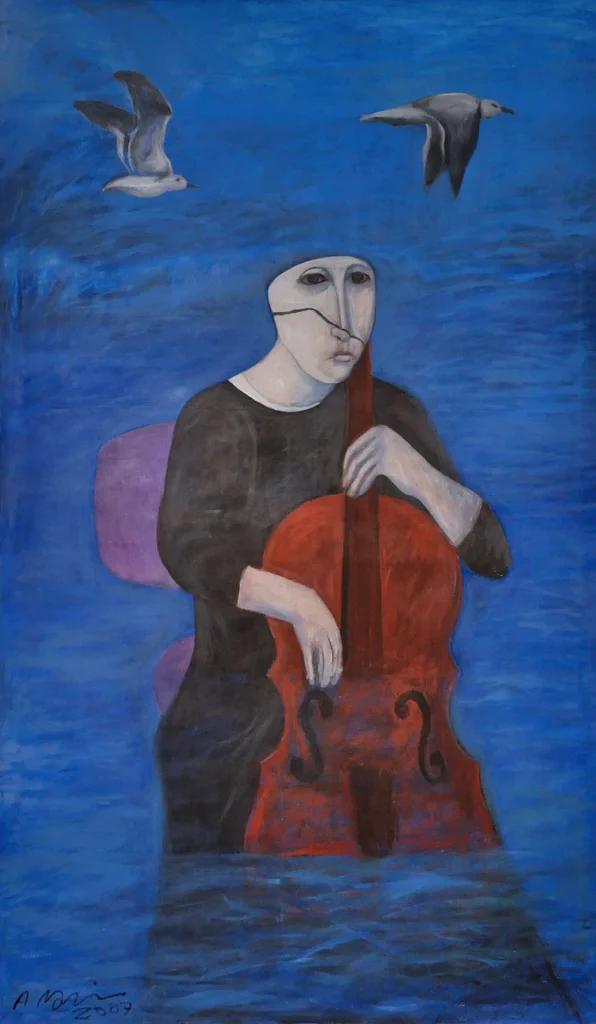
The Cello Player, 2007, Acrylic on Canvas, 213 x 125 cm.
Image courtesy Ahmed Morsi. Collection of Mathaf: Arab Museum of Modern Art, Doha, Qatar.
In his early years in Alexandria and later Cairo, Morsi’s canvases were populated by folkloric figures, peasant bodies, and talismanic symbols, reflecting a broader interest among Egyptian artists in the Shaabi (“of the people”) life and culture. These works, often marked by bold outlines and saturated colors, carried the imprint of local traditions while also engaging with European modernism – Picasso’s fragmented faces, cubist constructions, and the visual language circulating through postwar Alexandria. But even then, his figures were never fully anchored in realism, already drifting toward something more symbolic and interior.
His time in Baghdad in the mid-1950s marked a first expansion rather than a rupture. Between 1954 and 1957, immersed in a vibrant literary and artistic scene, Morsi wrote criticism, translated poetry, and designed for theater, moving fluidly between disciplines. This period reinforced what would become a defining characteristic of his craft: a refusal to separate writing from painting and criticism from creation. “I paint my poetry and write my paintings,” he later reflected on his artistic vocabulary.
It is in New York, however, where the transformation becomes most palpable. When Morsi moved there in 1974, following his wife’s appointment at the United Nations, his work distanced itself from his origins, even if not abandoning them altogether. The dense, culturally loaded environments of his earlier paintings gave way to flattened, ambiguous spaces. Blue began to dominate the palette. The sea, once a physical presence in Alexandria, reemerged as a conceptual horizon holding memory, distance, and longing.
The figures remained, but they changed in nature. Across works Morsi produced from the late 1970s onward, bodies appear suspended within sparse, often undetermined settings. They walk, sit, or wait, but rarely arrive. Faces become like masks, nearly emptied of expression. Almond-shaped eyes recall ancient Egyptian iconography while resisting direct identification. What emerges is not a depiction of New York as a city, but a condition of being within it. The question Morsi seems to pose is not where one belongs, but whether belonging itself is possible.
If there is an existential thread that runs through his work, it is not exile in its geographic sense, but estrangement as a permanent state. Perhaps this is why recognition came late, and quietly.
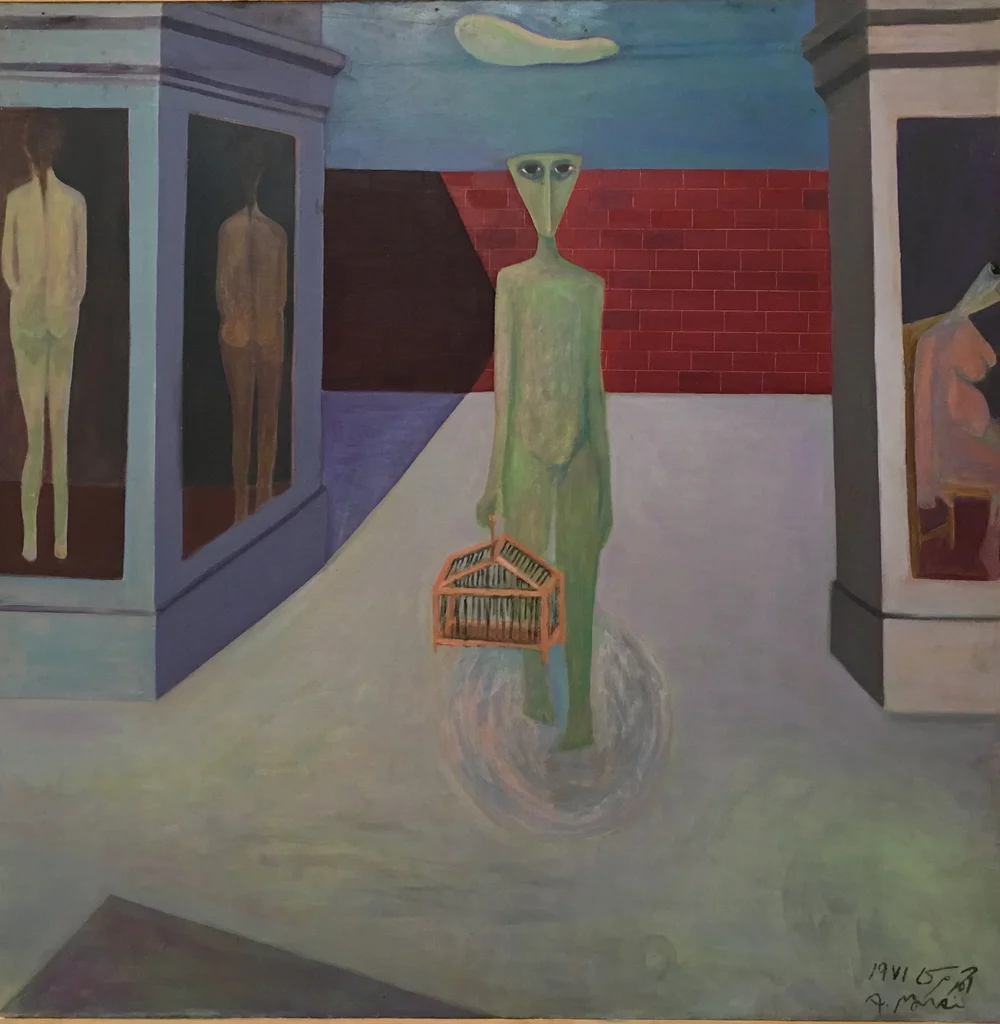
Walking the Bird II, 1971, Oil on Canvas, 122 x 121 cm.
Image courtesy Ahmed Morsi. Collection of Museum of Egyptian Modern Art, Cairo, Egypt.
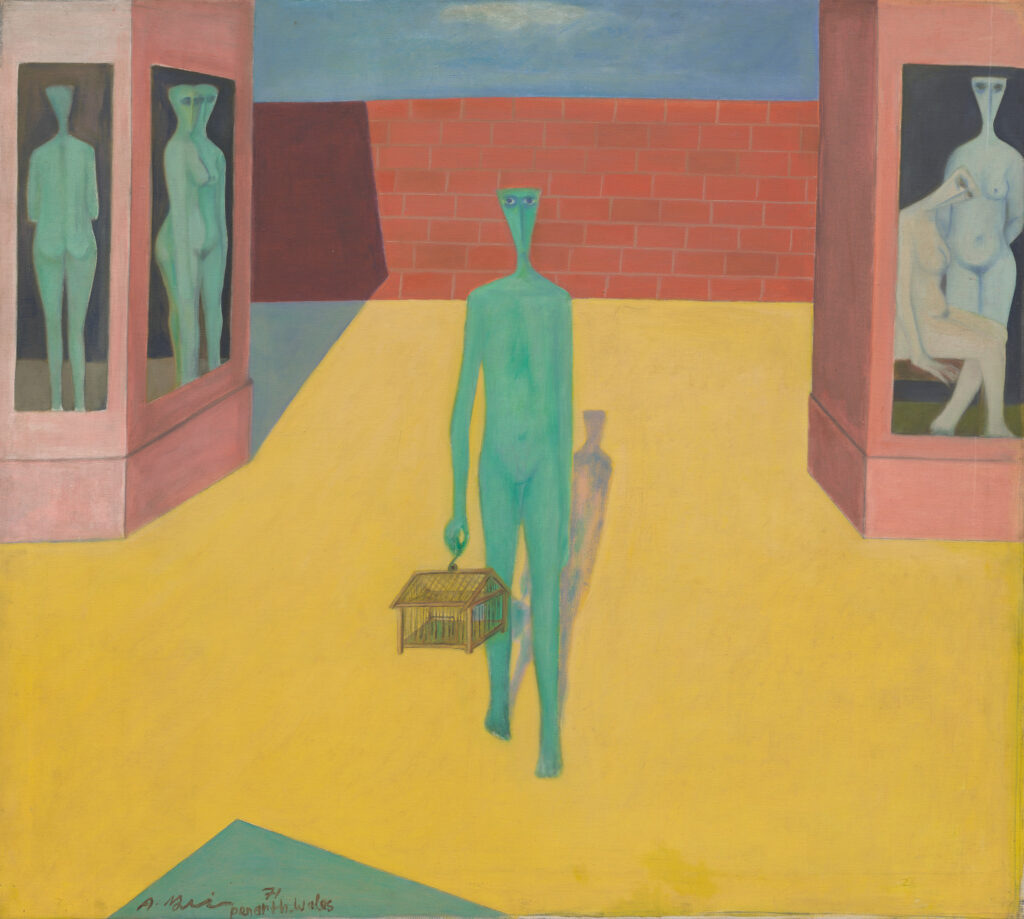
Walking the Bird I, 1971, Oil on Canvas, 95.3 x 106 cm.
Image courtesy Ahmed Morsi. Collection of MoMA, Museum of Modern Art, NY, USA.
Despite a career spanning over seven decades, Morsi remained largely outside the dominant narratives of both Egyptian and Western art histories. His distance from institutions, his refusal of market-driven production, and his commitment to an inward, self-defined language all contributed to a visibility that unfolded gradually rather than strategically. Yet in recent years, his work has gained renewed attention through major exhibitions, including Ahmed Morsi: A Dialogic Imagination at the Sharjah Art Foundation, Greater New York at MoMA PS1, and Ahmed Morsi in New York: Elegy of the Sea at ICA Miami. His works are held in collections such as the Museum of Modern Art in New York, Tate Modern in London, Mathaf: Arab Museum of Modern Art in Doha, and the British Museum, among others.
It is safe to say none of these spaces fully contain his work, because Morsi has never been interested in mapping the world as it is. He has spent his life constructing another one that only exists in the act of seeing – and in the art of not belonging.