
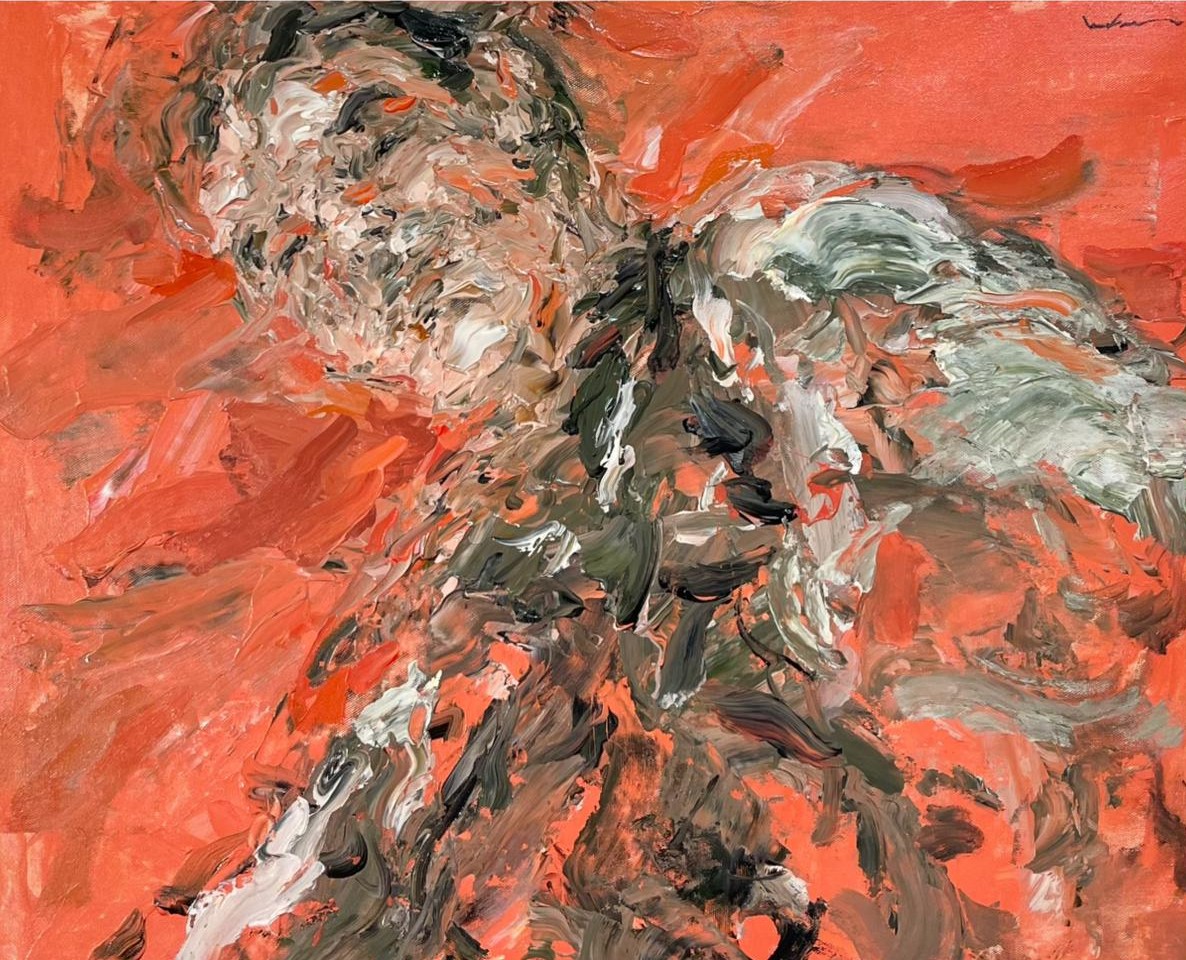
Abd Kasha, The Human As Accident, 2026, Acrylic on Canvas, 60 x 63 cm. Image courtesy of the artist and Kalim Bechara Art Gallery.
Some artists paint the human figure as a subject. Multidisciplinary Syrian artist Abd Kasha paints it as evidence.
In his work, the body is never neutral. It is often burdened, sometimes self-assured, enlarged, displaced, and in his most recent paintings, almost dissolved. Kasha’s figures carry history in their shoulders, anxiety in their hands, and something heavier than expression in their faces. What first appears as figuration quickly becomes a wider investigation into what the human can or can no longer hold, and what remains when the physical begins to fracture.
Born in 1997, Kasha graduated from the Faculty of Arts at Tishreen University in Latakia in 2020. He began his career as a photographer before expanding into painting, drawing, and sculpture. His work grows out of expressionist figuration, using the human form as a starting point for broader sociocultural reflection. This visual language is not unfamiliar within Syrian art, where figuration has long carried the pressure of social, political, and existential crisis. The son of prominent Syrian sculptor Jamil Kasha, Abd Kasha comes from an artistic family. Yet he has developed his own, very distinct vocabulary, marked by vivid brushstrokes, psychological tension, and a sharp awareness of life under instability.
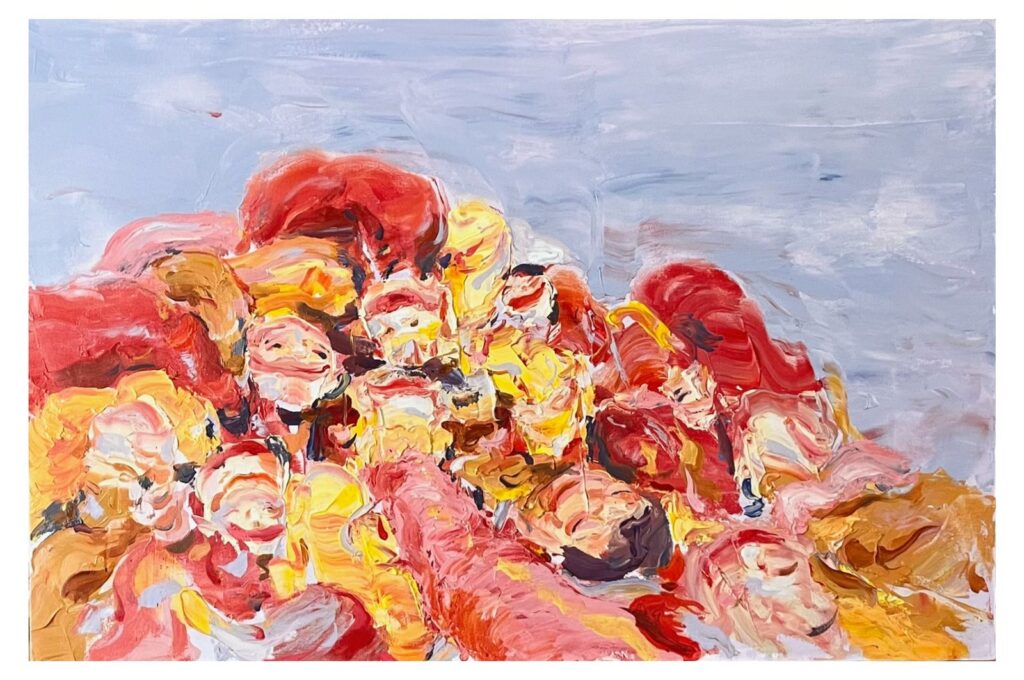
Abd Kasha, What Do You See (Still Life), 2024, Acrylic on Canvas, 80 x 120 cm.
Image courtesy of the artist and Kalim Bechara Art Gallery
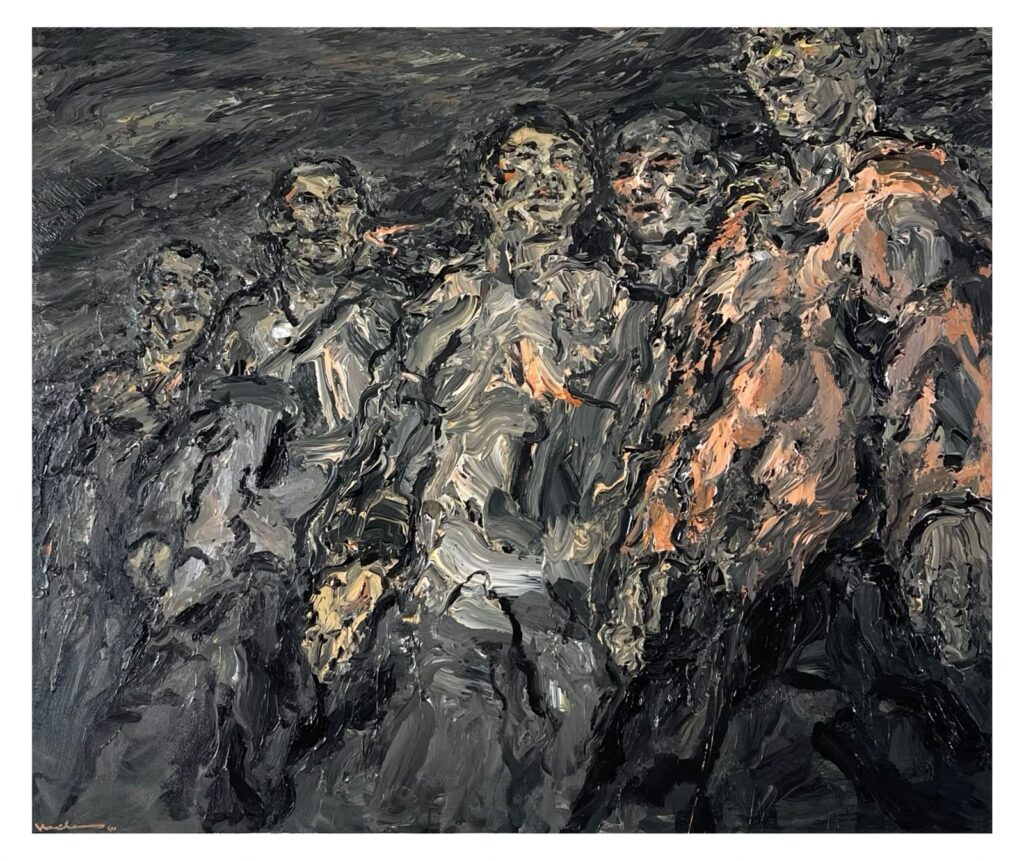
Abd Kasha, Safar Berlek, 2024, Acrylic on Canvas, 120 x 140 cm.
Image courtesy of the artist and Kalim Bechara Art Gallery.
This instability is central to understanding his early work. Before the monumental, wounded figures of Safar Berlek, there were the puppets. In his earlier paintings, puppets appear as “stand-ins for human models” – as Fann-A-Porter puts it – hauntingly theatrical and deeply anxious. Far from innocent toys, these puppets are figures through which Kasha could speak of war, loss, destruction, and the psychological weight of everyday life in danger.
In 2023, Kasha held his first solo exhibition in Lebanon, an important step in the regional visibility of his practice. But it is with his Safar Berlek exhibition in 2024 that the full force of his visual world begins to unravel. The series takes its title from the forced displacement and conscription campaigns that affected Arab populations under Ottoman rule in 1914. But for Kasha, this is not a closed historical episode. Instead, he treats it as a wound that has never fully stopped reopening. The names may change, the conflicts may shift, but the condition of displacement persists.
This is what gives Safar Berlek its emotional urgency, with works that ponder whether the past is still happening under another name. Figures seem to rise from earth, memory, and exhaustion all at once. Their faces are strained, their bodies heavy, and their hands oversized and expressive. They are wounded, but never collapse.
There is a phrase that feels especially close to the emotional register of these works: resilient agony. Rather than romanticize suffering or turn survival into triumph, Kasha paints endurance as something raw and unfinished. Often seen from below, his figures tower over the viewer, albeit unprotected – and even exposed – by their scale. They carry history like a physical burden.
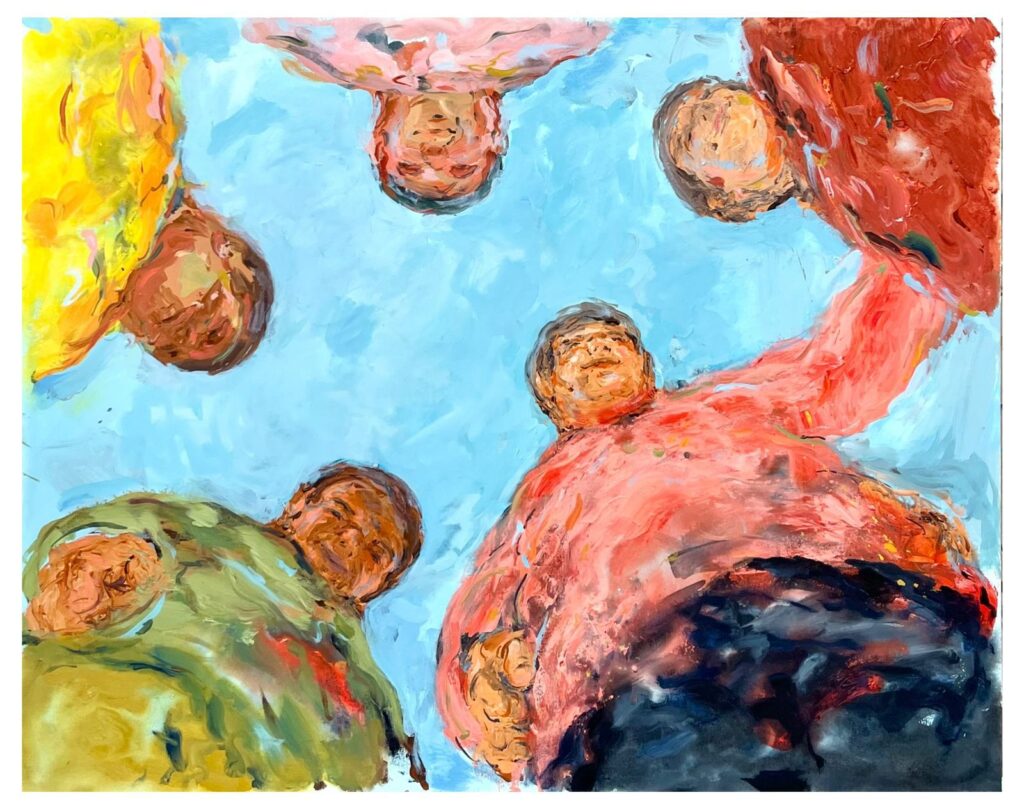
Abd Kasha, Folly Below, 2025, Acrylic on Canvas, 99 x 125 cm. Image courtesy of the artist and Kalim Bechara Art Gallery.
If Safar Berlek depicts the body as a vessel of historical displacement, Folly Below turns toward the body as a problem of perception. In this series, Kasha alters viewpoint and scale, enlarging the human figure to suggest vulnerability, rather than power. The shift is subtle but decisive. No longer carrying history, the figure is looked at, distorted, and questioned through the act of looking itself.
In Folly Below, figures hover, lean, look down, or appear from unusual angles. The viewer faces blurred lines between what is above and what is below, who the observer and observed are, the serious and the absurd. The “folly”, in that sense, belongs to everyone. And the figures even border on amused by this ambiguity.
This concern with looking continues with Gaze Long, Kasha’s 2025 solo exhibition, framing sustained attention as a way of encountering absurdity, balance, and contradiction. It seems to suggest that if one looks long enough, apparent chaos reveals an order of sorts. In this context, Kasha’s figures become philosophical instruments, forcing the viewer to remain with discomfort until it changes shape.
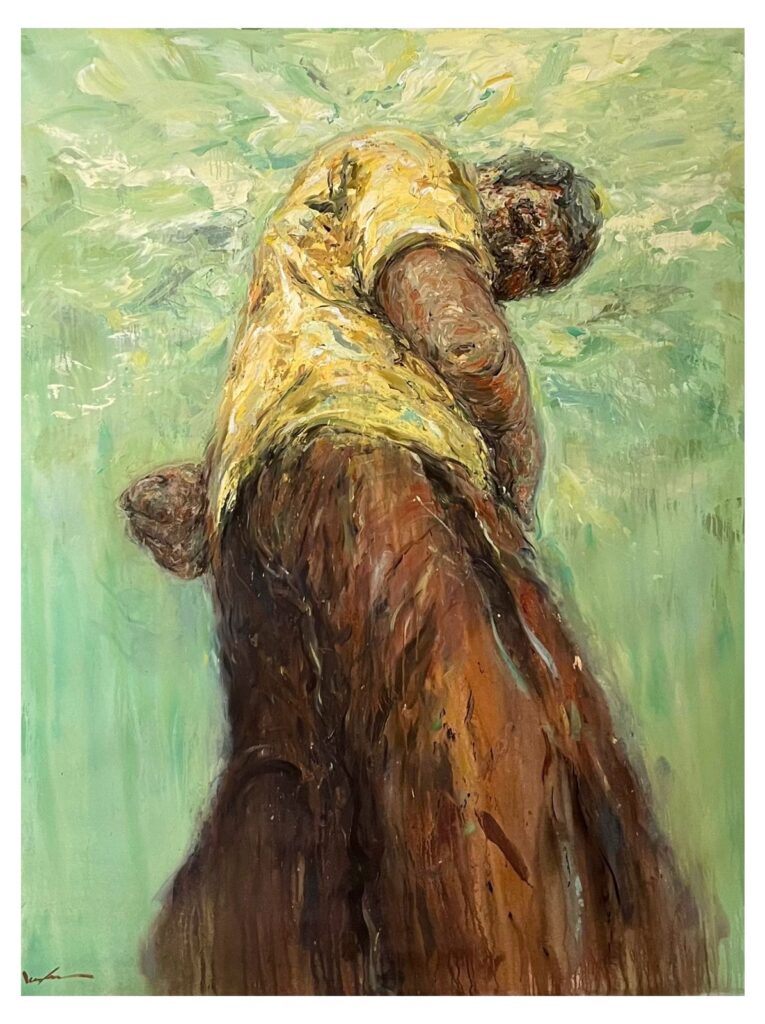
By 2026, with The Human as Accident, Kasha pushes the figure even further. The body, no longer a fixed center, becomes fragile, unstable, and almost temporary. Faces dissolve and bodies melt into their surroundings. The figure seems to have become part of the very condition it once contemplated.
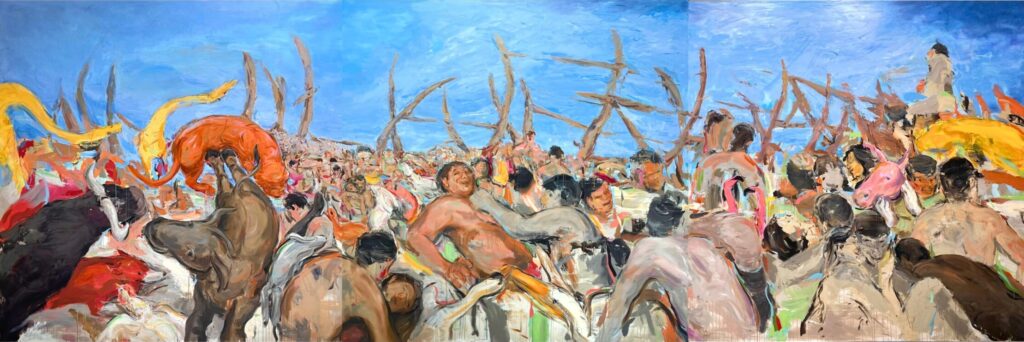
Abd Kasha, Gaze Long, 2025, Acrylic on Canvas, 200 x 600 cm.
Image courtesy of the artist and Kalim Bechara Art Gallery.
This is where a clear progression begins to emerge across Kasha’s practice. In the puppet works, the human appears by proxy, displaced into an object. In Safar Berlek, the human body carries collective trauma. In Folly Below and Gaze Long, the body becomes a question of perspective, scale, absurdity, and looking. In The Human as Accident, the body itself begins to dissolve, as though identity were no longer a stable form.
What makes this progression compelling is that it remains intensely and intently physical. The human figure in Kasha’s work is the site where ideas, notions, and emotions happen. It is perhaps why it also challenges closures and resolutions, be they historical, emotional, or formal. His figures remain in states of pressure. And through them, Kasha asks one of the most urgent questions of contemporary figuration: what can the human body still mean in a world where history repeats, perception fails, and identity is unstable?
His answer is not simple, but insistent. Even when the body breaks apart, figures refuse to vanish quietly. They stand, stare, melt, and return as the evidence of being human under pressure.
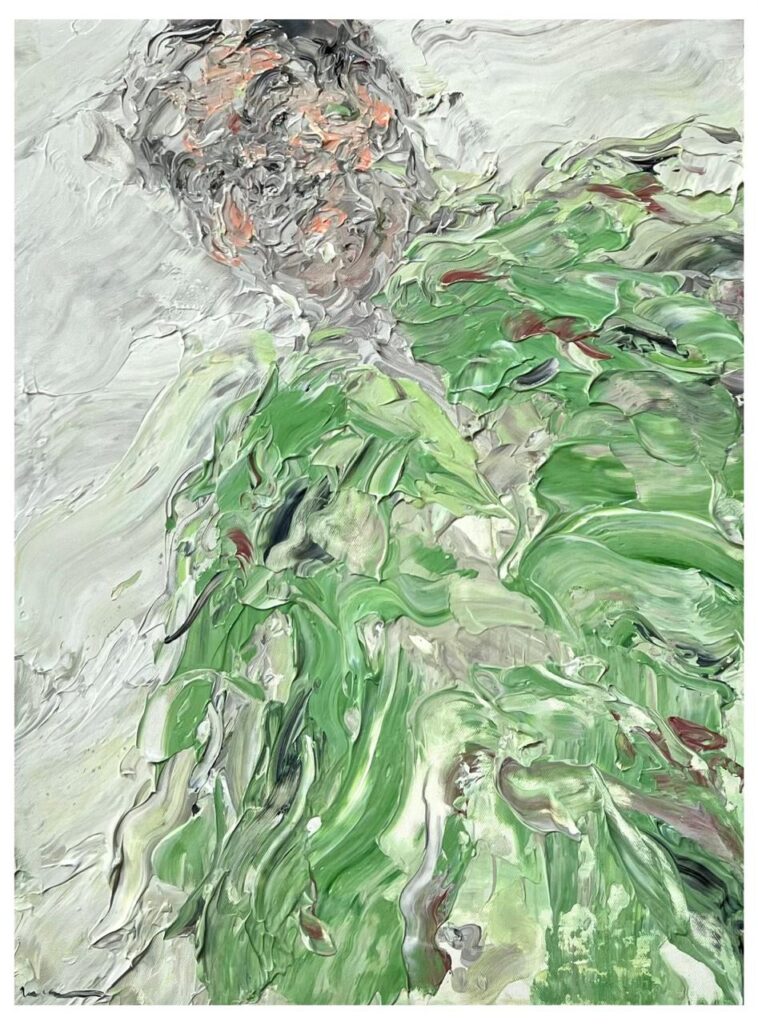
Abd Kasha, The Human As Accident, 2026, Acrylic on Canvas, 58 x 44 cm.
Image courtesy of the artist and Kalim Bechara Art Gallery.
Abd Kasha, The Human As Accident, 2026, Acrylic on Canvas, 185 x 145 cm.
Image courtesy of the artist and Kalim Bechara Art Gallery.